2026 KRob Jurors
First organized by AIA Dallas in 1974, Ken Roberts Memorial Delineation Competition (KRob) is the longest-running architectural drawing competition in the world. For 52 years, KRob has celebrated excellence in architectural delineation. A Dallas institution with international recognition, KRob honors both hand-drawn and digital works submitted by professionals and students from around the globe.
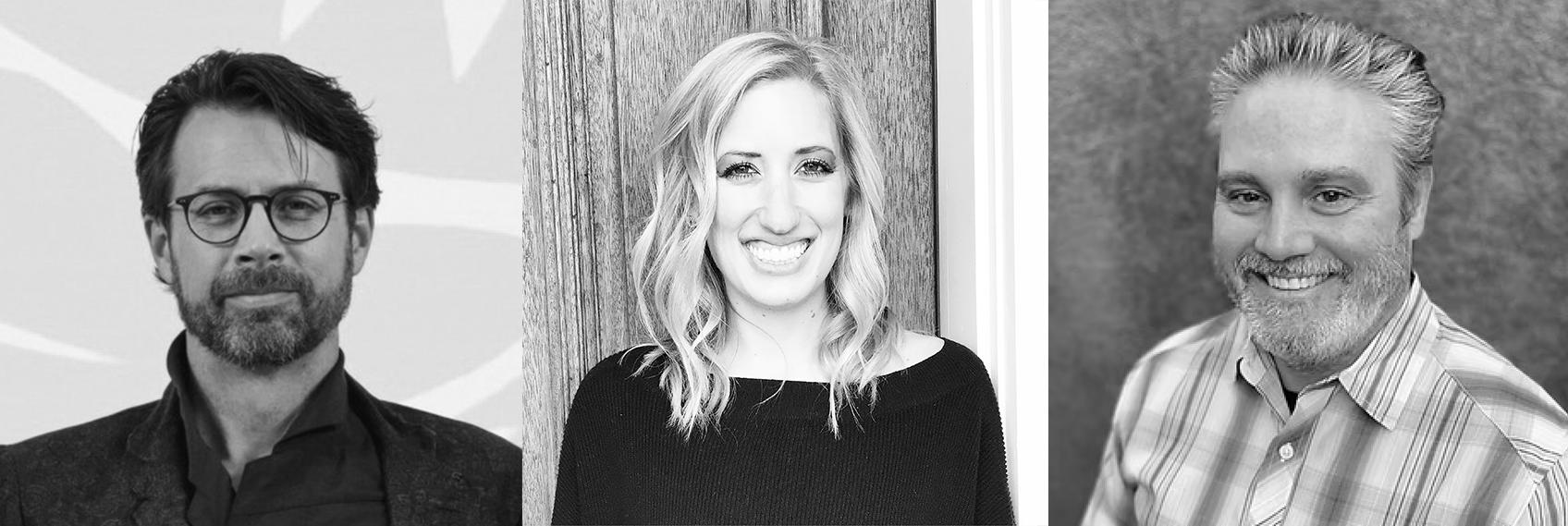
Ahead of our 2026 KRob Events Series, we’re excited to host jurors Arne Emerson, Amanda Aman, and Thad Reeves, AIA. We asked a few questions to give insight into their work, the process, and what they’re looking forward to in the competition.
What’s one book, object, or reference on your desk you return to constantly?
Arne Emerson: My sketchbook and pen.
Amanda Aman: While it isn’t specifically a reference text, I consistently think about and refer others to Kate Orff’s Petrochemical America. It’s been profoundly impactful to me since I received my first copy in grad school, signed along with a personal message to me as a gift from a friend, and it’s one of my most prized possessions. The book combines visual representation with environmental and social storytelling. It doesn’t just document a landscape—it reveals the lived realities of the people and communities shaped by those environments. The mapping and narrative drawings make complex systems of extraction, pollution, and inequality visible in a way that feels immediate and deeply human.
For me, it demonstrates that drawing and mapping can do more than analyze space—they can be tools for empathy, advocacy, and awareness. It gives visibility to often overlooked stories and conditions, while creating an emotional connection between the viewer and the people being represented. This is exactly what I hope to achieve with my work and with our work in design studios.
Thad Reeves, AIA: Good question. And a tough one to narrow down. I love the work of Edward Tufte. I always learn something new from his Visual Explanations book. For architecture, I have a pet peeve about architecture books that don’t have drawings, so anything that is a picture book does not make the cut. I would say either Eduardo Souto de Moura (El Croquis or monographs) or the great Catalan architect, Jose Antonio Coderch.
As for objects, I have a couple of old shuttle looms sitting on my desk at home. I love the craft and form of these items. They are made of wood and metal and are beautifully crafted. Besides loving the look of them, I like that they bridge the gap between a time when things were handmade versus mass produced.
Which category in this year’s competition are you most excited to jury? What are you hoping to discover there?
Arne Emerson: All of them, honestly. I am always inspired by people’s expression of thoughts and ideas through drawing. A few pull at me in particular—”Digital/Hybrid Media” because I want to see the innovative ways people are working in the medium, “Travel Sketch” because I travel all over the world and love how the hand quality of a sketch can capture a place better than a photograph ever could, and “Process Visualization” because I am obsessed with how others create. Seeing someone else’s process inspires and pushes me.
Amanda Aman: I’m a big fan of the “Digital/Hybrid Media” category. These drawings often embed a narrative directly within the representation, communicating layered relationships that may be harder to discern from other drawing types. They invite us as viewers to become readers, unfolding spatial narratives in the same way a novel reveals stories through description, interpretation, and most certainly imagination. I love to read, and this category is a lot like visual reading.
Thad Reeves, AIA: My favorite entries are the ones that have elements of hybridization or evidence of how the images are constructed. I love working backwards to figure out how someone might have made the work. The hand of the author is always nice to see.
What project, material, or design idea currently occupies your mind?
Arne Emerson: Project: Our new music building and performance hall at UT Dallas, now nearing completion. The 680-seat hall is taking shape and exceeding what I imagined. Alongside it, our two U.S. Embassies are under construction in Beirut and Riyadh, both of which have transformed how I think about designing across cultures.
Material: Concrete in all its forms. I am teaching a seminar in Bologna on concrete innovation, which has me revisiting old favorites: Ronchamp, Nervi’s St. Mary’s, Candela, the Pantheon, Wright’s textile block, Chandigarh, the Perot Museum.
Design Idea: Transforming a 70-year-old, 10-story building on a public square in downtown Tripoli, Lebanon into a vibrant mixed-use village. We rarely take on renovations, which is exactly what makes it interesting.
Amanda Aman: Salt and sand. I’m currently working on a project in its infancy with a colleague of mine, Cord Read, that investigates how representational practices, material systems, and environmental histories—embedded within extractive landscapes—can be reimagined through mapping, fabrication, and narrative to reveal hidden ecological and cultural processes while proposing new forms of materially responsive design. We’re specifically looking at the material afterlife of extraction. Halite and siliceous sands are prominent within the mineral waste streams around the project. We’ve been thinking a lot about salt and sand and their architectural possibilities.
Thad Reeves, AIA: I find myself more and more preoccupied with ideas of permanence and durability. Materials that are self-finishing like stone, brick, and steel are something that I love, especially masonry construction.
Where should we collectively give focus that we aren’t currently?
Arne Emerson: Protect the time to draw. Time to think, to create, to iterate. Outside forces are constantly compressing that time, and we should push back. Drawings and sketches are still the fastest and most intuitive way to capture an idea, to test it, refine it, and discover what it actually wants to be. A sketch can hold doubt and conviction at the same time. Whatever else changes in our profession, drawing remains the primary language through which architects and designers think, explore, and communicate. Keep drawing. Make the time.
Amanda Aman: Speaking specifically as an educator, I feel strongly that we should place greater emphasis on process as a form of inquiry rather than simply a means of producing finalized objects. It certainly hasn’t always been the case, but it seems like recently there’s a growing tension between process and finality. Rather than privileging polished images that fix architecture as a singular vision, I would advocate for design to operate as an open-ended medium for speculation, storytelling, and collaboration. In this sense, drawings become less about depicting the finished form and more about constructing relationships, mapping networks, and engaging uncertainty, allowing architecture (and our students!) to address contemporary challenges with greater depth, adaptability, and critical awareness.
Thad Reeves, AIA: I think cost is one of the biggest impediments for many people to engage an architect for their project. We, as architects, don’t have a lot of control over the markets, but one thing that helps is being more engaged in the building process. The more you learn about the process, the better chance you have of controlling cost and quality.
What’s the best kind of surprise a project can give you?
Arne Emerson: The unexpected. The way light animates a space or a surface. Spatial and acoustic qualities that exceed what was drawn. The tactile pull of a material once it is in your hand. How a technical detail comes to life. The best projects always give back more than they were designed to.
Amanda Aman: Surprise, surprise… an incredibly thoughtful process that uncovers (instead of creates) meaningful narrative.
Thad Reeves, AIA: Architecture is meant to be experienced. When I think about projects that have surprised me, it always has to do with a feeling. I remember discovering the work of Alvaro Siza (Boa Nova Teahouse and the Matosinhos Swimming Pools) and Eduardo Souto de Moura (Casa de Artes) as a young student travelling in Portugal. The feelings that those projects and spaces evoked are still with me today. I had the good fortune of visiting Barragan’s House last year. I felt the same way.
The KRob Award Announcement Celebration will be held virtually on Friday, June 26, allowing for international participation. An exhibition showcasing the entries will be on display at the Architecture and Design Exchange (AD EX) from Monday, July 20, through Saturday, August 15, with an in-person opening reception on Tuesday, July 28.