Commons in Motion
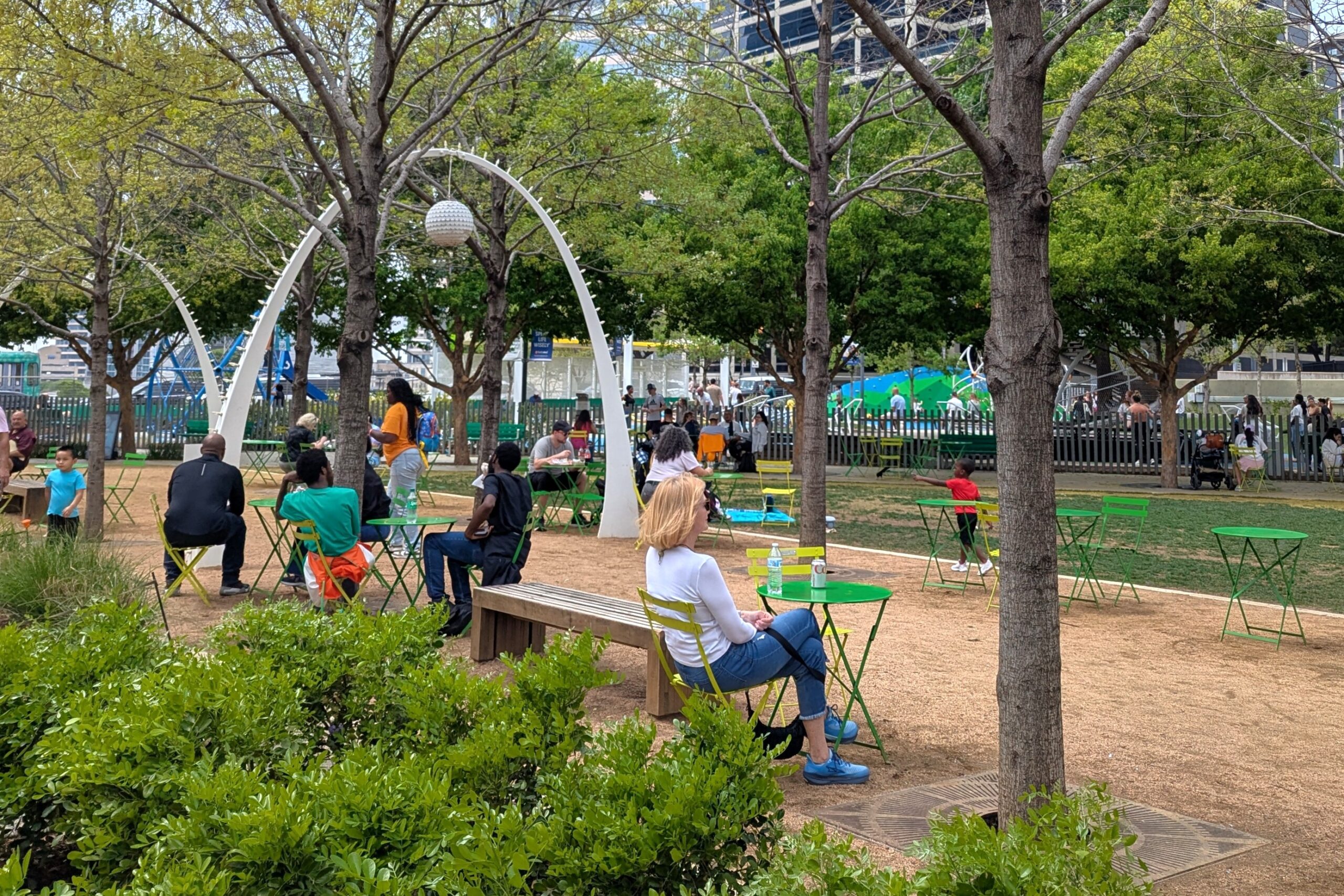 Klyde Warren Park, 2025. Photo by Sahana Ashwathanarayana
Community commons and public squares have long been imagined as democratic spaces—messy, joyful, unpredictable places where anyone might claim a seat and feel they belong. On a warm evening, it is easy to believe it: café chairs scattered beneath string lights, children orbiting a fountain, teenagers draped across planters, and older couples sharing ice cream as a busker leans into the sax. It feels effortless. But the truth is more complicated. Commons do not flourish by accident; they are held together by invisible scaffolding—programming, maintenance, security, funding. Increasingly, they are shaped by partnerships that blur the line between public and private stewardship. Cities once carried the full weight of these spaces, but as budgets contracted and expectations grew, private dollars stepped in to fill the gap. Many plazas are now cleaner, safer, and more vibrant than ever—but also more curated, more controlled. Somewhere between welcome and permitted, shared and sponsored, we find the modern American commons: beloved, bustling, and quietly contested. How we choose to maintain them today may determine who they truly belong to tomorrow.
What Makes a Successful Commons
A successful commons does not rely on design alone. It is choreography: the placement of benches just close enough for conversation, shade landing where people naturally gather, the subtle pull of music or market tents that signal a place worth lingering. William H. Whyte famously observed that “people tend to sit where there are places to sit,” a simple truth that designers, planners, and cities still sometimes forget. The best plazas make it easy to stay—they welcome curiosity, pause, even boredom. A good commons gives you something to do, but also the freedom to do nothing at all.
Programming is the heartbeat. Without it, even the most elegant square can feel like an empty stage. Markets, concerts, yoga classes, food trucks, lunch-hour chess tables, seasonal traditions—each turns passive space into lived space. Yet programming is not just events; it’s everyday life. A fountain that draws toddlers on hot days. A lawn where teens sprawl with headphones. A coffee kiosk that creates morning ritual. When people become the activation, the space succeeds.
Maintenance is invisible until it isn’t. A dying planter, a broken light, trash collecting in the corners—these small failures compound into disuse. Cleanliness and care signal respect, both for the space and for those who inhabit it. Jane Jacobs wrote about the safety produced by “eye on the street”; the same rule applies here. When people feel safe enough to linger, others follow, and the plaza becomes self-sustaining. Lighting, sightlines, staffing, and stewardship all shape the perception of safety, and perception can matter as much as reality.
Successful commons are rarely grand. They are human. Enclosed just enough by buildings or canopy to feel held, yet porous enough for discovery. They balance comfort and spontaneity, order and energy. Above all, they invite everyone—housed and unhoused, children and elders, residents and tourists—to occupy the same ground, even if only for a moment. That shared ground is the essence of the commons, and the reason we fight so hard to preserve it.
History of the Commons and the Decline of Municipal Maintenance
The concept of the commons in America predates our cities. In colonial towns, the “common” was literal common land—shared grazing fields, militia training grounds, burial sites, a place where life’s most practical needs overlapped with civic ones. It was not designated to be beautiful; it was meant to be shared. Yet even in those early patches of grass and dirt lay the foundation of something powerful: space that belonged to everyone and no one, where class and commerce dissolved long enough for people to coexist.
By the time the Revolution reshaped the young country, the purpose of the commons shifted. They evolved from utilitarian landscape to social terrain. Town greens hosted speeches, celebrations, protests, picnic blankets, marriages, and mourning. They were where neighbors recognized each other. They were a public stage for civic identity.
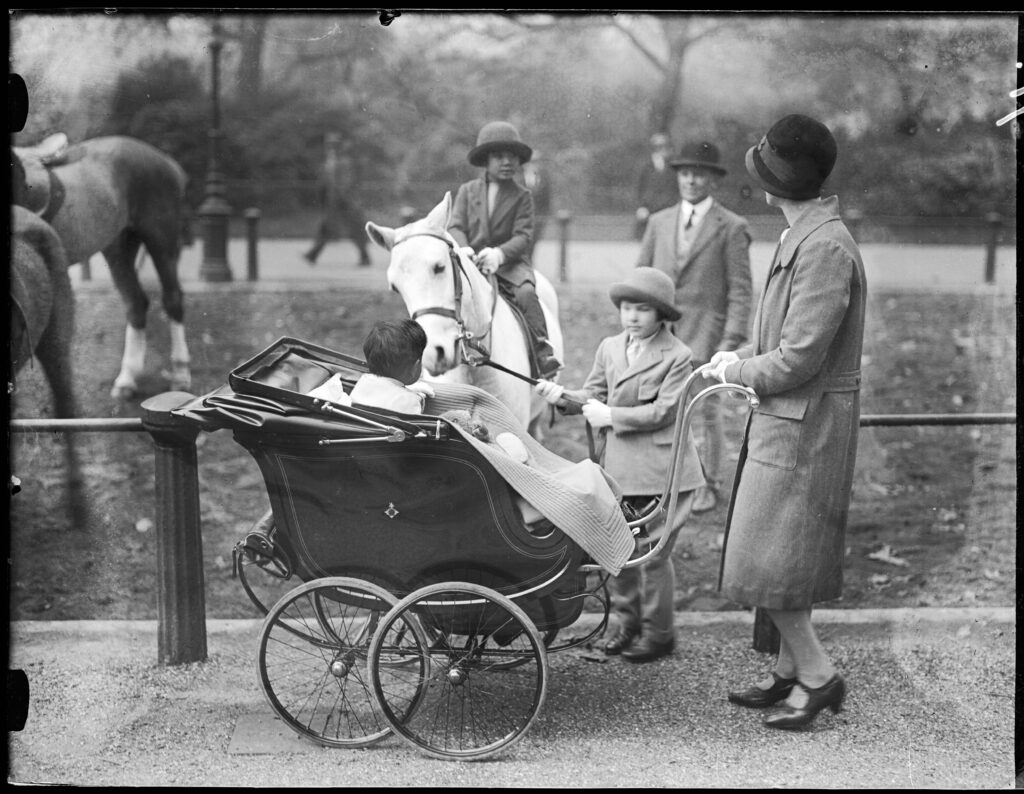
Then came the pressures of the twentieth century. Suburbanization—the outward shift of households and tax base away from city centers—pulled wealth and residents out of the urban core, shrinking tax revenues and stretching municipal budgets. What was once a point of civic pride became, in many cities, a maintenance liability. Grass went unmowed, fixtures rusted, lighting dimmed. A commons cannot survive long in neglect; people retreat from places that feel abandoned.
Central Park in New York City became the emblem of this decline. By the 1970s, its lawns were patchy, pathways crumbling, graffiti common, and crime high enough that locals avoided it at night. It was not just a park losing its luster—it was a symbol of a city losing its grip on stewardship. The problem was simple: love alone couldn’t maintain these spaces. Cities needed resources that they no longer had.
The Central Park Conservancy, founded in 1979, marked a turning point. It was a radical idea at the time—a nonprofit partner stepping in not to own the park, but to restore and manage it alongside the city. Volunteers planted, philanthropists funded, experts planned. Slowly the park came back to life. The lawns filled, the paths brightened, people returned. Other cities watched closely. If public budgets couldn’t keep parks thriving, perhaps public-private partnerships could.
The model spread. Conservancies began to emerge in cities across the country—from the Central Park Conservancy in New York to Millennium Park in Chicago, the Golden Gate National Parks Conservancy in San Francisco, and Discovery Green in Houston—each proposing a hybrid solution: the city retains ownership, but a separate entity provides care. Programming, maintenance, funding, capital projects—often all handled by private or nonprofit management, creating a structure where philanthropic dollars translate directly into visible improvements on the ground.
It worked. And it raised questions.
When public spaces become dependent on private dollars, do they remain fully public?
The tension continues to define the modern American commons.
The Turning Point: Hybrid Management and the New Model of Care
The success of Central Park’s turnaround didn’t just save a landmark—it offered a template. If cities lacked the funding and staffing to care for large public landscapes, perhaps private partners, philanthropists, and nonprofits could help fill the gap. And in many places, they did. Conservancies spread first to major parks then to waterfronts, plazas, greenways, and even neighborhood squares. Urban commons gained staff instead of shrinking staff. Lawns were revived. Programming flourished. It was, in many ways, a renaissance.
This new model—where the city retains ownership but relies on outside partners for maintenance, programming, or funding—brought undeniable benefits. Spaces once tired or unsafe became lively again. Walk through Bryan Park on a summer evening, or Millennium Park at lunchtime, or Klyde Warren Park on any given Saturday and you can feel it: activation. Chairs scraping on stone. Dogs tugging leashes. A line at the food stall. Kids navigating splash pads. Programming is constant—exercise classes, art festivals, movie nights, chess tables, food trucks—a rhythm that makes the park not just visited, but lived in.
And yet, every renaissance carries a shadow. With private dollars come expectations of quality, of security, of curated experience. Rules become clearer, sometimes stricter. Security presence increases. Behaviors once tolerated as part of urban life may be discouraged in the interest of “comfort” or “family-friendliness.” The question emerges quietly, without a single moment signaling its arrival: When private money helps sustain public space, do priorities inevitably shift toward those who fund it?
The commons, historically messy and democratic, becomes refined. Safer, cleaner, easier to market. But in that refinement is tension. A public space that feels overly managed can lose the loose spontaneity that makes urban life electric. A commons with heightened surveillance may not feel welcoming to everyone equally. A park that relies on philanthropy may be more responsive to donors than to the unhoused, teenagers, or anyone who doesn’t fit the picture of “ideal user.”
It is not that hybrid management makes a space less public. In many cities, it has preserved public space that otherwise might have declined beyond recovery. But it does change the nature of publicness. Where once the commons was simply shared land, today it is a shared contract—between a city and conservancy, between a donor and taxpayer, between safety and freedom, between invitation and control.
The trade-off is not binary. It’s subtle. And it forces us to ask: What do we gain by professionalizing the commons—and what do we risk losing in the process?

Two Models, Two Outcomes: Downtown Garland Square and Klyde Warren Park
On a warm Friday night in Downtown Garland, the Square feels like the definition of easy community. A band plays under marker lights, kids chase each other across the lawn, and parents lean against storefronts holding snow cones that are melting too fast to eat politely. No one is checking bags. No one is scanning wristbands. The space belongs to the city, and the city feels present but not policing. The fact that Garland maintains and manages its square entirely as a public effort is part of its identity.
Here success isn’t powered by philanthropy or corporate partnerships; it is powered by commitment. City leadership, staff, and residents have aligned around the benefit that the Square is worth tending—not as a revenue engine or a landmark brand, but as a civic living room. Programming exists, but it’s not incessant. Events draw people, but so does the everyday. A good public square doesn’t need a festival to feel alive. It needs seating, shade, restroom access, surrounding businesses that thrive off foot traffic, and the feeling that you can stay as long as you want without buying anything. Garland, in many ways, has achieved that balance.
The story is different—though equally successful—30 miles away at Klyde Warren Park in Dallas. Wander through on a Saturday afternoon and you’re struck not by stillness, but by orchestration. A food truck line hums. Children leap across the water jets. Yoga mats dot the lawn in symmetrical rows. There is music, programming, equipment rentals, beer gardens, concerts, dog events, seasonal tree lightings. It is energetic by design—and that design requires a small village to run.
The deck park exists because of private donors, public agencies, and a nonprofit that came together to build something the city alone never could. Operations, programming, and maintenance are led by the Woodall Rodgers Park Foundation, supported by sponsorships and philanthropic giving. The result is extraordinary: a beloved space stitched over a highway, a magnet for families and tourists, an engine for surrounding development. It is hard to imagine downtown Dallas without it.
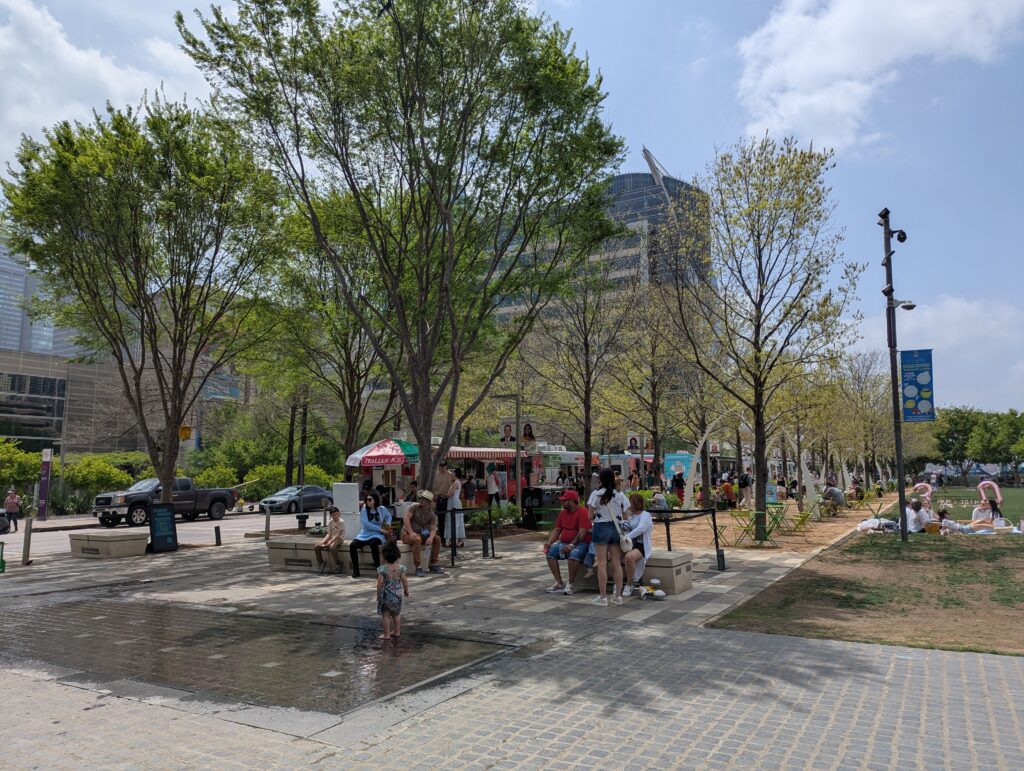
Yet the contrast with Garland reveals something important. Klyde Warren thrives because it is actively managed—also curated. Safety is visible. Programming is constant. Cleanliness is nonnegotiable. There is a sense of oversight—not heavy-handed, but present like an usher reminding you that the performance is ongoing. This model delivers vibrancy but also structure. The park is open to all, but the experience is shaped. Rules exist to ensure comfort; comfort sometimes requires control.
Garland’s approach, by comparison, succeeds with lighter touch. Fewer rules, fewer sponsors, fewer layers between the public and the space itself. The city invests not through private endowments, but through municipal will. Its success is fragile in a different way: it depends on political continuity, community buy-in, and city budgets that prioritize the Square. If those pillars falter, public maintenance can wobble. If they hold, the commons remains wholly public in ownership, operation, and spirit.
Neither model is inherently better. They simply answer different questions.
Klyde Warren Park asks: How do we maximize vibrancy, programming, and investment in the urban core?
Its answer: Partnership, philanthropy, and management intensity.
Garland asks: How do we maintain a civic square rooted in local identity and public ownership?
Its answer: City-led stewardship, broad community participation, and consistent care.
Both succeed, but each carries trade-offs. One relies on a highly coordinated, professionally managed programming ecosystem; the other depends on municipal leadership, cross-department collaboration, and ongoing community buy-in. One is shaped by scale and sponsorship; the other by civic commitment and continuity.
And woven through both examples is the question this article keeps surfacing: Does safety come from surveillance and structure—or from belonging and trust?
Perhaps the real test of a commons is not which model funded it, but whether people feel it is theirs.
The Tension and the Future: Who Do the Commons Belong To?
Walk through any successful plaza today and you see the product of careful orchestration. Programming is vibrant. Maintenance is meticulous. Security is visible but unobtrusive. Yet beneath the surface of every thriving urban commons lies a quiet tension: the very systems that preserve, enhance, and protect these spaces can also shape who truly feels welcome. The question is subtle but persistent: when public space relies on private dollars, curated programming, and management structures, are they still fully “common”—or is a new definition of shared space emerging?
The hybrid model has delivered undeniable gains. Parks that once teetered on neglect now flourish. Fountains sparkle. Gardens bloom. Children play safely while adults picnic without fear. Businesses nearby thrive as foot traffic increases. Cities no longer bear the sole burden of upkeep, allowing planners and managers to dream bigger. These spaces offer clarity, vibrancy, and often safety—a commons that works, visibly and reliably.
But what do we trade in the process? Every rule, every security guard, every curated event subtly shapes the experience of the people who inhabit the space. The commons of yesterday was messy, unpredictable, and democratic in its very disorder. Now, at times, it is a carefully composed performance. Individuals who once lingered freely may feel nudged out. Loiterers, skateboarders, street performers, or anyone not fitting the imagined “ideal visitor” may find themselves at the edge. Even the perception of safety can be a double-edged sword: what protects some may exclude others.
Suburban examples like Garland show that the tension is not inevitable. In smaller-scale, city-run spaces, success depends less on private money and more on shared civic identity. Commitment from leadership, staff, and residents creates vibrancy without heavy-handed curation. Yet these models carry fragility: budgets, politics, and engagement can shift, leaving the space vulnerable. Here, the trade-off is not over-management, but sustainability.
Perhaps the question is less about a single “correct” model and more about the values each community chooses to protect. Is curated safety an acceptable exchange for consistency and reliability? Is spontaneity and informality worth the unpredictability that comes with it? How can public spaces remain places where belonging is not merely permitted, but genuinely felt?
The answer is not fixed. As cities evolve, as demographics shift, as resources wax and wane, the negotiation over public space will continue. What we gain and what we lose will always be intertwined. In the end, the commons may remain less a physical space than a living contract: a reflection of the community’s priorities, trust, and willingness to share. And the ultimate question—who it belongs to, and who feels welcome—may never be fully resolved.
The commons, it seems, is always in motion. And perhaps that is exactly how it should be.