Rolling Hills Elementary
 Images provided by Glenn | Partners
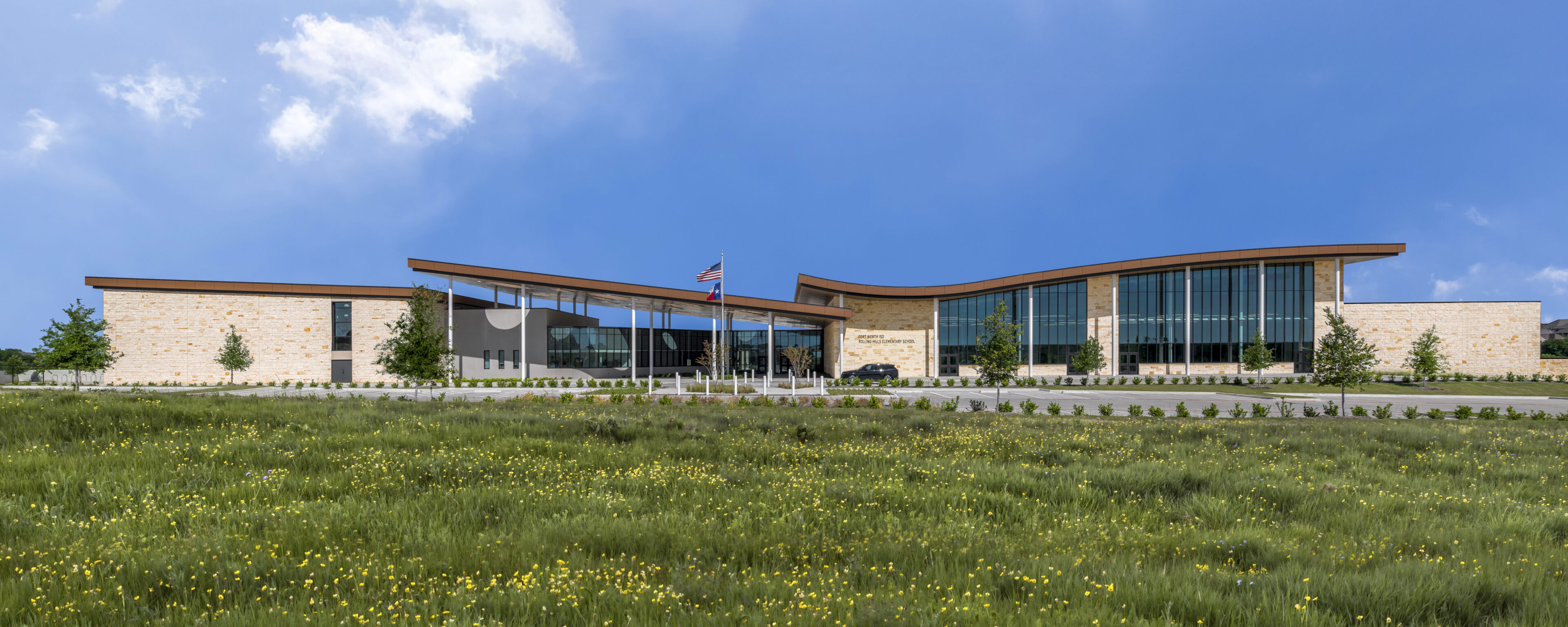
Elementary schools are being asked to do more than ever before. Beyond supporting classroom instruction, they are now expected to address equity, connect with their communities, and adapt to changing educational models. Rolling Hills Elementary, located in the fast-growing southwestern outskirts of Fort Worth and designed by Glenn | Partners for Fort Worth ISD, responds to these demands in a quiet yet whimsical way. At 120,000 square feet, the project explores how familiar spaces can be arranged to create a school that feels open, intuitive, and welcoming.
Early in the process, the district encouraged the design team to move away from traditional school layouts. Long corridors and inward-facing classrooms gave way to a plan organized around daylight, visibility, and shared spaces. These choices support student well-being while also helping the school function as an open neighborhood resource rather than an insular institution.
Working Within Real Constraints
As with most public school projects, Rolling Hills Elementary was shaped by a set of fixed requirements, including Type II-A construction standards, ICC-compliant storm shelters, and district-wide equity goals. The district was particularly conscious of maintaining the right “level of nice,” aiming for a campus that felt uplifting without setting it apart from others in the district. The architects responded by emphasizing durability, clarity, and the quality of everyday spaces.
The result is an architectural language that feels playful and approachable, appropriate to the character of a school for very young students. Still, the design team paid careful attention to budget, building systems, and long-term performance. Mechanical, lighting, and energy strategies were closely coordinated, reinforcing the idea that comfort and focus are essential parts of any learning environment.
Familiar Pieces Ordered in a New Way
The program itself is straightforward: classrooms, administrative offices, a media center, and support spaces typical of an elementary school. What sets Rolling Hills apart is how these elements relate to one another. Rather than organizing the building strictly around efficiency, the designers arranged spaces to encourage movement, interaction, and choice.
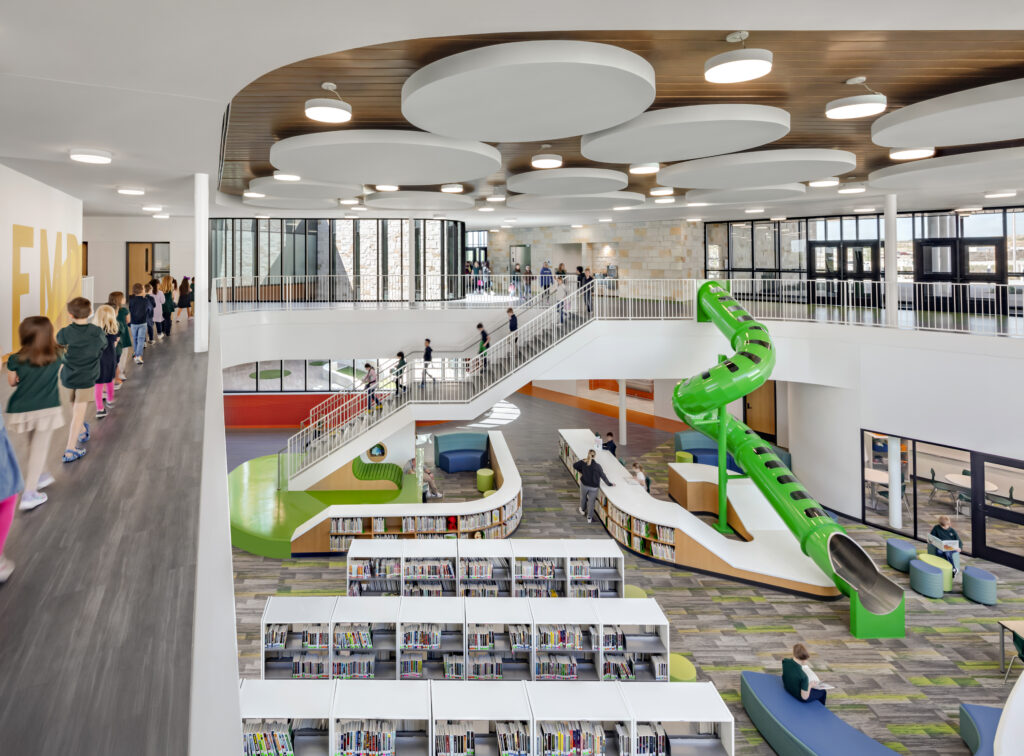
The school’s plan clearly embodies the project’s guiding idea, an “Educational Giving Tree.” At the heart of the school is a split-level media center that acts as a shared core. Unlike traditional libraries that are often quiet and tucked away, this space is open and active, visible from multiple points within the building. It separates more energetic, communal areas from quieter classroom wings while reinforcing the collective activity that is part of learning.
Shaped by the Site
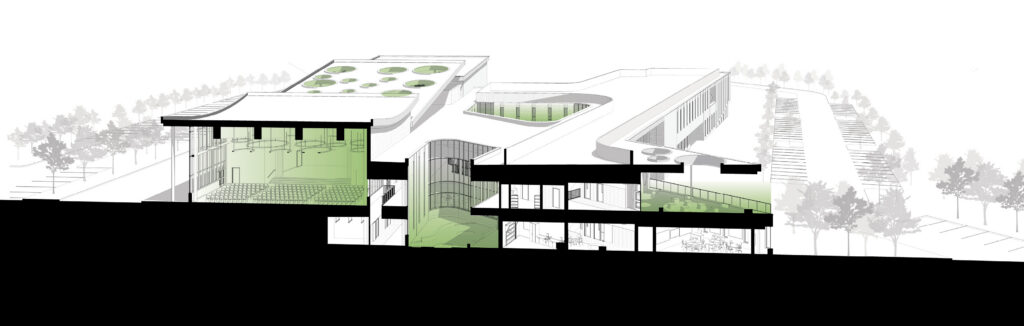
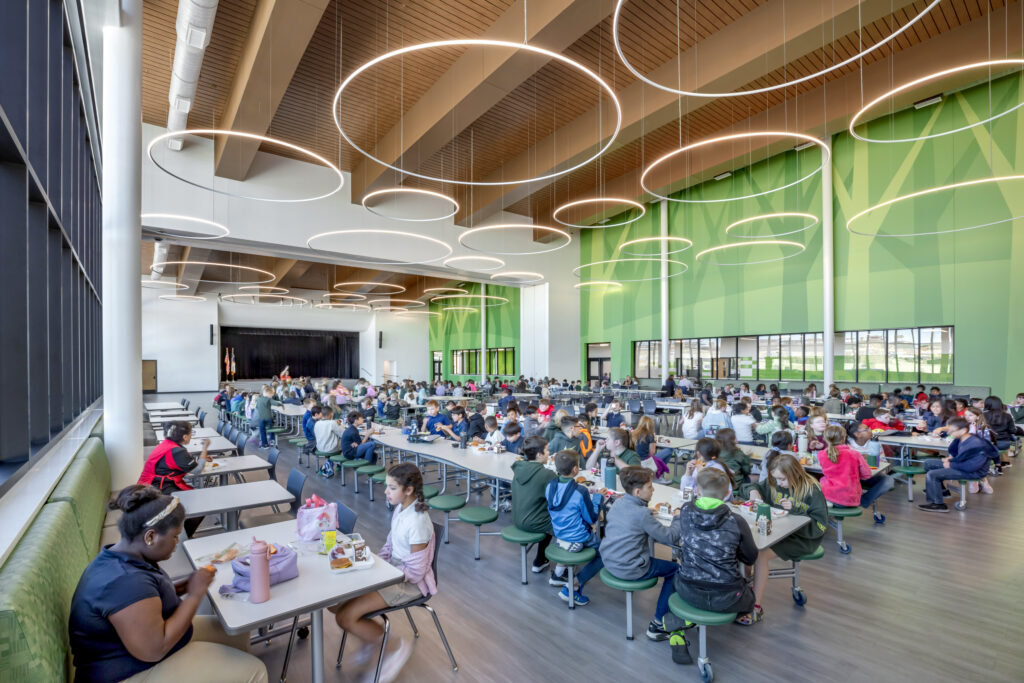
The campus sits on a sloping site with more than 30 feet of elevation change, and this topography strongly influenced the design. The main entry is placed at the highest point, giving the school a clear presence along the street and helping buffer nearby homes. This front portion of the building also contains administration, the cafeteria, multipurpose room, and gymnasium, clearly defining spaces intended for community use.
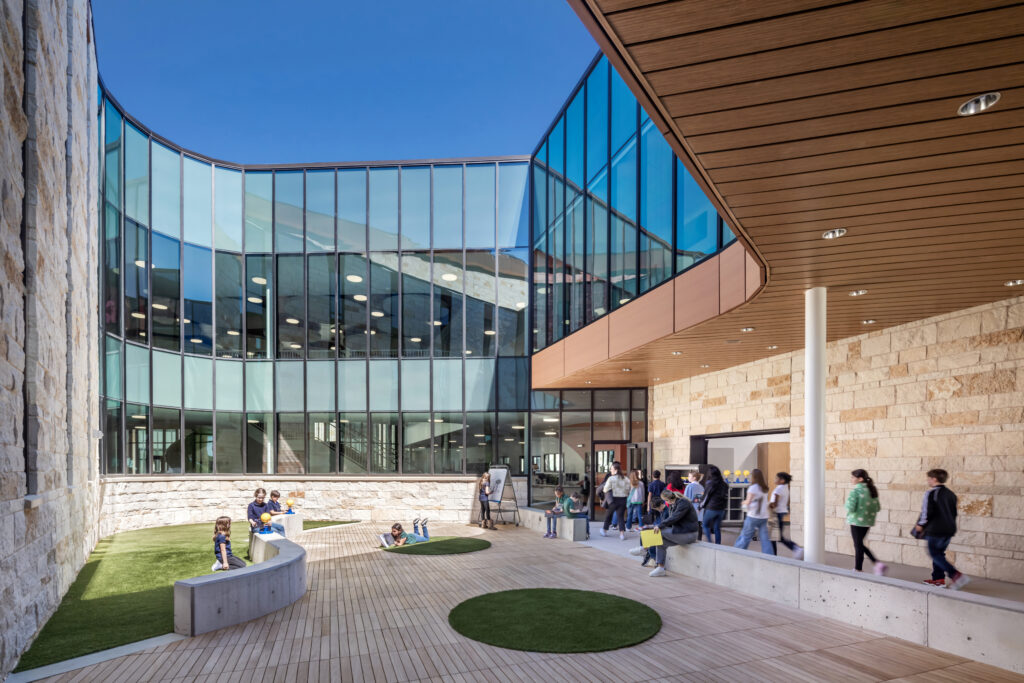
From there, the plan opens into the split-level media center, framed by two interior courtyards that bring daylight deep into the building. Students enter the upper level and gradually move down into learning spaces, a sequence that makes orientation and a sense of progression intuitive. Rounded forms appear throughout the building, from gathering spaces to circulation areas, softening transitions and creating an atmosphere that feels welcoming and fun.

Learning Beyond the Classroom
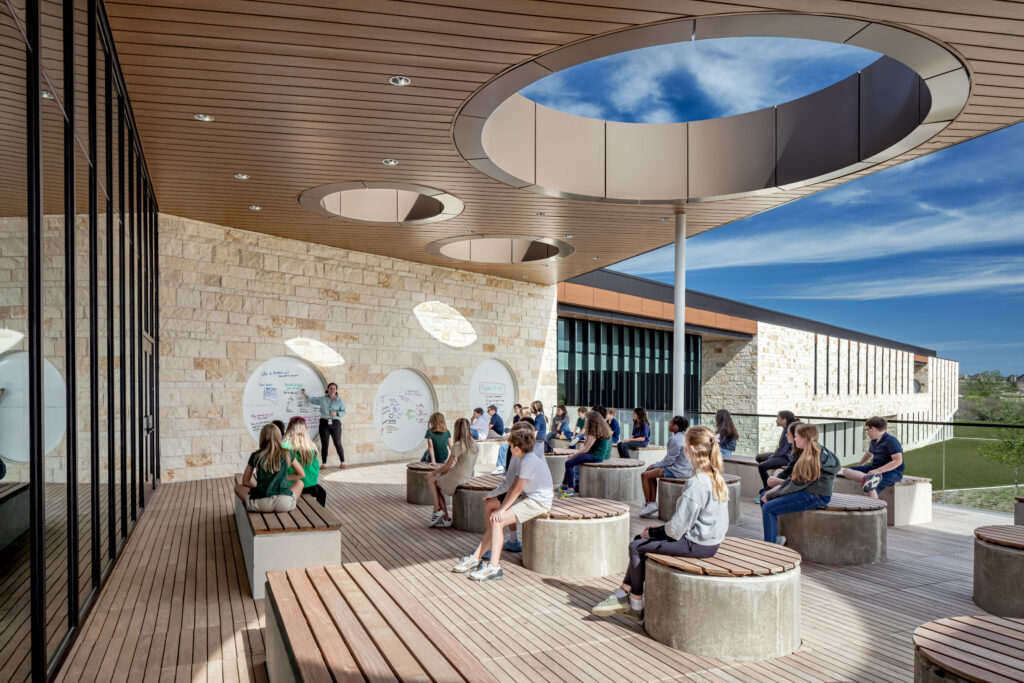
Academic wings extend outward from the media center, with indoor and outdoor collaboration areas placed between them. These spaces support informal learning and flexible teaching while also shielding outdoor play areas along the edges of the site. The building nestles into an existing ravine, maintaining strong visual connections to the surrounding landscape.
The exterior design includes subtle references to leaf-like shapes, especially along the administration wing, reinforcing the project’s central concept without becoming literal. Daylight and framed views play an important role throughout the school, contributing to student comfort and strengthening ties to the neighborhood.
The client has responded positively. Former Fort Worth ISD chief academic officer Jerry Moore encapsulates the district’s experience: “We challenged Glenn | Partners to design a next-generation-ready school building that would bring innovative design to our Westpark community. The design for the new elementary school far exceeds those expectations! I am confident this building will be a point of pride for Fort Worth ISD and win recognition statewide.”

All images courtesy of Glenn | Partners.