Some Notes on the Everyday in Architecture
We live in the everyday. It is our world of familiar things, places, activities, people, and events that make up the context we inhabit—our common place. Taking a term from language, the everyday is our vernacular, recognized and used by everyone and taken for granted. Contrasting with the everyday are the special, the unique, the rare, the precious, and the extraordinary.
Attention to the everyday is relatively new to architecture, but not to building. Building has gone on since we first made shelter. But for most of history, what we think of as architecture concerned itself with creating places for the elites of its culture—the 1% of their time—the powerful, the rulers, the rich, the noble, and the holy. Architecture was temples, churches, palaces, villas, theaters, and monuments. The Ecole des Beaux-Arts, the longtime leader of architectural thinking, grew out of the Royal Academy of Painting and Sculpture and served the cultural needs of the French Court and the affluent haute bourgeoisie. The Beaux-Arts became an international style for the 1%.
But in the late 19th and early 20th centuries, with the rise of industrialization, democratic pressures, public education, scientific advances, and wider communication, the movement we call Modernism challenged received “high” culture. Modernism accepted the broader culture—the cultures of the middle and working classes—as legitimate sources for art, music, and literature. Van Gogh painted a pair of workers’ boots. Elements of everyday life became legitimate subjects: folk melodies were woven into symphonies; common talk and dialect emerged in novels like Huckleberry Finn. Newsprint, wallpaper, fabric, old photographs, sheet music, and fragments of wood were collaged into Cubist art. The value lay not in the materials but rather in their composition, in how they were assembled.
For architecture, Modernism meant responding to the new needs of the broader population, such as factories, schools, hospitals, department stores, and large-scale housing. It meant using the new materials and products of industrialization in buildings. The artisan’s craft, costly materials, and classical forms no longer sufficed. Architecture’s concerns and its means expanded into the lives of the many, not just the few. The Industrial Revolution and mass production brought new materials, objects, and machines into people’s lives.
Le Corbusier’s book Aircraft1 is a long love letter to these new possibilities, which entered and shaped his architecture. Modernism recognized and appropriated both the social everyday and the material everyday. Constructivism and the Bauhaus led in giving substance and form to these radical changes.
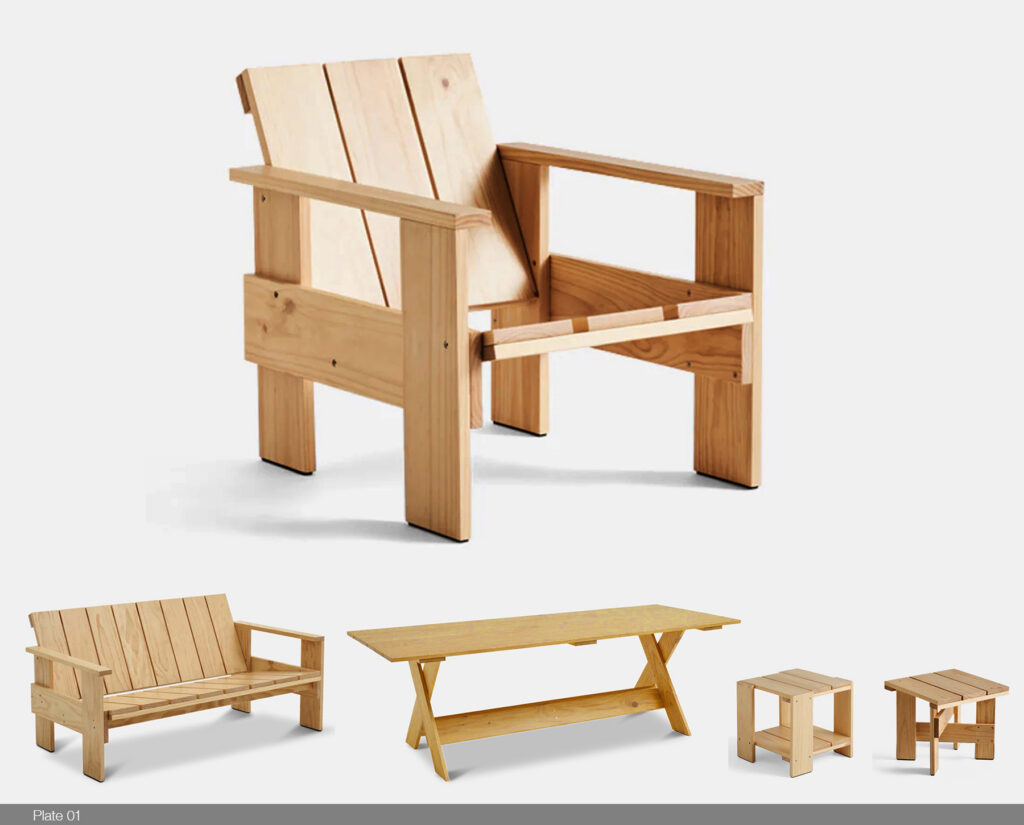
Let’s look at examples. A particularly direct and poetic one is the series of Crate Furniture (Plate 01)2 made by Gerrit Rietveld (1934), constructed from the wood boards of shipping boxes, often from the crates that traditional furniture came in. The point is finding in the most mundane of things the means for creating value—from sow’s ear to silk purse.
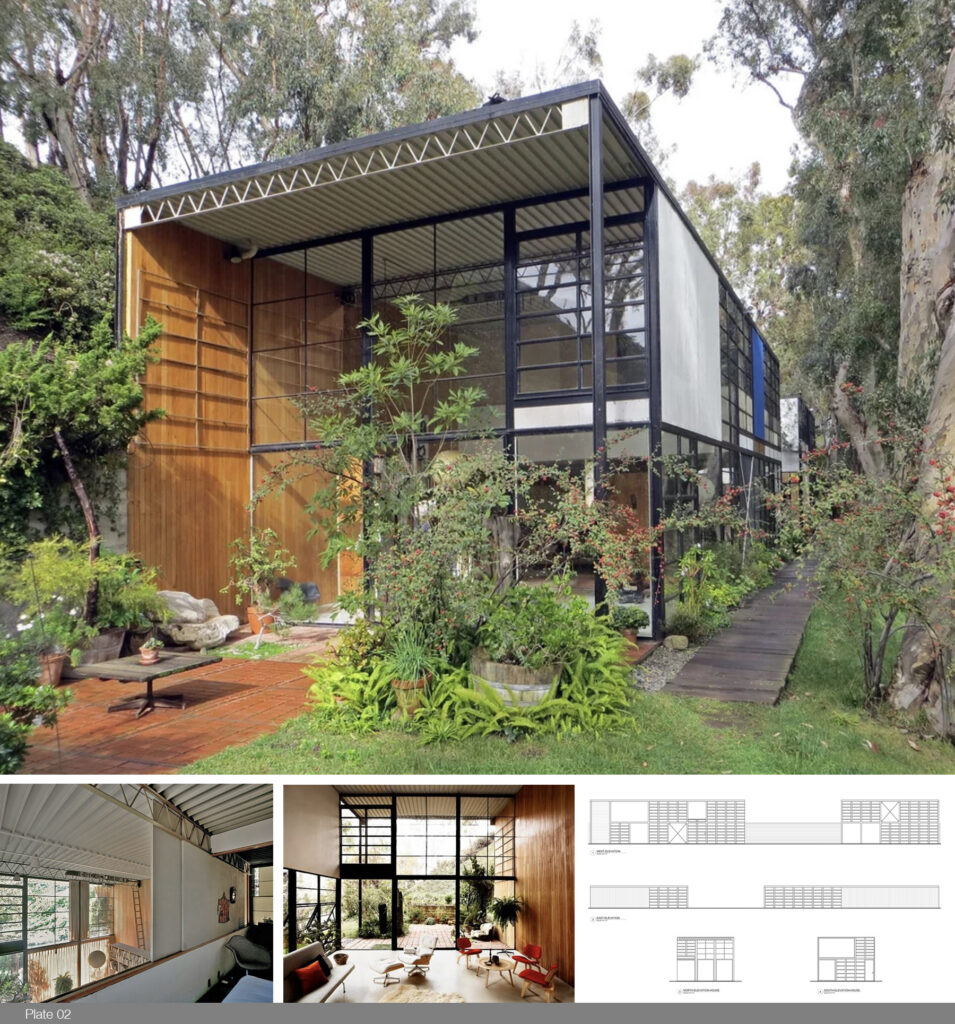
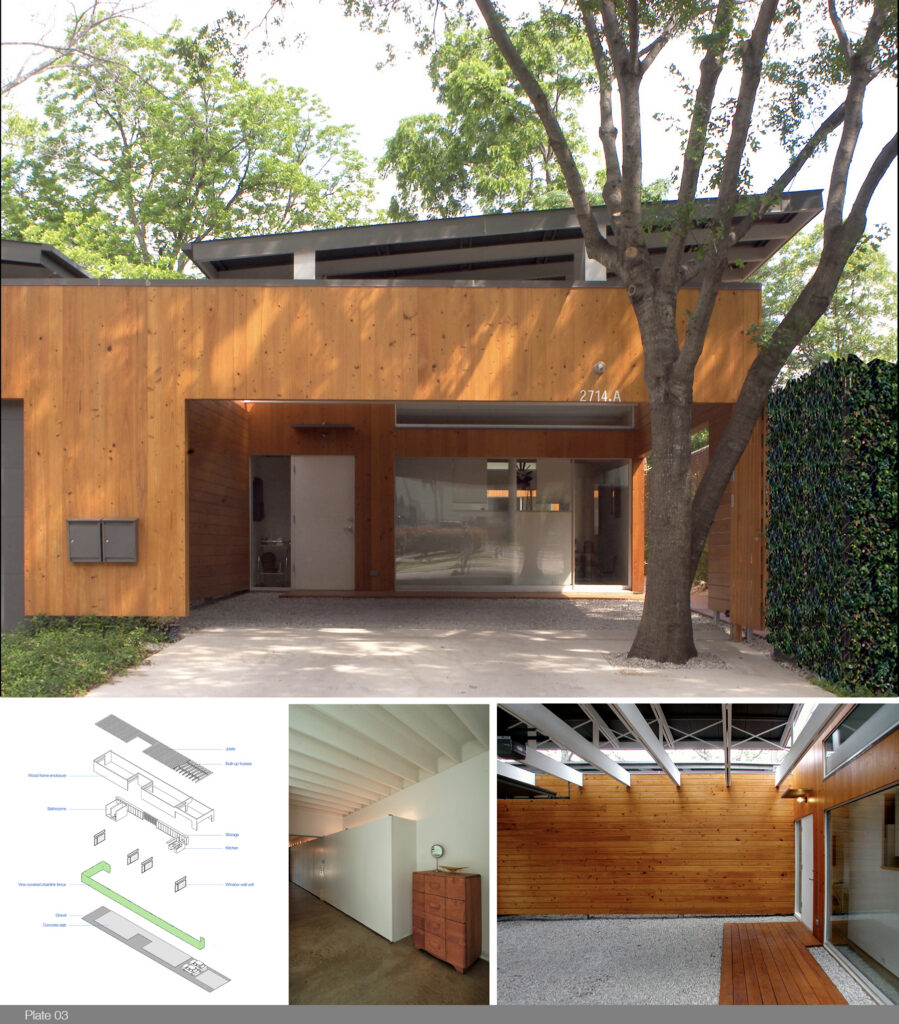
From off-the-shelf to one-of-a-kind…Charles and Ray Eames’ own Case Study House (Plate 02)3 in Los Angeles (1949) is assembled from readily available systems and components used in industrial construction. The brilliance lies in producing a new, more valuable reality from the stuff of the everyday and showing how to use the economy of serial production to provide better lives for more people. And I humbly add my series of prototype courtyard houses (Plate 03)4 in Dallas as examples. To demonstrate that the economy of common components is no real limit, I pointedly used materials, products, and systems from big-box building centers such as Home Depot and Lowe’s. Fences are chain-link mesh grown over with evergreen vines; 30 standard hollow-core doors make up an 80-foot-long storage wall; cross-bracing is electrical conduit; and standard crushed rock aggregate is ground cover. In its 2005 issue on world housing, the Spanish journal AV Monografías called them “Casas-Patio de Catálogo.”
Looking at the Overlooked5…What happens when everyday common materials enter the realm of “high” culture? Two examples illustrate this.
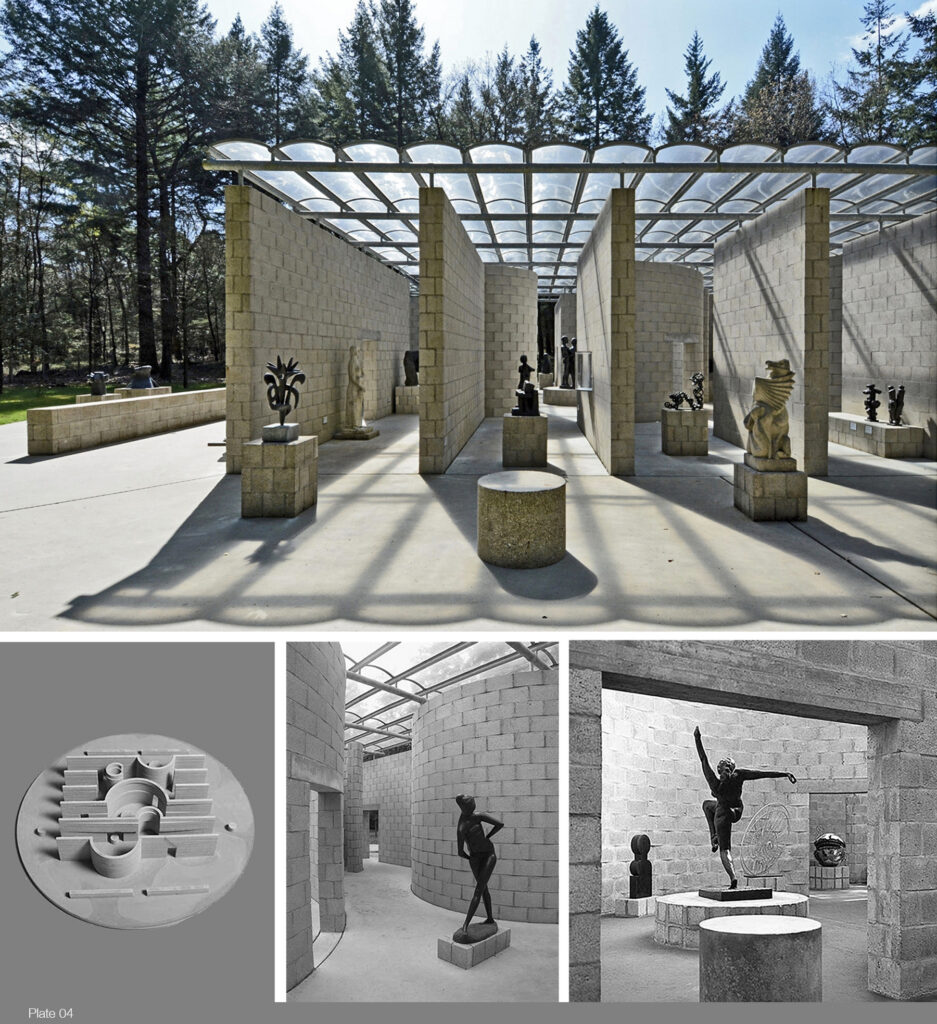
The first is Aldo van Eyck’s temporary outdoor sculpture pavilion (1966) in Sonsbeek, Netherlands, later rebuilt permanently at the Kröller-Müller Museum (Plate 04)6. Regular concrete blocks of the most ordinary, functional kind are laid in parallel walls, occasionally curved to form niches for special statues. Repeated rows of common acrylic skylight units carried on steel tube beams form the roof plane. The sequence of spaces and the high source of light recall the great museums. Again, the value lies in the brilliant assembly of parts; by themselves, the elements are very mundane.
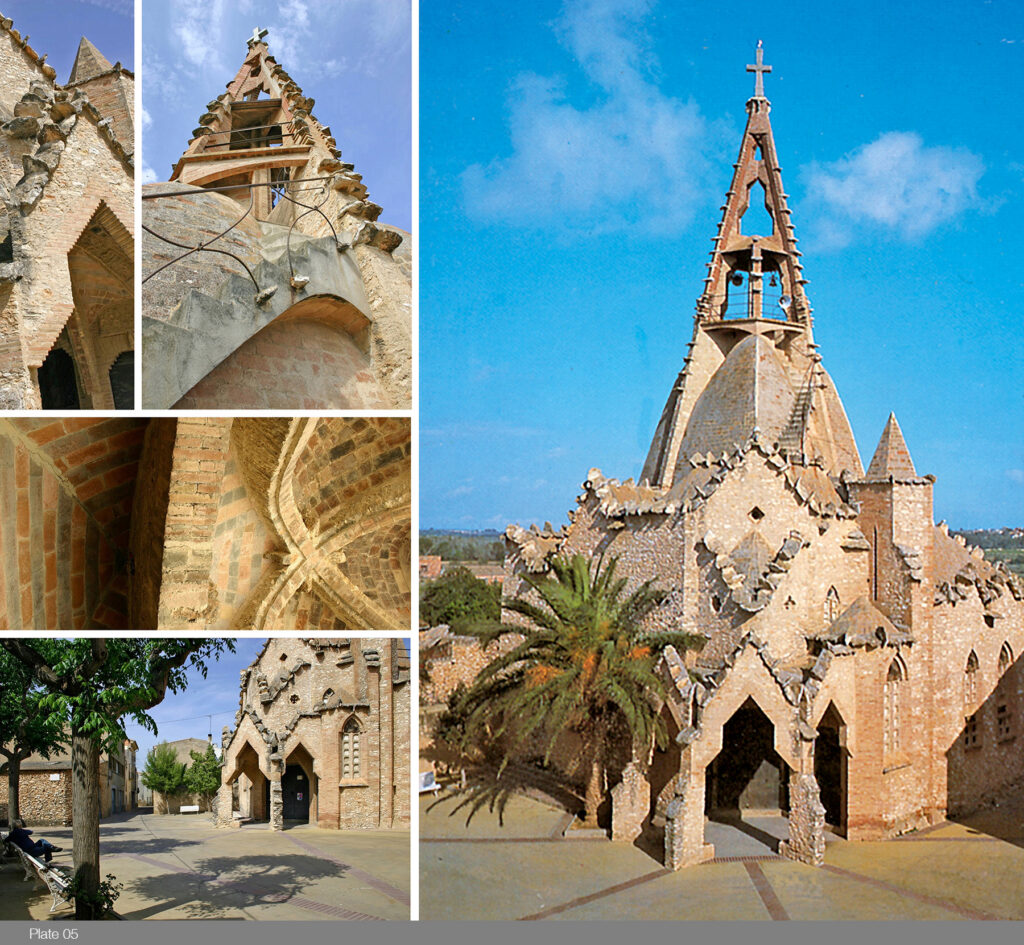
The second example of raising the everyday to create the especially significant is the Church of El Sagrat Cor (Plate 05), by Josep Maria Jujol (1923), in the small Catalan town of Vistabella. Jujol was a collaborator of Gaudí and was himself one of the great masters of modernismo in Spain. Here, the everyday takes the place of the more refined and costly and stands in for it, making a poetic and perhaps even a spiritual statement. The town’s familiar common brick and mortar is used for walls, arches, towers, and ribs—the Gothic elements usually done in meticulously dressed stone. Most touching, where we would expect figural sculpture and carved ornament, Jujol places rough rocks brought in from the surrounding fields. Nature has done the carving—the familiar nature of this place. If the Gothic offered a vision of heaven, then El Sagrat Cor might suggest that this promise can be found in everyday life and in the common community.
As an aside, when I first visited Vistabella with a Spanish friend, I noticed that the church’s plan and massing were remarkably similar to José Luis Sert’s proposal for a small chapel in Boston, a project I was in charge of in Sert’s office. My friend laughed and said, “Of course! Jujol was one of Sert’s teachers.”
In Dallas, we don’t have to look far to find sophisticated champions of the everyday. Architects like Max Levy and Gary Cunningham find lyrical potential in the commonplace, often giving it pride of place in their work and challenging our preconceptions, as the best design often does.
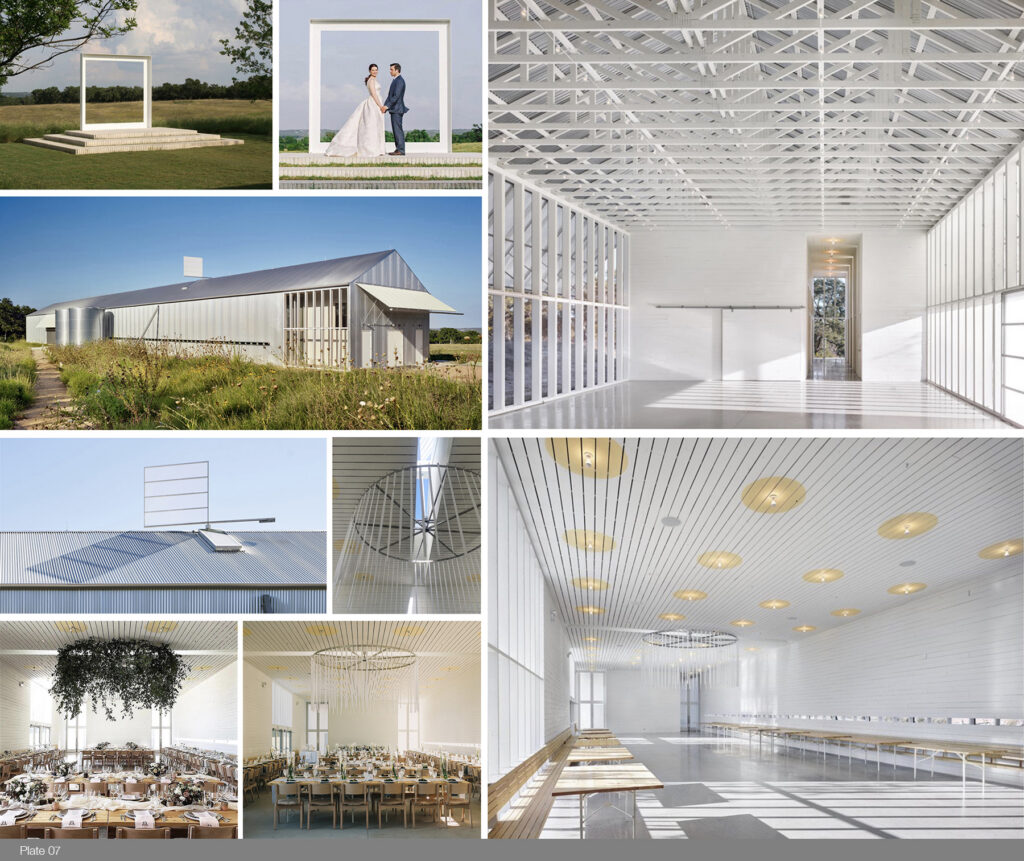
Levy’s Prospect House (Plate 07), a wedding and event venue outside Austin, is a master class in building with the everyday, using the ordinary to create an extraordinary place. Here are corrugated metal and fiberglass, conventional wood framing and trusses, standard lumber—materials from any farm and ranch store. The wood framing and trusses, all painted white, are enclosed on the outside by gray galvanized siding and roofing. On the inside, the framework is left open in some places and sheathed with horizontal boards in others. With the open trusses above, the density of the structure creates a geometric cloud.
Simple but sophisticated details abound. A grid of glass test-tube-like vases on a wall invites decorating with fresh flowers. Half-mirrored bare bulbs in industrial fixtures bounce light from painted yellow halos to make a slatted ceiling glow. A steel rectangle on a podium frames the landscape as well as the wedding couple for photographs. The steps up are formed by the same corrugated metal that clads the building. A translucent weather vane connects down to a chandelier-like ring with hooks holding long strips of silk. The changing wind animates the silk or the decorations the celebrants wish to hang. Something as everyday as the weather joins the occasion.
The Cistercian Order of Catholic monks and nuns was founded in 1098 at Cîsteaux, in Burgundy, as a reform movement seeking a simpler, more rigorous and austere adherence to the monastic Rule of St. Benedict. When the Order’s Dallas abbey needed a new church (Plate 08), it asked Gary Cunningham, an alumnus of its prep school, to design it. And the grandfather of one of the students offered to contribute common limestone from a quarry he owned in West Texas. Instead of using the stone as a cladding veneer, Cunningham wondered if large, thick blocks of stone, freshly sawn from the earth, could make up all the walls of the church, by laying one massive block on another.
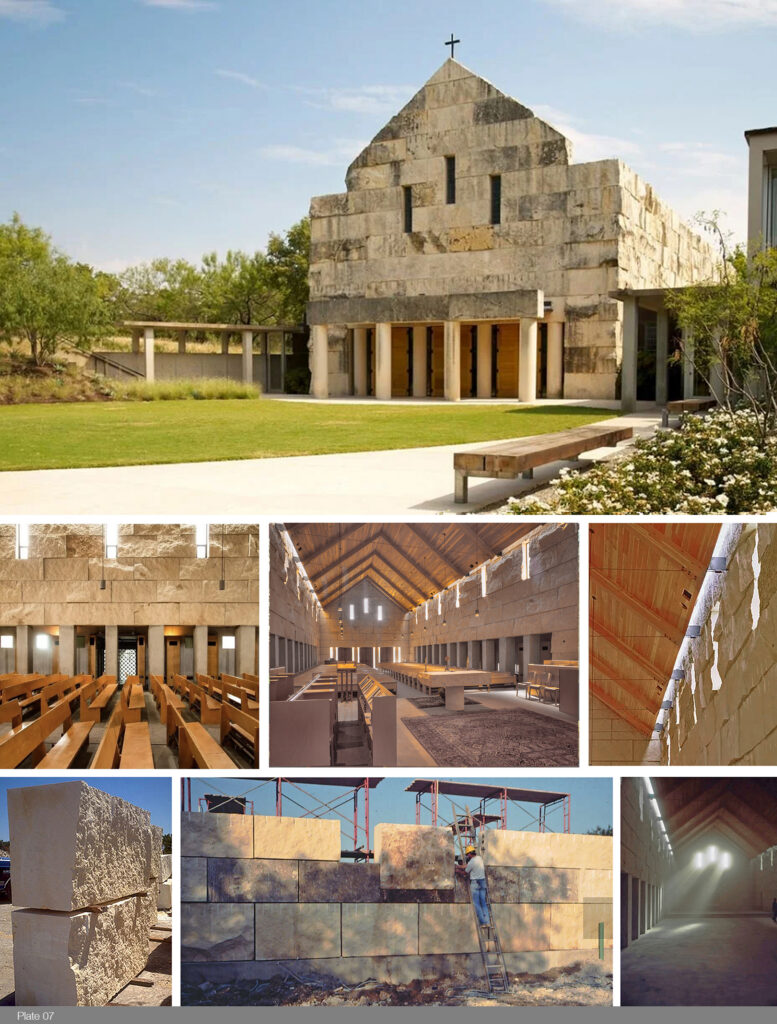
The simplicity, economy, and logic of this construction reflect Cistercian discipline. While the walls are massive, almost Neolithic, contemporary concrete columns occur at the porch and along the aisles, and a simple steel-and-wood pitched roof covers the nave. In a brilliant stroke, the bottoms of the rain gutters between the roof and the walls are cast glass, letting the roof seem to float above the nave and bringing light that rakes across the huge blocks of stone. The marriage of two very everyday things—sunlight and stone—gives the church its power. Surely this is one of the best works of religious architecture in recent history—anywhere. The Cistercian founders of the order nearly a thousand years ago would have understood and been pleased.
More for Less . . . As a concluding point, I’d like to suggest that the most important architects working today are Anne Lacaton and Jean-Philippe Vassal, the Pritzker Prize-winning partners in Paris. Not the hottest or most fashionable architects—but the most important.
Why? Because they work in the everyday—building for everyday people, using everyday systems, meeting everyday budgets, and producing highly useful and powerful work. They work with the foundational ideas of the Modern Movement. In one of their iconic projects, the tower of Bois-le-Prêtre in Paris in 2011, they persuaded the authorities to let them renovate a socially failed public housing building that was scheduled for demolition. By removing the existing facade and extending a 3-meter-deep layer around the building, they added space to each room, a new area that the occupants could use as either indoor or outdoor space by opening and closing their new walls, walls made of everyday aluminum patio doors. These replaced the old enclosure and created a second enclosure at the new exterior. Thus, the residents get more space, more flexibility, and more light and air. The images show how everyday people live in their transformed dwellings. A building designated as failed housing becomes much desired. This idea has since been used by the architects to transform dwellings for thousands of families in “problem” public housing throughout France and beyond.
In their diverse practice of designing housing, schools, museums, and urban spaces, Lacaton and Vassal resolve everyday issues using common, everyday means. What is unique is the vision, skill, and determination that get it done.
Footnotes:
- Book first published in 1935 ↩︎
- Photo: https://rietveldoriginals.com/en/collections/crate-series ↩︎
- www.reddit.com/r/Mid_Century/comments/haa9p9/eames_house_los_angeles_usa_1949_by_charles_and/ ↩︎
- The reference is from AV Monografia 116: Vivienda Formal, 2005. ↩︎
- The title of Norman Bryson’s wonderful book on still-life painting ↩︎
- Aldo Van Eyck, Sonnebeck Museum, later rebuilt at the Kröller-Müller Museum. https://www.archiweb.cz/en/b/aldo-van-eyck-pavilon-socharsky-pavilon-sonsbeek ↩︎