Strip Malls Are Almost All Right
Imagine an open-air courtyard space next to restaurants and shops: people of all kinds—kids, elders, families, and students—sit informally, enjoying coffee, tea, and food. Dappled light falls across the textured space, and spontaneous activity is everywhere. Is this what you picture when you hear “strip mall”? For most, the answer is no. Yet this is the Arabian Village complex in Richardson, TX: a vibrant, spontaneous hub of micro-commerce and social gathering.
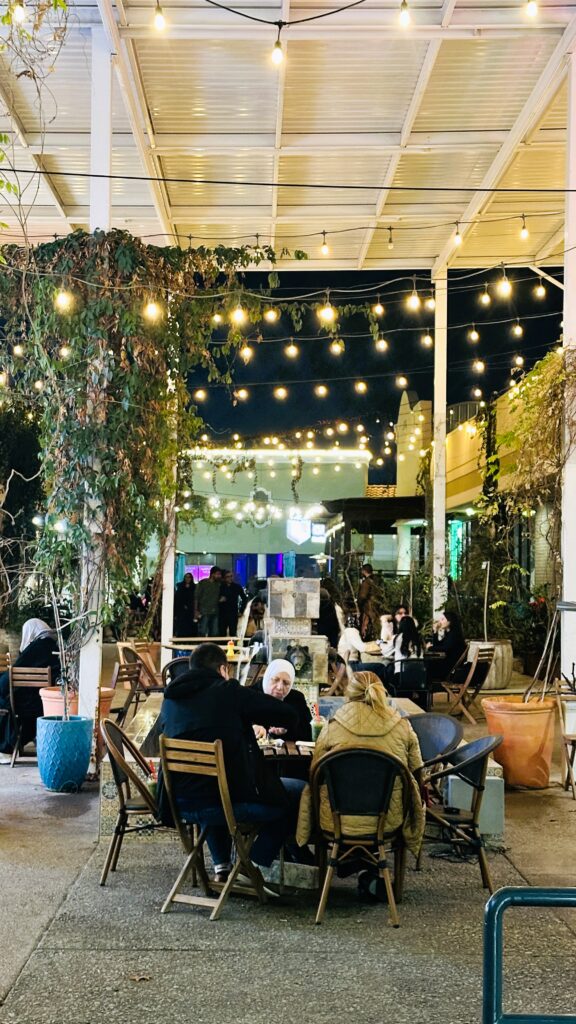
This jarring contrast highlights the issue. Banal strip mall complexes suffer a terrible reputation, derided by architects as examples of urban decay. However, their ubiquity presents a unique, often unacknowledged opportunity to engage with the theme of the commons in the American suburb. To unlock this potential, we must adopt a nuanced stance: the strip mall’s economic model is “almost all right,” but its spatial model is “all wrong.” By reclaiming the “Decorated Shed,” we can facilitate a vernacular revival of this quasi-suburban civic hub.
Why Banality Is a Virtue (The “All Right” Economy)
Architect Robert Venturi’s “Decorated Shed” typology perfectly describes the strip mall: a generic, utilitarian shell where identity is provided by the “decoration” of the tenant1. In this context, the Shed is the developer-provided typology, consisting of the tilt-wall concrete and standardized 20-foot bay. The decoration consists of tenant improvements: the vibrant signage, the window displays of a halal grocer, and the specific cultural artifacts that breathe life into the glass storefronts.
By decoupling the building’s structure from its identity, the strip mall becomes a flexible stage for micro-commerce. Economically, this model is “all right” because it is essential. DFW’s neighborhood retail centers maintain a crucial affordability index, with average asking rents hovering around $22.45 per square foot2. These are the “starter homes” for the entrepreneurial class. When we criticize the strip mall for being “cheap,” we are inadvertently critiquing the very low-barrier infrastructure that allows immigrant micro-commerce to exist. The economic “banality” of the shed is its greatest democratic virtue.
Spatial Failure (The “All Wrong” Design)
However, if the economics are “all right,” the spatial configuration remains “all wrong.” This failure is rooted in a design typology that prioritizes the vehicle above all else. The typical strip mall is a vast parking field with a single-loaded structure at the periphery: a template engineered for quick consumption and immediate exit.
This “in and out” design ideology ensures the complex acts as a place of transaction but never a place of assembly. The design is so ruthlessly auto-centric that even after a customer has parked, traveling from one store to another within the same strip mall often necessitates getting back into the car. This complete lack of on-site pedestrian permeability proves that walkability was never a design consideration. The absence of shaded seating, fountains, or central gathering points further prevents any form of spontaneous social lingering.
Case for Incrementalism: A Texan Realism
To realize the strip mall’s potential, we must directly confront the spatial isolation imposed by this auto-centric layout. Yet we must also recognize that the remedy does not require a singular, heroic gesture. Dallas is historically a sprawling, car-centric landscape. To suggest that the vehicle must be entirely erased is to ignore the cultural and climatic reality of North Texas.
Instead, we must advocate for a process of incremental evolution. Solution-making in this context is about coexistence, allowing car culture to merge with new, human-centric typologies unique to Dallas. By viewing the strip mall not as an object to be demolished but as a site for slow, culture-led change, we find a viable path forward. The path to reclamation exists on a spectrum of interventions, ranging from light-touch cultural hacks to deep, systemic densification.
Layer One: Tactical Acupuncture and Organic Infills
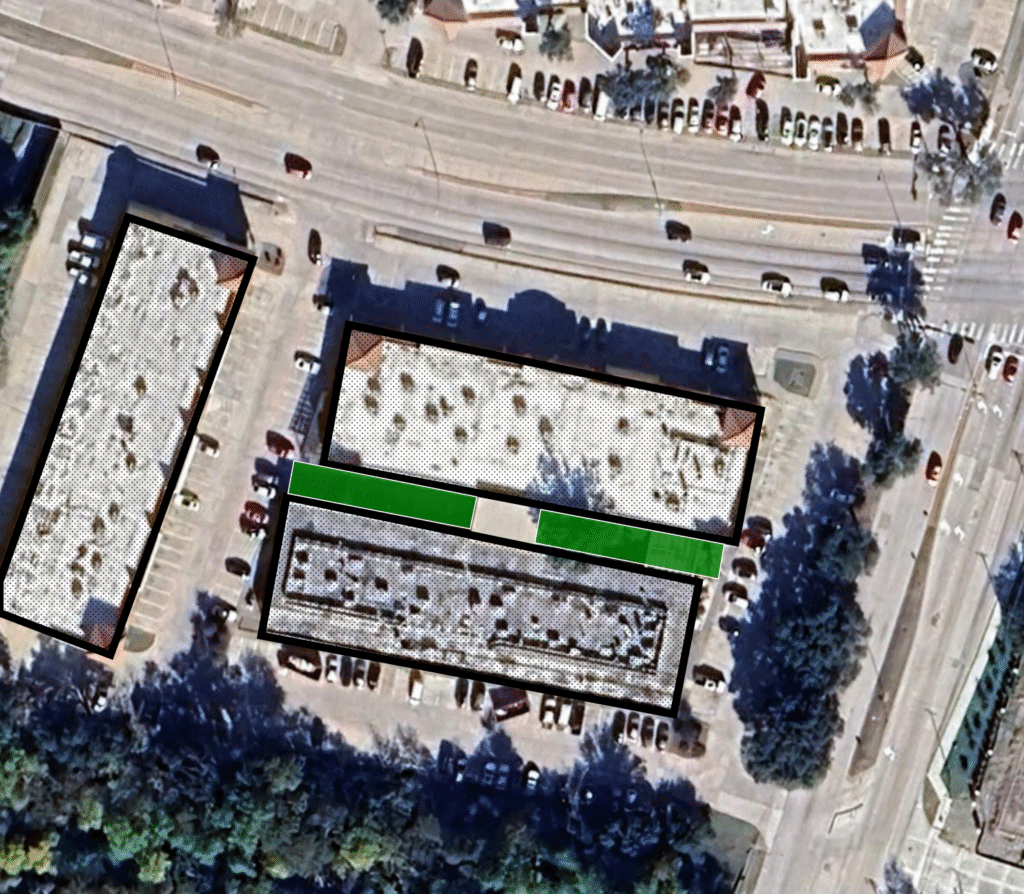
Transformation begins with light-touch fixes that shift the spatial psychology of a site without requiring massive capital. The Arabian Village in Richardson embodies this layer: its vibrancy is an organic result of tenants infilling affordable space with cultural purpose.
The design interventions here are ingenious in their simplicity. Tenants have utilized string lighting as a space-making element, creating an invisible diaphragm that lowers the perceived ceiling and brings the vast sky down to a human scale. Furthermore, the site’s planning, featuring a double-sided strip, utilizes what would typically be a “back of house” service area as a protected internal courtyard. While this creates operational challenges for deliveries, the tenants have turned this into a spatial advantage. By inserting water fountains, shading devices, and mobile heating and cooling units, they have engineered a responsive micro-climate. These minor changes prove that even a banal structure possesses the functional bones to support a vibrant social life if tenants are given the agency to linger.
Layer Two: Focused Design and the Regulatory Friction
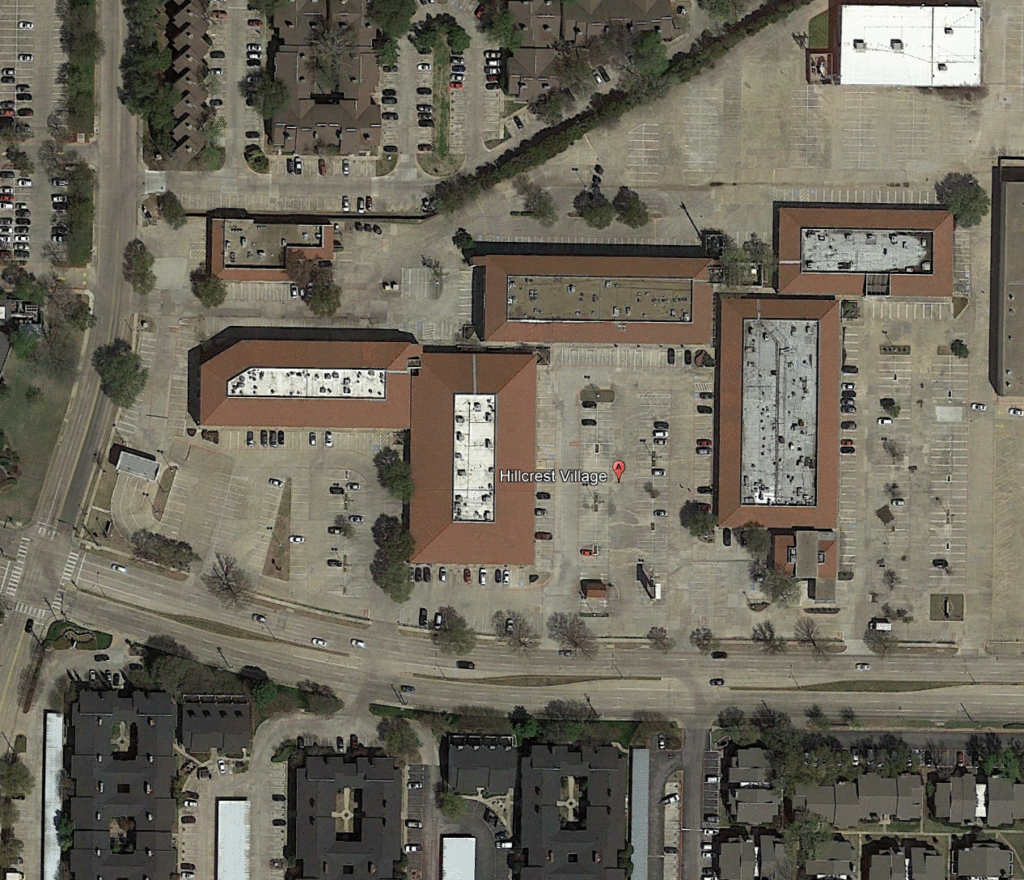
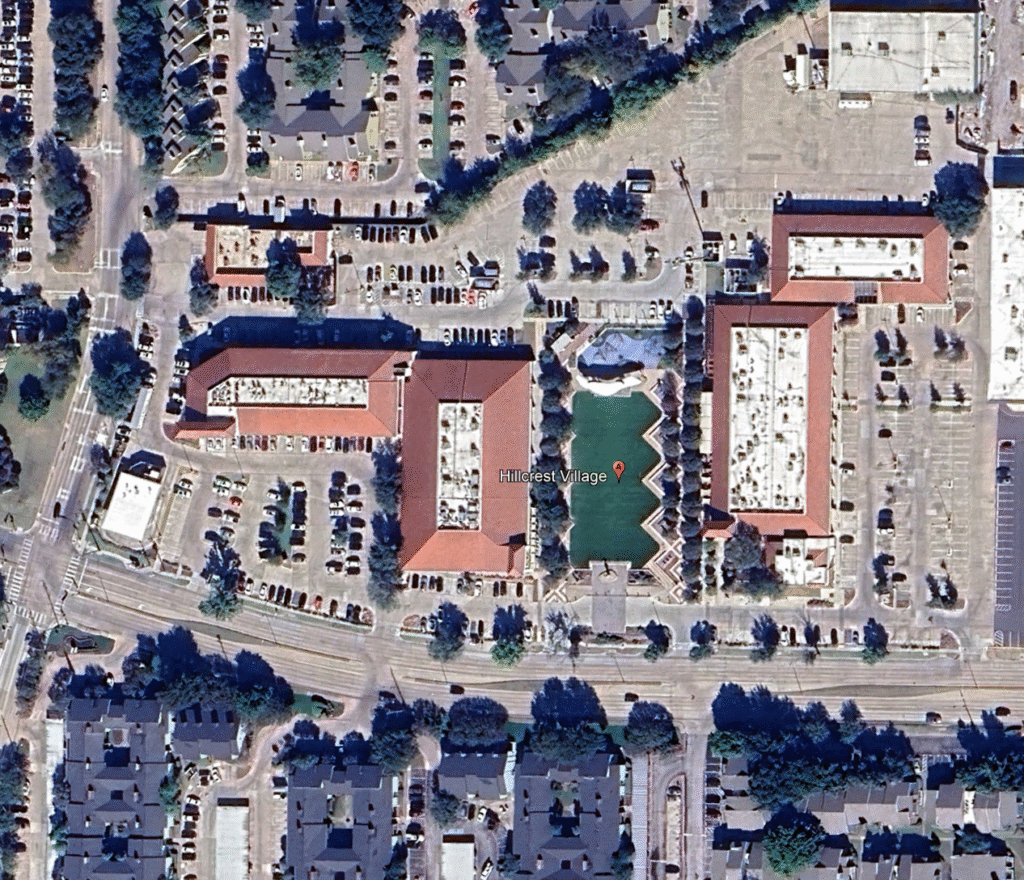
The second layer involves a more deliberate, study-based intervention: reclaiming underutilized asphalt to create a permanent social anchor. This stage is best exemplified by Hillcrest Village Plaza in Dallas. Surrounded by a dense catchment of both single-family homes and apartment complexes, the site possessed a “hidden” pedestrian population historically suppressed by the auto-centric parking moat.
By converting a large swath of central parking into a landscaped courtyard with turf and colonnades, the developer tapped into this latent demographic. At 9 o’clock in the evening, the space remains filled with children playing on the grass while parents sit in the shaded colonnades. Removing the parking did not impede the restaurants’ ability to make money; instead, it reduced vehicle reliance while capturing walkers from the surrounding apartments during “odd hours.”
However, this success hits a major wall: the invisible barrier of zoning. In much of North Texas, converting a parking stall into a courtyard is a legal battle against rigid minimum parking requirements. These codes treat a vacant parking space as a sacred legal necessity rather than a waste of land. As Donald Shoup argues, these mandates are the “starvation diet” of suburban civic life, legally prohibiting the very “Commons” we claim to desire3. For the strip mall to move from “almost all right” to a “Vernacular Civic Hub,” the revolution will not be led by an architect’s pen, but by a city planner’s eraser.
Layer Three: Comprehensive Transformation and the Gentrification Paradox
The final end of the spectrum is a full-scale reimagining of the strip mall as the foundation for a complete urban neighborhood. Projects like The Hill in Dallas demonstrate this by “inverting” the site, turning buildings inward and regrading for vertical growth. This layer adds the critical component of residential densification. However, this comprehensive approach presents a profound ethical challenge: the gentrification paradox. If the root virtue of the strip mall is its affordability, then a high-capital transformation risks destroying the very micro-economy it seeks to house. We must distinguish between “retrofit” and “premiumization.” The latter uses high-design finishes as a justification for rent hikes that price out the very entrepreneurial class the “Shed” was built to house. To remain “almost all right,” densification must be married to community-led planning that protects existing tenants.
Without intentional protections, a densified strip mall risks becoming a premiumized enclave rather than a true communal asset. Projects like the Brodie Oaks Redevelopment in Austin and Wheatland Plaza in Duncanville illustrate this delicate balance. In Austin, developers are phasing construction to allow existing retailers to relocate on-site while adding a mandated 10% of units as affordable housing.4 Similarly, Wheatland Plaza utilizes “incremental development” by breaking up failed big-box spaces into micro-units for local entrepreneurs, ensuring the community that sustained the plaza is not priced out of its future.5 These examples prove that with empathetic management, a strip mall can evolve into a dense district that provides both a “starter home” for the entrepreneur and a permanent home for the resident.
Conclusion: A Vernacular Revival
The strip mall is the inescapable architecture of the modern American suburb. For decades, we have dismissed it through an aesthetic lens, ignoring the vital function it already serves as a Commons of Access. The path forward is a paradox: we must improve the physical space of the strip mall without “premiumizing” it to the point of exclusion.
By reclaiming the parking field, whether through tactical “acupuncture” or strategic densification, we can move the strip mall from a place of mere transaction to a place of true assembly. We must defend the low-barrier “Shed” while aggressively redesigning the Parking Stall. If we recognize the immense potential of this simple architectural form, we find the “Main Street” we thought we had lost. The strip mall is economically “all right” only as long as its banality keeps it affordable.
Our task is to surgically insert the “Commons” without triggering the price hike that kills the very culture we intend to house.
End Notes
- Venturi, R., Scott Brown, D., & Izenour, S. (1972). Learning from Las Vegas. MIT Press. ↩︎
- Cushman & Wakefield. (2025). MarketBeat Dallas-Fort Worth Retail Q3 2024/2025. ↩︎
- Shoup, D. (2005). The High Cost of Free Parking. APA Planners Press. ↩︎
- City of Austin. (2023). Brodie Oaks PUD Ordinance No. 20230921-100. (Documenting on-site affordable housing and environmental superiority). ↩︎
- Neighborhood Evolution LLC. (2024). Wheatland Plaza Case Study. (Detailing the 88% occupancy increase through incremental subdivision and community partnership). ↩︎