Here and There
I entered the world at Memorial Herman in the early days of the Houston hospital district and near the tail end of GenX. My parents had been married just a year or two, which made me a prompt yet necessary step in their pursuit of the American Dream. Confronted with a new high maintenance reality, my dad dutifully sold his El Camino Super Sport (with swivel bucket seats) to acquire something less exciting and more practical. His recollection now partially polished by the notion that “it was the only car I ever made money on.”
When their apartment lease expired, our fledgling family escaped the big city for the rice fields out west where one could buy a three-bedroom house for the cost of a present-day bathroom remodel. The Katy Freeway (Interstate 10) was in its infancy with sparkling new elevated overpasses dotting the otherwise empty horizon. These mounds were mere pimples along an adolescent stretch of concrete which would ultimately grow to feature 26 lanes with a peak right of way (ROW) width of 556 feet.
With miles of new lanes beckoning, the expansive agricultural land faced an inevitable transformation. Before the sprawl gained momentum, our grocery store was closed on Sundays and there was a line out the door when a Long John Silver’s sprouted from a never-ending sea of parking lots.
Despite a handful of vivid recollections from my early days in the vicinity of the bayou and finishing my school years in the less than urban enclave of Bedford, Texas, I consider myself to be “from” Dallas. For a kid raised in the suburbs, Dallas was far more interesting than a town known casually and depressingly as part of the Mid Cities.
Aside from groceries, gas, and church, we had to leave the city limits for pretty much everything. Even my high school was in another (mid) city. I don’t remember being unhappy with the arrangement, but a void of culture and design made the magnetism of (real) cities even more powerful. So, on the day I turned 16 and my dad handed me the keys to a sedan of comparable vintage, my horizon expanded.
From my strategic central location, downtown Dallas contained the places that people my age wanted to be. There was a density which was foreign to my strip mall enclave. My cooler friends had fake IDs, bragging about concerts and extralegal exploits in Deep Ellum. I only ventured as far as the West End—home to the Spaghetti Warehouse, where reservations were recommended to secure the unparalleled experience of eating pasta inside a trolley car.
Fort Worth had less personal appeal. The city made a big deal out of free downtown parking. My high school self knew that old people liked free parking, and old people are not particularly cool, so clearly any destination was better if you had to pay for parking.
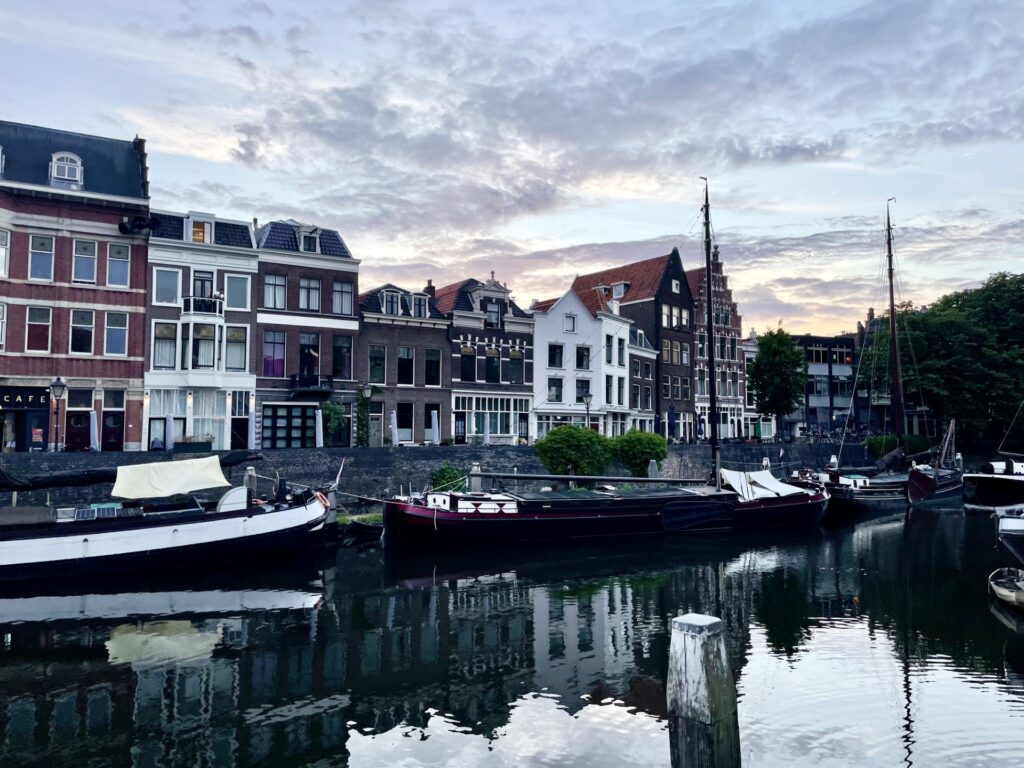
Having lived in the Metroplex for most of the last 40 years, my only departure was spent in Houston for two years of graduate school, followed by a few years abroad working in Rotterdam. At the time, OMA and MVRDV were building and publishing projects all over the world giving rise to Rotterdam’s reputation as a modern architectural playground.
Any aspirations of working for Rem Koolhaas of OMA were reset when I spoke with peers who had less than glowing opinions of the working conditions. The consensus was maximum hours with minimum pay. It seems that making money on world class architecture required at least some employees to subsidize the enterprise as indentured servants. That didn’t sound appealing or realistic as a newly married and extremely educated professional. So, I focused my search on other interesting firms with the goal of doing things beyond work such as traveling around taking pictures of buildings.
Based on my limited and less-than-scientific personal experience, the nearly universal response from Dutch locals who learned where I was from featured an enthusiastic variation on two themes: JR Ewing or JFK. While I was aware that Southfork Ranch still existed, at least for tourists, the giddy interest was not what I expected from the inhabitants of Western Europe. Apparently, reruns of Dallas found a prominent home on Dutch TV
I ultimately landed at De Zwarte Hond (The Black Dog), a local architecture and planning firm with around 50 Dutch and German cohorts who conveniently spoke English. The atmosphere was engaged and creative despite not understanding about half of what was being discussed. Most of our planning work was published in graphic boekje (booklet) format which was a natural transition from my recent thesis work.
Our projects involved a variety of housing, office, and institutional uses integrated with public spaces. Parking was a programmatic element, but it was secondary to concepts and quality of space. Commercial uses were threaded into most residential planning without resistance, in part because parking wasn’t driving the mix of uses. In a culture where people walk or bike most places, they embraced shops and services integrated into their neighborhoods.
What was notably lacking was discussion about liability. There were building and planning regulations, but the experimental design culture was supported, at least in part, by freedom from financial ruin derived from a simple mistake. This approach to liability is consistent across Europe but only works in places where healthcare is universal, and the social safety net is robust.
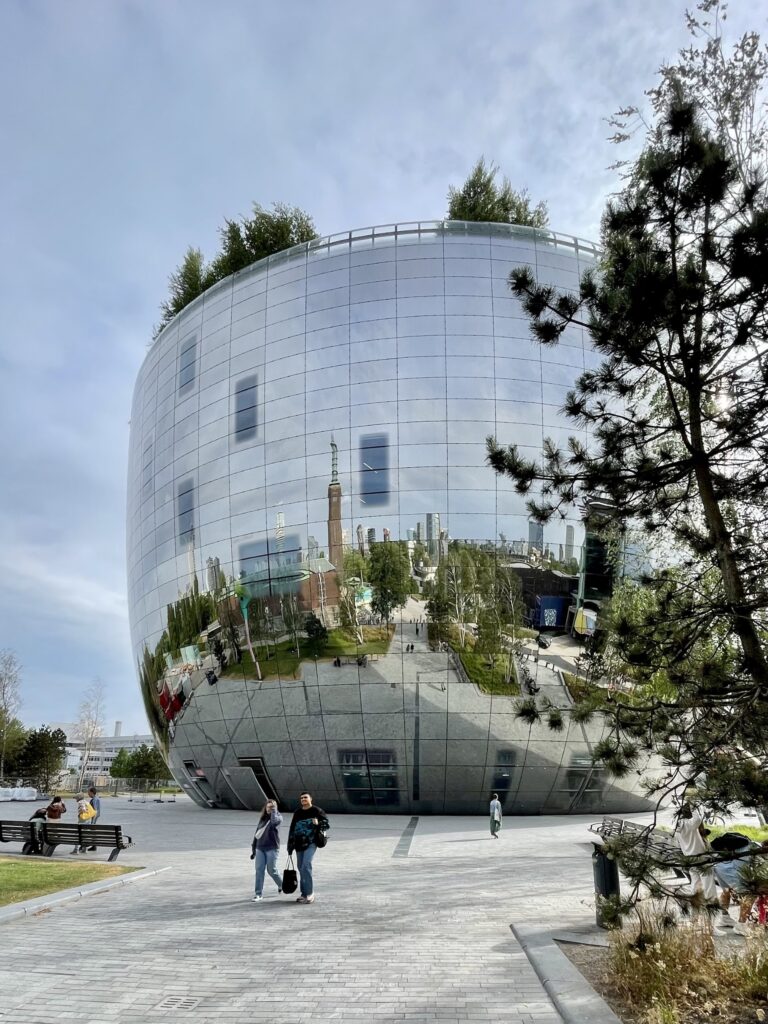
Over the course of 18 months, I only fielded a handful of questions about Dallas, mostly related to whether I liked it there or if I knew George Bush. I had a coworker I hardly knew appear at my desk one morning to explain that he was in a theater group and wondered if he could borrow my hat and boots for their upcoming production. I had never worn anything to the office even close to western wear, yet he seemed genuinely confused when I explained I did not own those things.
Having spent the first two decades of my life driving around Texas, realizing that a trip to Paris would be roughly equivalent to driving from Dallas to Houston was exhilarating. Even closer were Amsterdam, Antwerp, Brussels, and Cologne. Driving to Amsterdam was like visiting Fort Worth (without free parking or horses). The Dutch were not accustomed to this strain of travel, so there were many Monday morning office exchanges where it seemed they thought I was insane after casually explaining what I had done over the weekend.
As the second most populous city in the Netherlands (behind Amsterdam) and because of its strategic importance as a port, most of Rotterdam was destroyed during WWII. While a handful of buildings were salvaged, almost everything was scraped down to the street and canal infrastructure. Its redevelopment focused on the needs of the world to come, a resiliency which embraced the future through the lens of modern architecture. Their spirit of experimentation continues to permeate the built environment today.
Like Dallas, the Rotterdam skyline features a monumental cable-stay bridge spanning a river through the center of the city. However, the Dutch engineering marvel traverses a navigable body of water to accommodate river barges. Their statement bridge also elegantly connects neighborhoods for cars, trucks, bikes, pedestrians, and trams. The Dallas version, while visually appealing, simply gets vehicles across a floodway, abruptly transitioning a freeway to the city street grid at a stop light. The pedestrian accommodations initially proposed were value engineered from the structure and pushed over to a couple hundred feet away. Dallas is a place where things happen when the right people want them to, but when projects face inevitable challenges what survives? Unfortunately, the answer is, almost certainly, accommodations for cars.
In the 1960s, while Dallas severed urban neighborhoods with interstate highways, Rotterdam was rebuilding and reimagining entire swaths of the city. Neighborhoods were stitched together initially with street cars radiating from Rotterdam Centraal station, followed by a subway system that debuted about ten years after Dallas closed its last streetcar line through downtown.
As a post-war city, Rotterdam has roadways which are scaled for cars, but like its famous bridge, the right-of-way is shared between all modes of transportation. The city center features extensive commercial areas limited to pedestrians. There is strategically located parking, but the storefronts are mostly supported by people on bikes and integrated public transportation, all of which was constructed after 1950. The Lijnbaan (Line – bahn), opened in 1961, was Europe’s first street given over solely to pedestrians. The outdoor mall still exists as envisioned anchoring several blocks of city center retail.
Dallas’ retail legend of the same era is similarly successful but occupies different geography and form. The suburban shopping mall is a struggling typology in most other iterations across the country, but North Park Mall’s proximity to high income households and high-end boutiques has kept the mall full of both people and commerce.
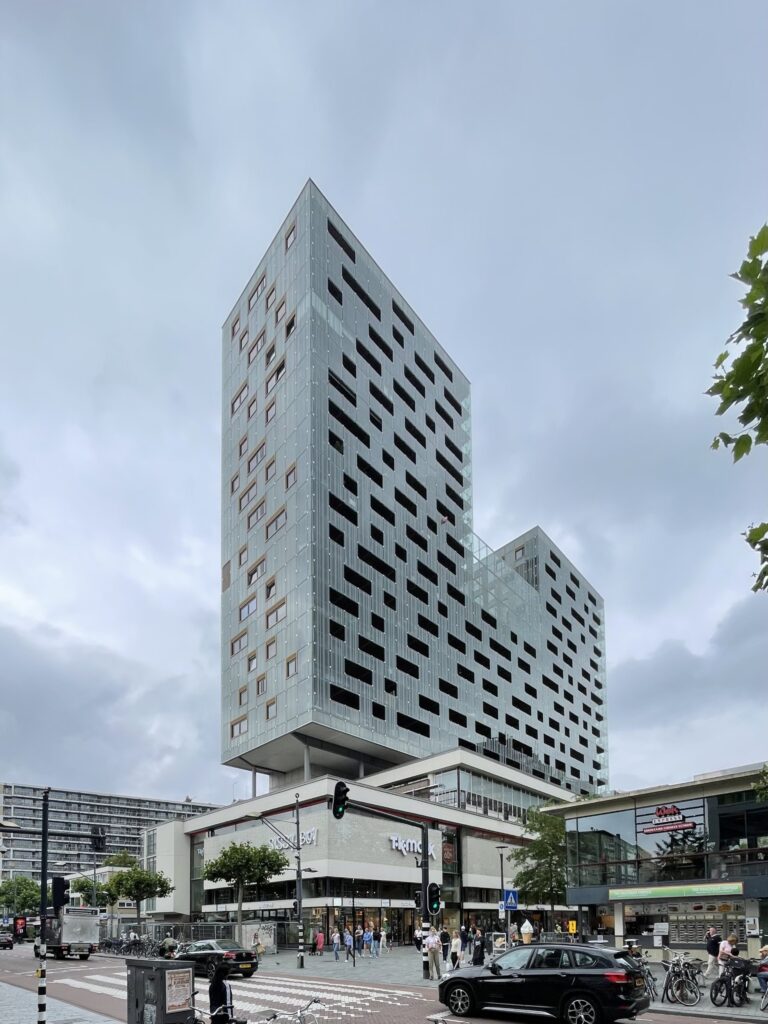
In Holland, the architectural embrace of modern design that I was attracted to more than 20 years ago endures. Rotterdam, specifically, has become an incubator for developing internationally recognized design firms. What started with Piet Blom (Cube Houses), OMA, and MVRDV now include West8, BIG, and UNstudio. Most people outside the profession have no idea what those letters represent, but it’s hard to overstate their impact on the design world both locally and globally. A city with a population about one third of Dallas cultivates and supports local architects and designers with civic projects, initiatives, and the freedom to push boundaries.
The city supports a robust planning department which identifies and champions projects from start to finish. Governments at multiple levels support planning which extends far beyond transportation and infrastructure to include housing and commercial developments in addition to more typical institutional buildings. Big, complicated projects are embraced as opportunities to improve the city for everyone.
When I first arrived in Rotterdam, my initial impressions of Dutch architecture had a tinge of disappointment with what seemed like a lack of detail and refinement. I have grown to appreciate their tendency for pushing ideas, materials and concepts over perfection. Their built environment has energy and spirit which can’t be replicated, because it cannot be faked.
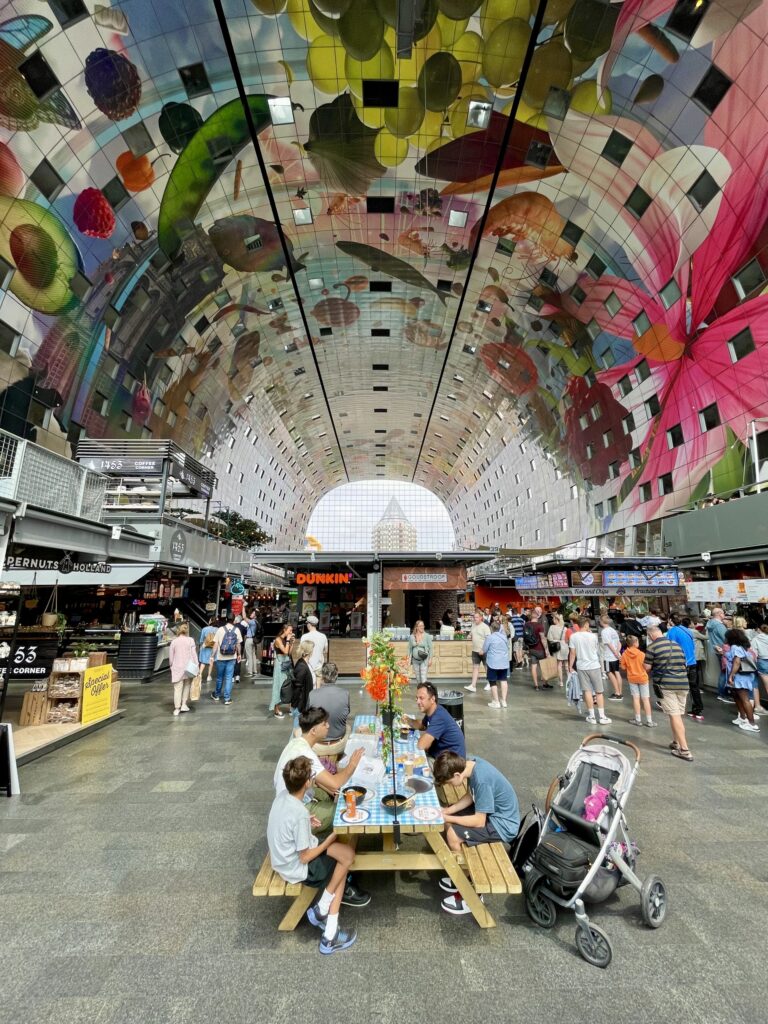
I took my kids recently, hoping to expose them to the places I fell in love with two decades ago, and the experience of visiting with adolescents provided a different lens. Rotterdam’s population has remained flat, but the city seems bigger. I’m certainly not smaller, so it’s not a change in perspective. The city invested aggressively in projects to improve the lives of the residents including transit and housing. There was also new energy in the older pieces of the puzzle like the public market and the Lijnbaan.
The nostalgic European return left me wondering about the soul of Dallas. Rugged individualism doesn’t promote a sense of place or engender the greater good. We have some impressive examples of patronage and civic design sprinkled around town but as with most of our nice things there is a preference for collection over connection and new over renewal. We need more people working on behalf of the city as opposed to a deal. This will require a new vision emerging from City Hall but that won’t happen without leadership and engagement from the design community.
The ubiquity of the terms DFW and Metroplex highlight the challenge Dallas faces to carve out an identity beyond cowboys, pickup trucks, guns, and “growth.” With the North Texas region basically touching the Red River, today’s vaunted growth is almost exclusively suburban in nature. The City of Dallas hasn’t grown its population significantly for two decades, but we have grown our highways and began naming our freeway interchanges.
To be fair, Dallas has made progress in the last 20 years as well, with investments in urban parks and some pedestrian oriented development in Uptown and Knox Henderson which bookend the Katy Trail. Ironically one of the biggest wins for the city during the last two decades was the demise of the Trinity “Parkway.” This was a city versus the region (and connected landowners) battle the city ultimately won, even if the leadership didn’t realize it at the time. But the war continues today with other transportation projects aimed at the heart of the city.
The success of Klyde Warren Park has been a blessing and a curse. It’s all roses for the immediate neighbors, but the lure of solving the gash of urban freeways with “deck parks” has become a recurring unfunded band-aid proposal for new projects which are always a little wider, taller and louder. Nobody seems to remember the 40 years Woodall Rogers existed uncapped.
Cities exist for sustaining and entertaining people. Accumulating over time, they are defined by collective decisions which reflect priorities and form a physical representation of those ideals. Does anyone visit another city because it’s a great place to drive (with or without free parking)?