Michael Malone, FAIA
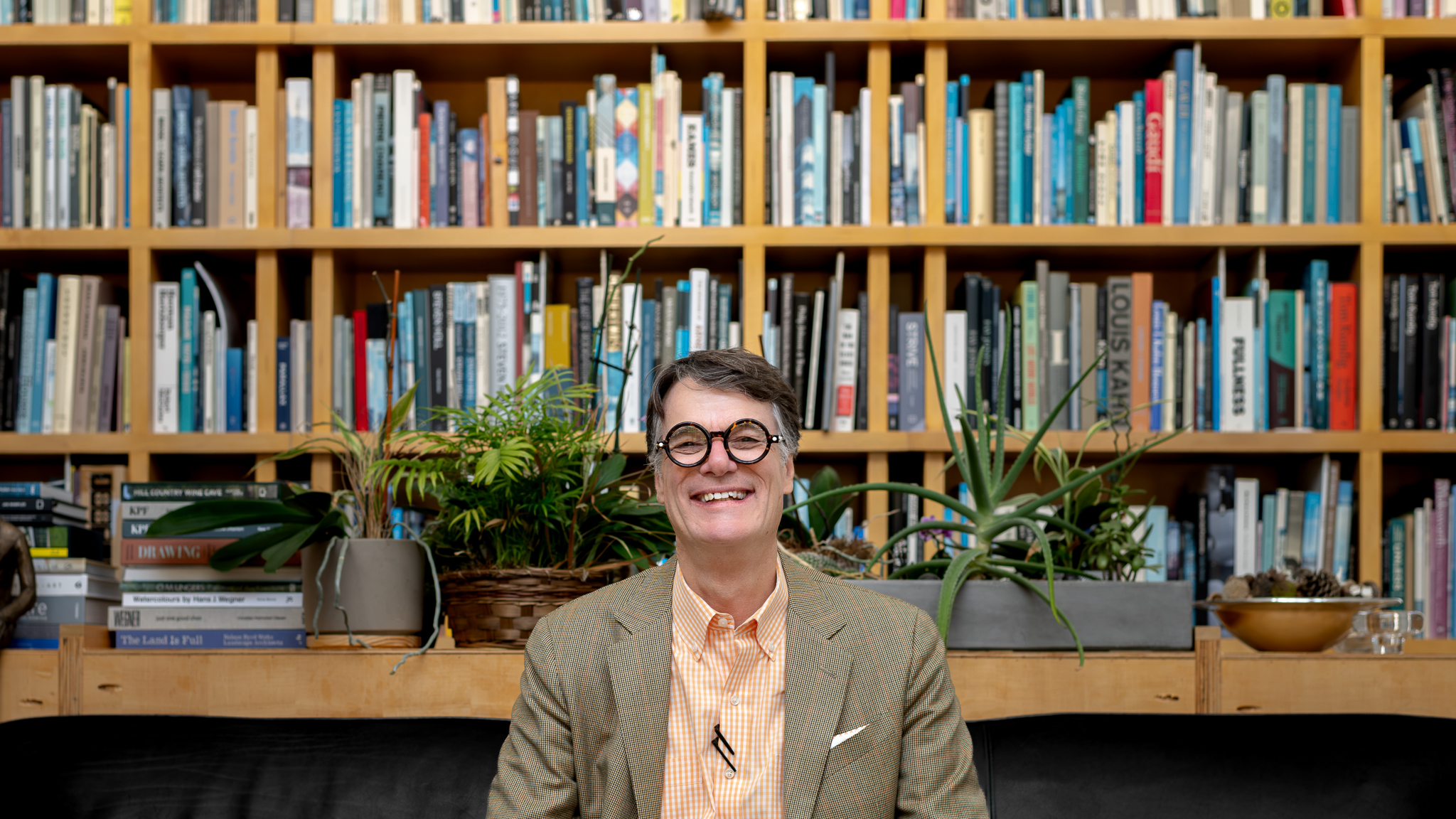 Michael Malone, FAIA in his home in Dallas, TX. Image by Conleigh Bauer
Michael Malone, FAIA has built a career that links careful, design-driven practice with visible leadership in Texas architecture. As founding principal of Michael Malone Architects, past president of the Texas Society of Architects and the Texas Architectural Foundation, and current president of AIA Dallas, he has focused his legacy on supporting the architects, students, and communities who carry forward the values of careful design, civic engagement, and professional service.
Zaida Basora, FAIA: You’ve built a career that spans practice, teaching, writing, and statewide service. When did you first realize architecture could be your life’s work? And what early experiences or places most shaped the way you see buildings and cities today?
Michael Malone, FAIA: A lot of people don’t know this, but my father worked for Disney, so I grew up around the people who created Disneyland and Disney World. My father was an engineer, but he was surrounded by creative people, so I spent a lot of time as a child and as a young man visiting Disneyland and Disney World. At some point, I started paying attention to scale, detail, materials, color, landscape, and the way buildings shaped the experience of moving through a place. Originally, I wanted to work for Disney, and someone there suggested architecture school as a way to begin a design career.
Those places became my introduction to architecture. In middle school, I took a drafting class and showed an affinity for mechanical drawing. One of my teachers suggested I consider architecture as a career and sent me to the school library to check out books on Frank Lloyd Wright. I took them home, and going through them changed my life. That experience reminds me of how important it is to mentor young people and how much influence we can have when we talk to them about their potential.
Basora: You’ve led your firm for decades. What have you learned about running a small or midsize practice—culture, client relationships, and the craft of building—that you wish more emerging firm leaders in Dallas understood before starting or growing a studio?
Malone: We are now Michael Malone Architects again. We are a team of five, as we have been for most of our history, and that size works well for us and the way we design and execute projects.
This firm was set up from the beginning to work around my vision for what architecture should do and how we should work. That’s terrific on one level because it allows us to focus on design and the quality of things—building models, making drawings, taking forever to do projects. But the negative side is that, from a business point of view, not everybody can work this way, and not everybody can sustain a firm this way. When younger architects ask me how to start a firm, I can talk about my own experience, but it’s not applicable to many people. I was fortunate from the beginning to have a very supportive wife, so I could make choices about not taking certain kinds of work or projects if they didn’t align with my personal goals. Eventually, we built a practice where we sell working with us as an experiential thing: you are going to be engaged in the process, and at the end of it you are going to have something distinctive and wonderful that you understand.
Basora: Your travel sketches have become a familiar presence in KRob and AD EX exhibitions. What draws you to sketching, and what does drawing on paper give you about space, time, and observation that digital tools cannot?
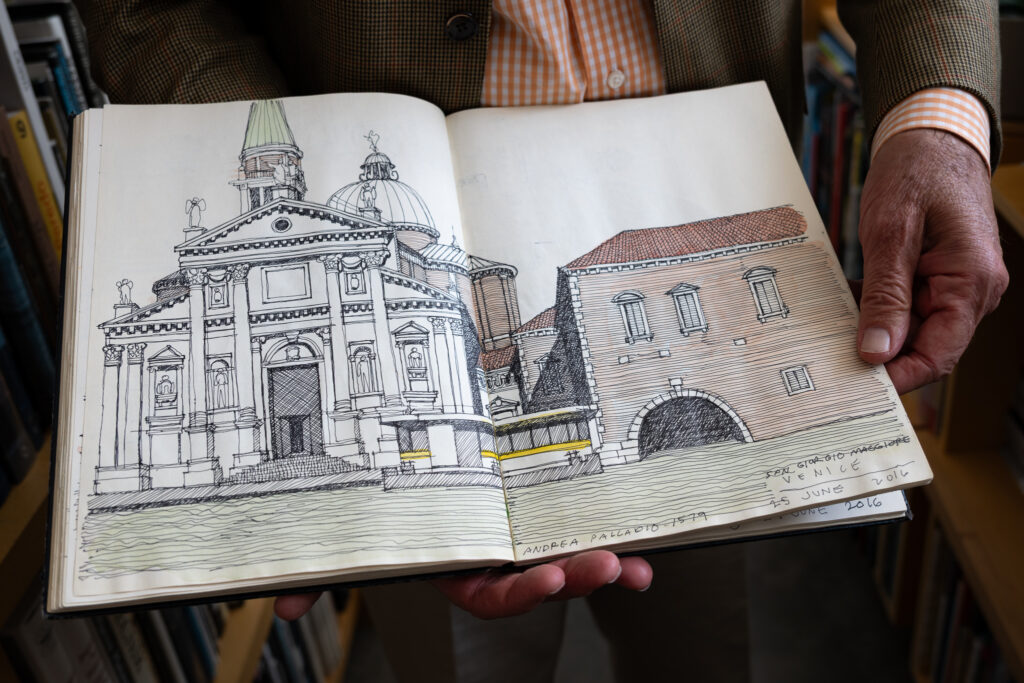
Malone: I went to Auburn University for my undergraduate degree, and at the time the Auburn program was heavily focused on drawing and representation. From the very first day of freshman year in architecture school, they told us to go out and get a sketchbook and start drawing in it every day. I have maintained a sketchbook from freshman year until today, so drawing is very natural for me. I design a lot of projects in sketchbooks, and when I travel, I make travel sketches.
Drawing by hand, I can imagine spaces in a way that I can’t when I see them on a computer. I can understand scale, detail, and atmosphere. Our projects are known for a high level of detail, very fine millwork, textures, and stonework, and a lot of that gets worked out in drawings. I draw to see. Auburn had a study-abroad program that involved traveling through Europe and documenting buildings in sketchbooks. When I came back, I had about 1,200 color slides that I never look at now, but the sketchbook from that trip is one of my most prized possessions. I look at it often. When I open it, it takes me right back to that time and place in a way a photograph never does.
If you draw something, it imprints on your brain forever. When I flip open a sketchbook to a sketch, I can remember the weather, what I was doing, and what that moment felt like.
Basora: When you look at your own work, from houses to corporate environments, where can you see the influence of your sketching practice most clearly? How does the way you stand, look, and draw in a place change the way you ultimately design for it?
Malone: The sketches are the way I understand scale. One of the things I find difficult about working on a computer is the constant zooming in and out. When you make a drawing, it’s fixed in scale. Everything stays in relationship to everything else, so you understand the connections among elements. One of the things I tell my students is that plotting is the great equalizer. When they plot something for the first time, we can finally look at it and understand the interrelationships and alignments. When something is floating around on a screen and twisting and turning, it is much harder to understand what somebody has actually done.
My drawings are the way I know what I want to do with materials and details to make the projects tactile and comfortable to inhabit. Drawing also affects how I present the work. When we interview for projects against my talented peers in Dallas, I show people sketchbooks, models, and drawings. They will ask, “Don’t you use the computer?” Of course we do, once we have figured it out, but this is how I work. If I can get them to the office and show them models and drawings, I can almost always get the job, because they realize how rare that process has become and how much value it adds.

Basora: You’ve practiced in Dallas through several waves of growth and reinvention. How would you describe the city’s architectural character today? And where do you think architects should focus their energy when it comes to preservation and civic infrastructure?
Malone: The architectural character of Dallas now is very interesting. I am fascinated by the way development in Dallas has evolved. If you look at the sheer amount and concentration of development, the transformation is astonishing. Uptown and other close-in neighborhoods have changed dramatically. The density of residential projects underway in those areas would have been hard for me to imagine when I first came here. There is a vibrant street life now. There are parks, amenities, and tremendous cultural opportunities. For all the complaints people make about Dallas and quality of life, it is actually a very good place to live. I only wish it were less car-centric, but that is one of the battles of this city.
As architects, we naturally have a predilection for caring about preservation, sustainability, and the public realm, and I think it is important that we keep those values in view. At the same time, we all work for clients, and clients set their agenda for projects. Their agenda may not include sustainability or preservation, but if you do a project with me, those concerns are going to be there whether we talk about them explicitly or not. We integrate them into the work.
I think all of us are overwhelmed that we’re even having a conversation about City Hall. What city with a civic building like Dallas City Hall would talk about doing what our city council and mayor are talking about right now? It’s heartbreaking that we’ve had to mobilize to try to convince the best angels in our city that we need to save this building. If there’s a hill for architects to die on, that feels like the right one.
Basora: As you talk with architects across Dallas and Texas—in your firm, in the classroom, and through AIA—what are you hearing most about practice right now? What pressures, hopes, and questions are emerging around technology, work, and public engagement? What do you think we most need to pay attention to as a profession in the next few years?
Malone: We have come off about 16 years of continuous growth. Since 2010, it has been an amazing time to be an architect in Dallas. Before that, the first 30 years of my practice life were marked by business cycles: boom, bust, people getting laid off around me. We haven’t had that for a long time. I think we now have two, maybe three, generations of people who entered the profession after 2010 and have no memory of 2008, or 2000, or 1986. I am always looking over my shoulder at what might come next, and that is what worries me most. A few years ago, whenever architects got together, the conversation was all about how to find people and how to keep up with the amount of work. Now the questions are different: Are you busy? What do you see happening down the road? The business environment feels scary right now. One lesson I have learned is that as long as you have work and are busy working as an architect, all the other fears are simply problems to be addressed.
AI concerns me, but it is still abstract in terms of my own practice and the way I work. I know the young people I teach at UT-Arlington will have to deal with it in real time. I may have missed out on that particular revolution.
Public engagement, on the other hand, is absolutely critical. If you do not deliberately set yourself up to work in the community or on things that matter to you in the place where you live, you are probably not going to do it. I tell younger architects to volunteer in any capacity they can. I have served on my city’s zoning advisory board. I was on the school district’s design and construction committee. I am active in my church and teach an adult Sunday school class. Those are the things I love most—being able to use my skills as an architect to work for and on behalf of others. It is enormously rewarding, and there is a direct correlation between our engagement in the profession and the way the public and the community see the profession.
Basora: You’ve served as president of the Texas Society of Architects and the Texas Architectural Foundation, and you now lead AIA Dallas. What has that long arc of service taught you about what architects can do beyond their own projects? And how has it changed the way you think about your role in the profession?
Malone: Perhaps the places where I have spent the most time and felt the greatest reward for my engagement are AIA Dallas and the Texas Society of Architects. Doing things you love with people you love for people you love has been one of the best parts of my life outside my family. Building community with other architects allows you to have friends who care about the same things you do, know the same vocabulary, have similar educations, and share many of the same values. The relationships I have had with my peers all over the state have sustained and enriched me in ways I cannot fully describe.
When you volunteer with AIA Dallas or the Texas Society of Architects, most of the time you get more out of it than you put into it. It has taught me that architects have a great deal to offer beyond their own projects.
Basora: You teach at UT-Arlington, and you write regularly about architecture. How do those roles—teacher and writer—inform your work in the studio? And when you look ahead, what impact do you hope to have on your firm, your students, and the communities you’ve helped shape, and what legacy do you hope to leave?
Malone: I’m about to start my eighth year of teaching at UT-Arlington. I love the school, the students, the colleagues I teach with, and the chance to focus on the ideas that first drew me to architecture. In daily practice, there often isn’t much room for conversations about history and precedent, but in school we do that every day. The work in the studio informs my work in the office, energizes me, and helps me set my priorities.
In practice, we can get so caught up in getting work, meeting business obligations, doing payroll, paying taxes, and all the rest that the work itself becomes secondary. Teaching has reminded me that the work is what we are doing all of this for. The building is the thing; everything else is peripheral. Nobody visits a building or lives in a house you designed and wonders about the issues you had with payroll or codes. School has reminded me that the work is the priority, and that has been deeply gratifying.
The other thing teaching has done is remind me how capable the next generation is. I am surrounded by people who are smart, bright, eager, enthusiastic, and talented. People say they worry about the future. I don’t worry about the future. I have seen the future, and the young people around me are smarter and more capable than I am. The world is going to be just fine.
Writing has also been a meaningful release for me. I love to write about our profession, particularly about work done by other architects I admire. Seeing their buildings, visiting with them as guides, hearing them discuss and explain their work, and then being able to share my own observations and insights is a tremendous gift.
As for legacy, I don’t think my firm will have much of one as an entity, because the kind of work we do has not really created something that can be easily transferred to other people. The legacy of the firm will be a handful of projects that may endure and that people may recognize as ours. What I am proudest of, though, is the people who have worked here and gone on to do great things. There is a long list of people who began in this firm and went on to do much more than I did. I hope I have planted a seed and gotten students and younger architects excited about what is possible. Legacy is what other people pick up from you. It is not just what you did yourself. If someone looks at my example and thinks, “If he could have that kind of firm, do that kind of work, and still find time to be active in AIA Dallas, then I can do it too,” that is the example I would want to leave behind.
This interview has been edited for brevity and clarity.