Backrooms
Clark is not, as they say, in a good headspace. His wife has left him because she can no longer cope with his alcoholism, and he’s operating a used furniture store, Cap’n Clark’s Ottoman Empire, while trying to get his career back on track. His wife took the house, so he’s also taken up residence at the store. Rock-bottom deals may abound, but customers do not. An attempt to record a promotional TV ad for the store—complete with breeches and a tricorn hat, pirate puns, and excessively rolled R’s—ends in failure when a chair collapses beneath him.
Clark, played by Chiwetel Ejiofor, is the main character in the psychological horror film “Backrooms“, this summer’s box office hit. The film explores the overlapping concepts of liminal emotional states and liminal spaces. Specifically, it explores Clark’s attempt to navigate the transition back to a normal life after the divorce, and the seemingly endless maze of spaces he discovers in the furniture store’s basement.
Clark may be in a desperate state, but it’s not for lack of trying to improve his situation. He’s determined to rebuild his life with the help of his therapist, Mary. He listens to her self-help tapes and attends regular sessions in her office. In a particularly poignant scene early in the film, Mary asks Clark to reenact moments from his past to help him move on and forge a new path, bringing his fragile emotional state into sharp focus. With Mary role-playing as Clark’s wife, they reenact the night his wife left him. What starts as a retelling quickly shifts into Clark reliving this traumatic scene, and he becomes enraged. The moment his dreams and marriage crumbled around him is a memory he’d rather bury. His wife accuses him of failing to support her dream of becoming a lawyer because he didn’t get to be an architect. “I am a fucking architect!” he screams. “I’m just stuck selling shit furniture because someone won’t get off their fat fucking ass and help me.” Pardon his French, but the outburst makes his motivation clear: being an architect is central to his identity. The walls of his office at the furniture store are covered with sketches on bumwad, haphazardly pinned in place. Unfortunately, if his taste in furniture is any indication of his skills as an architect, Clark’s issues may be deeper than we thought.
Released in May 2026, “Backrooms” quickly became A24‘s highest-grossing independent film of all time. A breakout hit on a tight budget in this genre is nothing new, with one coming along about once a decade. The success of films such as “The Blair Witch Project” (1999), “Paranormal Activity” (2007), and “Get Out” (2017) can be attributed to subject matter familiar to a wide audience. “Backrooms” is no different when it comes to exploring the limits of uneasiness, tension, or downright horror a familiar setting can evoke. It doesn’t take years of architectural education or practice to have a visceral reaction when walking through an empty hotel corridor or a deserted airport concourse. These liminal spaces—“liminal” derives from the Latin, limen, meaning “threshold”—are meant to be transitional. Often full of people passing through, they can feel eerie or downright haunting when empty. What sets “Backrooms” apart from these other films is that its creator and director, Kane Parsons, is only 20 years old. Parsons began exploring the horrifying potential of liminal spaces using the 3D animation tool Blender to create a series of short clips. He posted the clips to his YouTube channel, and they quickly went viral. Within a year, several studios approached him about developing the “Backrooms” concept into a feature film.
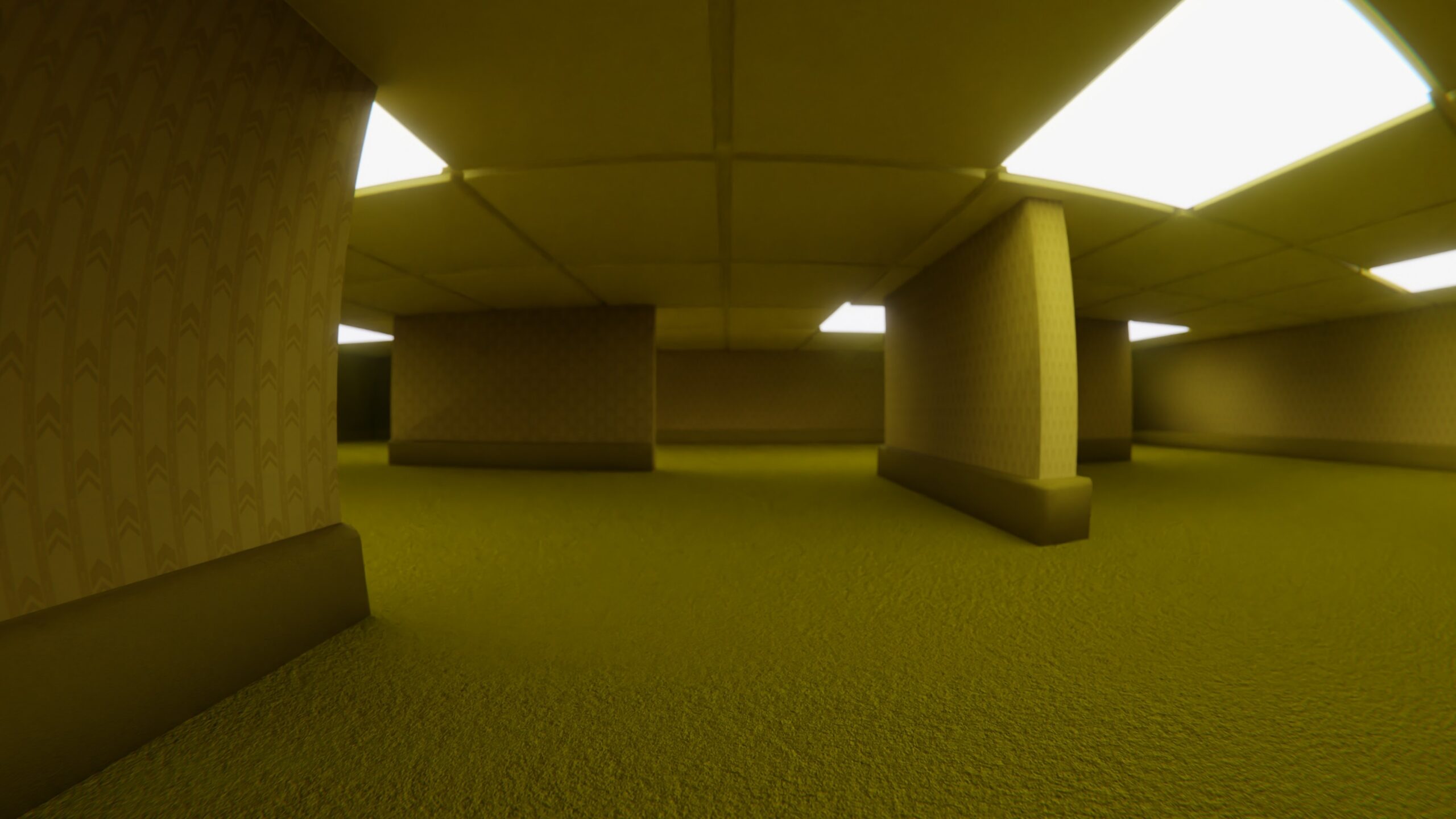
Clark discovers the Backrooms late one evening after the store’s lights flicker and his television erratically changes channels. He checks the electrical breaker box in the store’s basement, sees a narrow line of light emanating from a blank wall, and falls through the wall into another dimension of yellow-hued, mostly empty rooms. The first few spaces are not too different from an empty version of the furniture store, but they are even more nauseating in their banality. It’s a Cartesian dreamscape of jaundiced wallpaper in various painfully bland patterns, despair-inducing wall-to-wall ceiling tiles, and carpet the color of unsalted butter. Clark doesn’t venture far before the seemingly anodyne spaces become more distorted and his unease turns to dread about what may lie around the next corner. What begins as a generic abandoned 1990s office (with questionable architectural moves easily explained as the result of a hasty design process) becomes a disorienting clash of dull spaces with elements of the outside world—advertising banners emerging from the ceiling, shoes embedded in the floor. Soon, walls jut randomly into rooms, floors slope at odd angles, and lighting fails to illuminate acute corners. The film deftly adds to the tension and suspense with a soundscape of harmonically dissonant buzzing from fluorescent lights and the wavering drone of air-conditioning fans, punctuated by eerie electronic tones and pings. The farther Clark descends into the rabbit hole, the darker, grittier, and more derelict the spaces become. But for every room piled with discarded clothes, there is one resembling a half-remembered fever dream of Christmas morning in your grandmother’s basement. The novelty seems to excite Clark and overpower any hesitation about what this place represents. If he can’t create as an architect, maybe he can find fulfillment in discovery. But it soon becomes clear that he is not alone in the Backrooms. And whatever is lurking around the corner is not there to help him navigate this new world he’s discovered.
For a debut feature by a filmmaker not even old enough to drink, “Backrooms” is a skillful study of how space alone can fill us with dread. As unsettling as it is immersive, the world of the Backrooms is all the more impactful because of how familiar it is. Some have noted eerie similarities between the Dallas Pedestrian Network and the spaces depicted in the film (The Dallas Morning News). “The Shining” stands as the foundational example of cinematic liminal spaces, but the grand scale, intricate details, and finite setting of the resort amplify the feeling of isolation, not a sense of deeply familiar unease. And like the seemingly infinite online forums that elevated it to mainstream fame, “Backrooms” illustrates how easily the familiar can become a twisted version of itself and breed paranoia.
Returning to our poor protagonist, I’m left wondering why the film makes such a point of calling out Clark as a failed architect. Is the Backrooms (mild spoiler alert) something he has created to cope with the liminal psychological state he finds himself in? Early in the film, Clark listens to one of Mary’s self-help tapes, her calming voice guiding him as he doodles architectural forms on a legal pad at the furniture store: “Your consciousness is a room full of memories that is constantly evolving. But as you walk through life, the untrained mind can start to build walls, put up barriers to protect itself from the outside world.” If the Backrooms is a manifestation of an architect’s mind—someone who understands space and the physiological and psychological impact it can have—does this diminish a “room full of memories” created by a lay person? Is it not scarier to imagine the liminal spaces that could be dreamed up by your average therapist, lawyer, or used furniture salesman? Is it not more horrifying to imagine that anyone’s subconscious could take physical shape as a shape of misremembered spaces, open to anyone curious enough to stumble in?
“Backrooms” is available for rent on several streaming platforms or in a high-vacancy office district near you.