A Walk in the Park
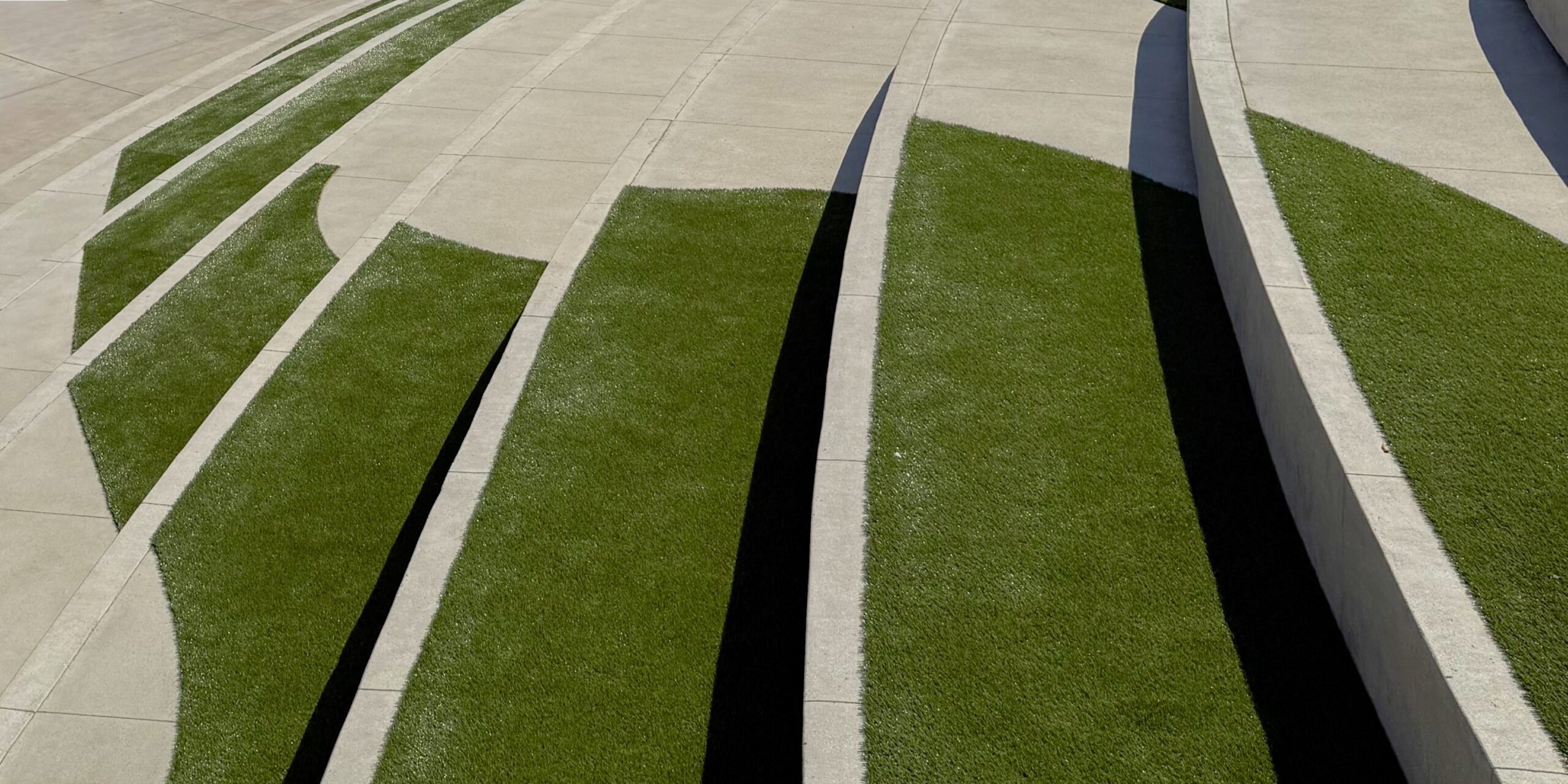 Halperin Park in Dallas, TX, Image by Ryan Yankel
Dallas loves new things. The fact that Dallas still loves Klyde Warren Park, already more than half as old as the soon-to-be abandoned American Airlines Center, is nothing short of astonishing. Yet, after looking at the vibrant urban space (especially considering the dearth of similar public spaces in our metroplex), one quickly understands why. Take a person dying of thirst in the Sahara and give them a 5-gallon bucket of chilled water. I bet they’ll take a drink. Maybe more. Take some Dallas residents accustomed to living life in weather-sealed conditioned spaces with no connection to or conception of public common space and give them a Klyde Warren Park, you get a park full of people at all times of the day and all times of year.
Those of us who were around before and during the opening of Klyde Warren Park remember the doubt that existed regarding the park’s ability to succeed. Why would people go to a park on top of a freeway, between two access roads? The perennial question: “But where is the parking?” The park’s success continues to demonstrate that those concerns were unwarranted, with the park’s context largely to thank for this.
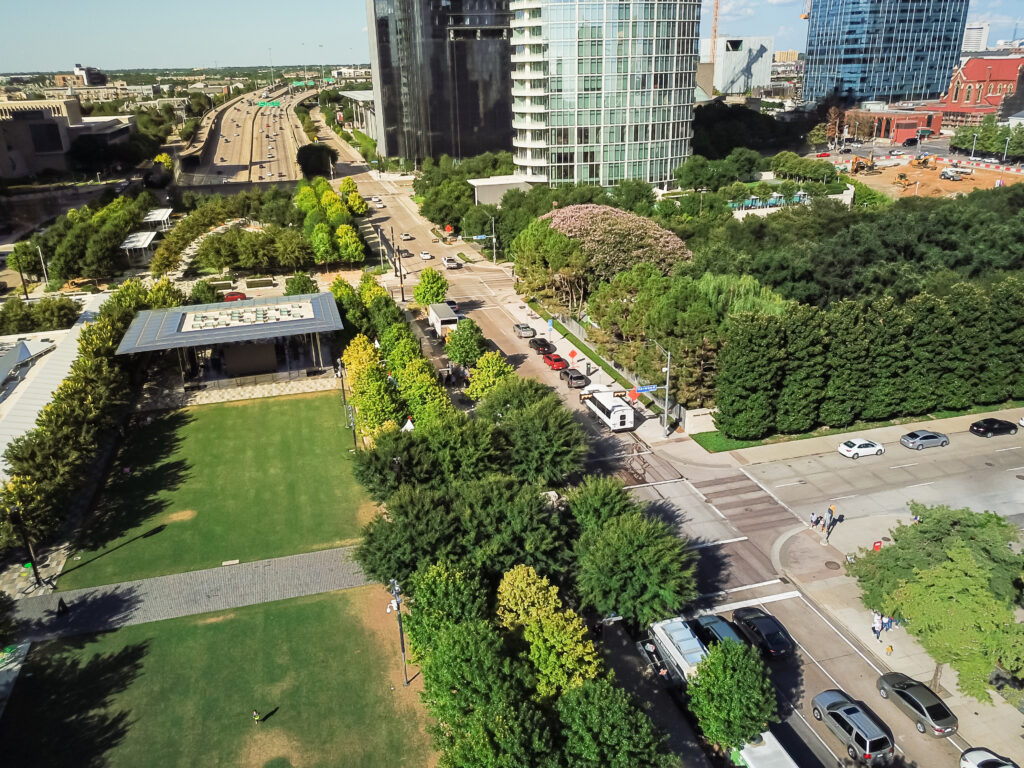
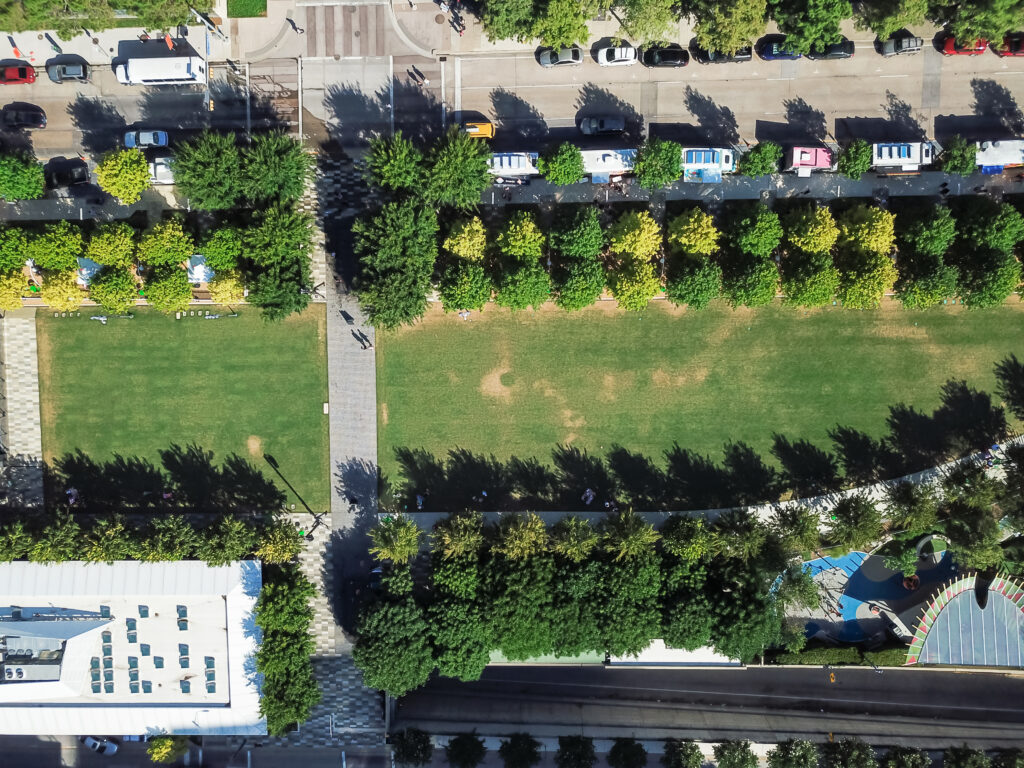
Klyde Warren Park connects Downtown and Uptown. The park is of sufficient length, is open and at-grade on all sides, and creates the illusion that for these three city blocks, there is no highway. Pedestrians can comfortably stroll from the museums across to the restaurants on the Uptown side, with the access roads behaving more like downtown streets than on- and off-ramps for the highway.
The park is a great space for people. It has an organic synergy with the cultural institutions in the Dallas Arts District. It provides a place for people who live and work downtown to simply be, without the requirement to spend money. It functions as a place of connection: being part of the city and enjoying the company of others.
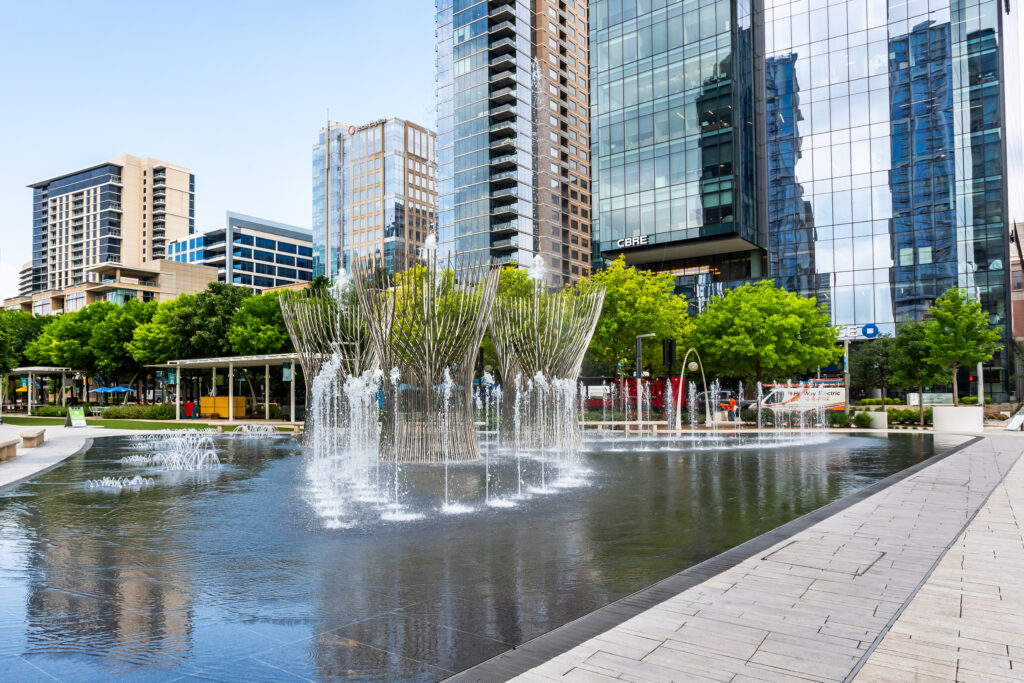
The park offers an experience rare for Dallas: the ability to sit in the shade of the restaurant pavilion, sip a margarita, and simply take in the action of the park—the people sharing a picnic lunch, the teenagers kicking a soccer ball, the children running through the fountains at the splash pad, the people eating under all of the trees near the food trucks, the people walking or running through the park. The park’s magical space can keep you there all day (there are even free public restrooms!)
But its main impact, if you talk to some, is economic. The park, according to the Woodall Rodgers Park Foundation, has generated more than $1 billion in development in its immediate vicinity. Now there’s a return on the $112 million investment! This development is still happening—the new Bank of America Tower at Parkside will be completed in 2027. By all measures, the park has been a success and now represents a model for similar contexts nationally.
In addition to supplying the best urban space in the region, Klyde Warren Park also seems to provide a general civic awareness of the unpleasantness of urban highways. In a state where the car is king, highways seem to bend all other aspects of life to their will. Yet, there emerged a nascent consciousness of the racially driven and intentional harm, destruction, and separation that our urban freeways had wrought on the places and people in their paths—and continue to wreak upon those living in their shadow. These issues are complex, emotional, generational, and ongoing.
This is still Texas, though, and the car is still king. We need our highways, but now proposals for highway expansions often include a deck park or two for good measure. No fewer than six parks have been proposed since the opening of Klyde Warren Park, in places with great contextual variation. The first of these will sit between aging apartments and a zoo in a part of town not known for its walkability, and also near the most intact remaining freedman’s town in the country. This park will take some of the ingredients used at Klyde Warren and see how they settle in this new location.
A New Deck Park Rolls Into Town
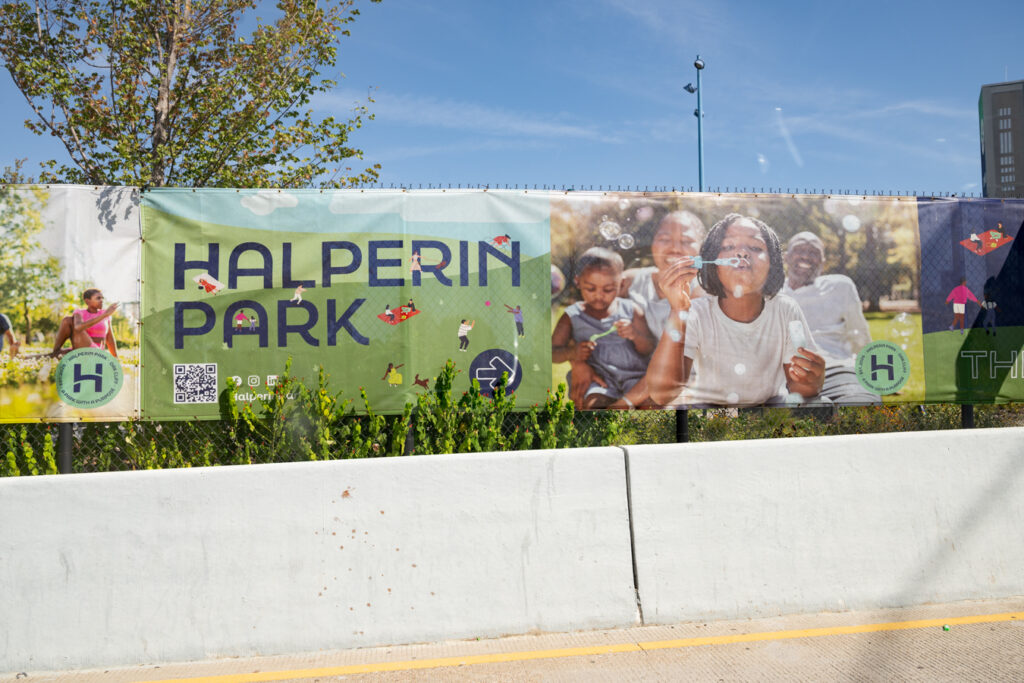
Enter Halperin Park. Originally named the Southern Gateway Park before the $23 million naming donation by Jim and Gayle Halperin and designed by Dallas-based HKS and SWA, Halperin Park’s messaging has consistently promoted this project as “reconnecting a community divided by highway construction.”
Let there be no mistake, the neighborhood was truly divided by the highway. The 10th Street Historic District, the aforementioned freedman’s town, was partially leveled and then cut off from the rest of Oak Cliff. The park aspires to undo this injustice. HKS put it in no uncertain terms in its article titled “Halperin Park Will Bridge Generations of Divide and Inequity.”
Dallas’ mayor Eric Johnson is quoted in that article, “For my entire life, Oak Cliff has been divided by this highway…but that’s not the way it was, or the way that it has to be. We have the opportunity now to heal this divide by literally bridging that highway, a connector of cities, with a park that is a connector of neighborhoods.”
Now, Klyde Warren Park was never billed as anything more than physically connecting Uptown—which had long ago replaced Little Mexico and the freedman’s town of State Thomas—and Downtown—which has always been the city’s commercial core. And connect them it did, by virtue of its planning, length, and visual porosity on all sides. Still, Halperin Park is aiming to be something more.
Halperin Park’s origins start within the community where it resides. Ten years ago, a long-time North Oak Cliff resident, Katherine Homan, first spoke up at a public meeting for the expansion of I-35E, saying that she wanted to see something like Klyde Warren Park in Oak Cliff. It didn’t take long for Paul Carden, who grew up in East Oak Cliff, to speak up in support. From there, the two have been intimately involved in the Park’s development. Carden currently serves on the Southern Gateway Public Green Foundation Board of Directors.
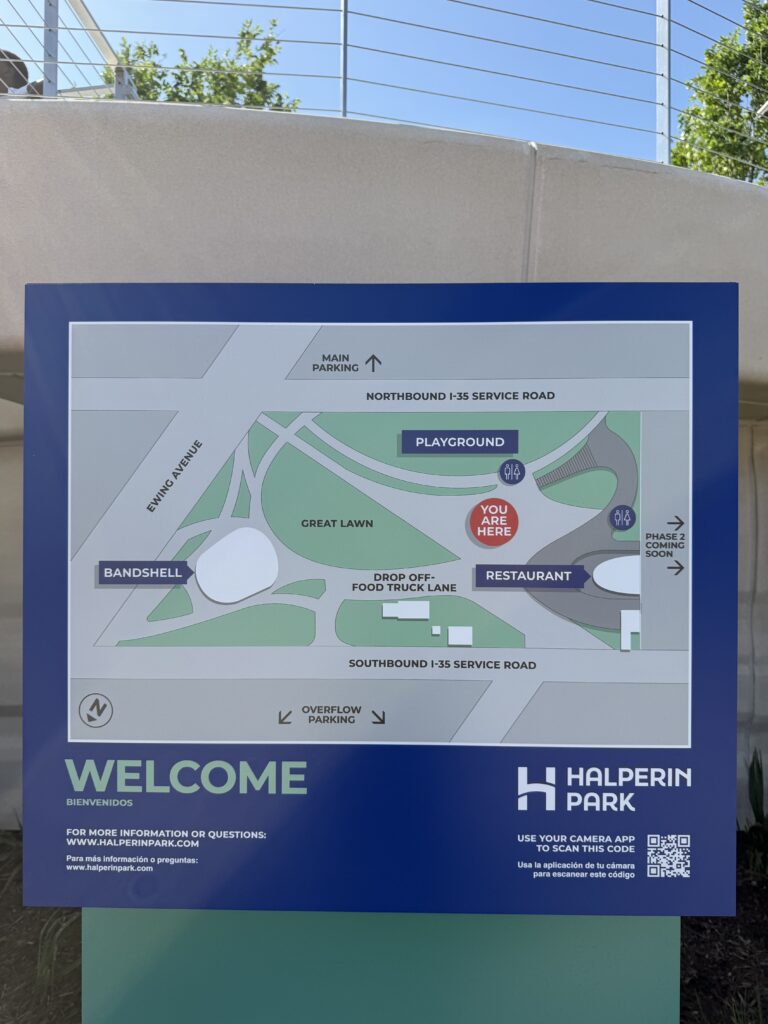
In a May 8, 2026, Dallas Morning News article, Executive Director April Allen says, “For too long, it’s been an open secret that Oak Cliff didn’t get to have nice things.” No one can deny that Halperin Park is, indeed, quite a nice thing. There is a lawn, a shade pavilion, multiple water features, and splash pads full of soaked and squealing children. There is also a meandering path that leads to an elevated terrace, amphitheater-type steps, a conditioned indoor area, and an expansive natural play area. While any architect may have their own judgments on the final geometry of the park, it is a jewel of amenities in a neighborhood that isn’t accustomed to this kind of showpiece civic investment.
And people have been going. There are now eyes on the adjacent land and anticipation—some eager, some apprehensive—about what may happen. Change inevitably follows signature projects like this. The question is now, what will that change be? How will the development community leverage this new amenity? How might the Dallas Zoo benefit from and respond to the park? How has the local community responded? What can we expect over the next five to ten years?
Henley Capital
Hudson Henley has been a busy man. As a local entrepreneur based in Preston Hollow with an office in Uptown, he has been around Dallas a long time. He initially purchased a few apartment complexes near Halperin Park, even before the park had been announced, simply based on his intuition of redevelopment opportunities in the area. Once the park was announced, however, he ramped up his acquisition efforts. Now, Henley owns most of the land from the north side of the park to Jefferson Boulevard and some significant assemblages on the south side of I-35E as well. He has positioned himself to be in complete control of a new park-oriented district that will rise from the former car dealerships, vacant lots, parking lots, and aging apartments that currently form the park’s urban context.
Signs proclaiming a “Future Parkside District” adorn vacant lots and the City Inn and Suites hotel. There is a preliminary master plan, but Henley prefers to allow development to evolve one piece at a time. The first project will be a 300-unit, 11,000-square-foot retail project on Jefferson Boulevard. He wants to bring in a stand-alone restaurant concept in the near term as well, and he is prioritizing providing additional parking for the park. Henley says to expect to see more options spring up within the next two years.
Henley says, “From a civic standpoint, [the park] will be a gathering place, make life happier, and give people an outdoor space to recreate. It’s an enormous economic catalyst. It will create demand for the space around it just like the Katy Trail, Klyde Warren Park, and the Calatrava bridge. Things like this draw people in. Then you get restaurants, bars, and people wanting to live next door and relax outside. People want to be outdoors.”
Time will show how it develops and how whatever is built responds to its unique context in this unique neighborhood.
EastDock
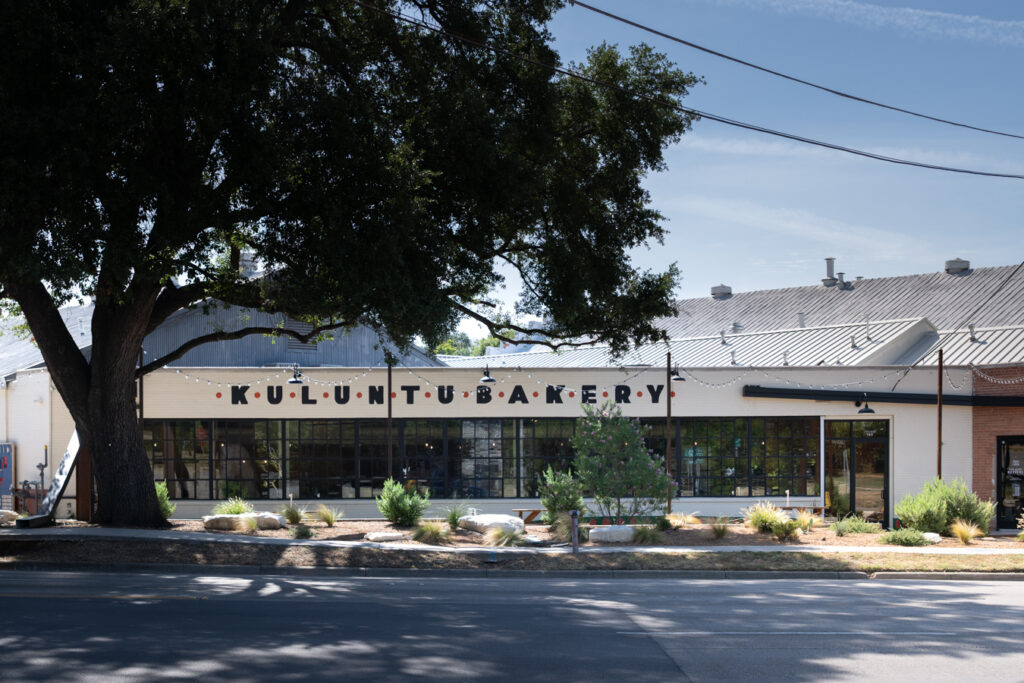
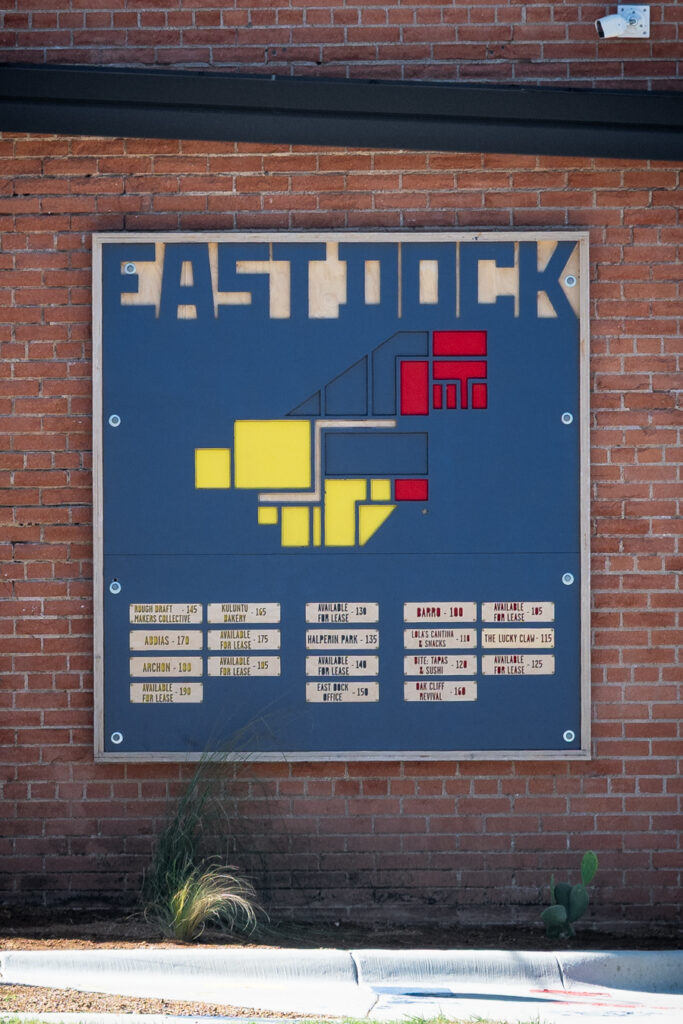
Just a few blocks away, down South Ewing Avenue and East Clarendon Drive, sits EastDock, a redevelopment of a former icehouse, book manufacturing site, and airplane parts factory by Proxy Properties. Like Henley, Proxy did not make the initial decision to invest in the building based on the location of the park. Proxy and principal AJ Ramler use a “building-first” approach when deciding on future projects. The building was right, and it was a “nice coincidence” that the park happened to be nearby.
As tenants (including the Halperin Park Foundation, a clothing store, a vintage shop, multiple restaurants, and more) have recently moved in and opened their doors to the public, the timing with the recent opening of Halperin Park couldn’t have been planned more perfectly. It seems as though EastDock, along with Halperin Park, are driving the area’s next evolution.
Haley Leavitt, Proxy’s manager of business and community development, says, “It’s not us as a development firm that decides what happens; it’s the community. We’ve worked with [the] 10th Street [neighborhood]; we want the community to be able to come here. We want it to be community focused.”
As more spaces continue to activate at EastDock, its proximity to the park surely won’t hurt. People just might saunter down Ewing and end up at one of the new restaurants or shop at one of the locally owned stores.
The Dallas Zoo
From his perch at the Dallas Zoo, Dustin Crawford, associate vice president of capital projects and facilities maintenance at the Dallas Zoo, has observed a marked change in the neighborhood since the park’s opening.
“The general vibe and sense of community in this area has completely changed,” he says. “There are now families walking along Ewing, which you never saw before.”
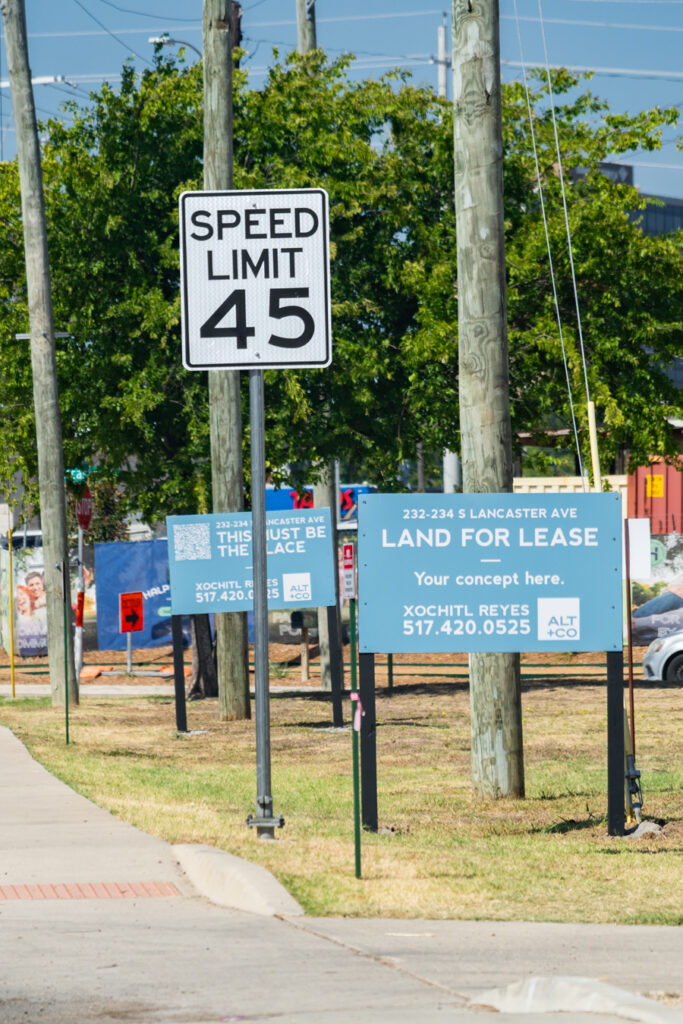
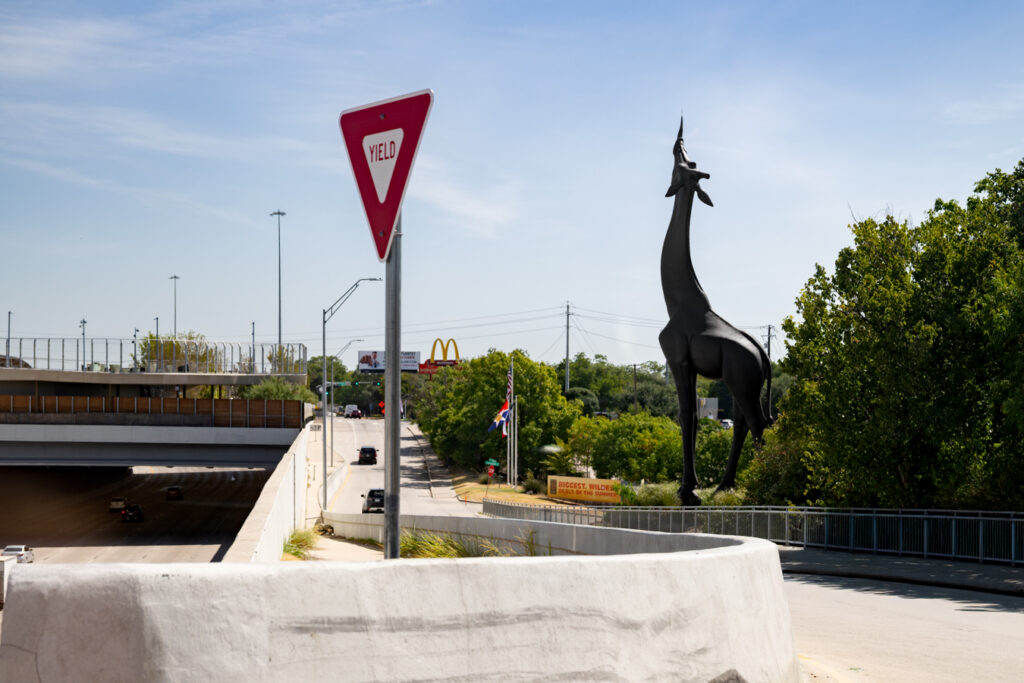
While the Dallas Zoo is Halperin Park’s immediate neighbor, it would be a stretch to call the two meaningfully “connected” at the moment. The northernmost part of the Zoo is a large parking lot, beyond which one encounters the northbound access road of I-35E, a three-lane road with a marked speed limit of 45 miles per hour. I’ll let you guess as to how fast cars actually drive. On the other side of this road, a roughly 15-foot concrete wall forms the park’s interface with its neighbor to the south.
The Zoo’s 2019 master plan shows that the north parking area will be redeveloped into a garage on the western portion and a park or greenspace activated with retail and food offerings on the east near South Ewing. The plan envisions a bridge that would reach across the I-35E access road and connect to the elevated terrace in the park. However, Crawford indicates that this is not an immediate priority of the zoo and any redevelopment of that area would be “a ways out.”
Images by Conleigh Bauer
One change that is coming soon is the widening of South Ewing Avenue. In the next two to three years, the street will expand from two lanes to four and include a 12-foot-wide bidirectional bike lane and 10-foot-wide pedestrian path. One may question the need for a four-lane thoroughfare in the middle of this nascent district—increasing the distance pedestrians must contend with vehicular traffic. Nonetheless, the project will expand and buffer the pedestrian pathway leading from the zoo’s new garage to Halperin Park. This garage—in addition to relieving the Zoo’s existing surface lot—will provide parking for Halperin Park visitors. The journey today is on a narrow sidewalk with no buffer from the street, making the 8-minute, 0.3-mile journey on foot a noisy and unpleasant one. We hope that the area will develop in such a way that this journey doesn’t feel too onerous in the future.
If it chooses to do so, the zoo can be in the driver’s seat for this development.
What Does It All Mean?
It means we’re trying. Inertia in Dallas is everything. The inertia of the way things have always been done (or at least in the living memory of the majority of Dallas residents) seems to determine future possibilities. Our large highways seem to be constantly growing; this is what everyone knows and what everyone expects. So, we are pushing back against that inertia, the dominance of the singular prioritization of maximum vehicular movement at the expense of all else. While physically these deck parks may be minuscule when compared to the surface areas of all urban highways in DFW, they have an outsized social and human impact.
It means that the voices of the local community, as amplified and guided by Homan and Carden, made a real impact and brought Halperin Park into existence out of thin air. It means that we as residents and stakeholders of our city have the power to shape it—not just by opposing the next apartment complex, but by fighting for assets that all can use, which will make the community stronger.
It means we would be right to push back against any public official who tells us our dreams are too big or too expensive or unrealistic. This is Dallas, after all, and our official motto is “Big Things Happen Here.” If we can’t figure out how to do some big things, we’d better tell Visit Dallas to figure out a new slogan.
As we as a city and region move the needle in the direction of people and public space, it behooves us to take stock of what has worked and what has not. Halperin Park’s messaging has consistently been about reconnecting a neighborhood separated by a highway. Has it done this? There is a difference between reconnecting—which implies increasing access points and reducing physical barriers—and creating a new draw that pulls people from both sides of the divide to a new common destination. Halperin Park has likely accomplished the latter, but the physical context and ways it has been addressed leave the former wanting. The number of connection points across the highway has not changed, and then there’s that insurmountable fence-topped concrete wall on the Park’s southern edge.
Are we asking our deck parks to do too much?
Is it fair to deck parks to ask them to right all the wrongs of urban highways?
As Collin Yarbrough, author of Paved a Way and past Columns contributor, says, “There’s a difference between connecting geographies and repairing context.” He hopes that Halperin Park and future deck parks can serve as a launching point to bring the deeper, more systemic issues of injustice to the surface. Ideally, for this and future projects, we can address these issues alongside the creation of a physical park. Maybe Dallas will eventually understand that it’s not simply a problem that can be solved by the next $200 million trophy project, but something that will be tough, messy, complicated, and ongoing. But worth it.