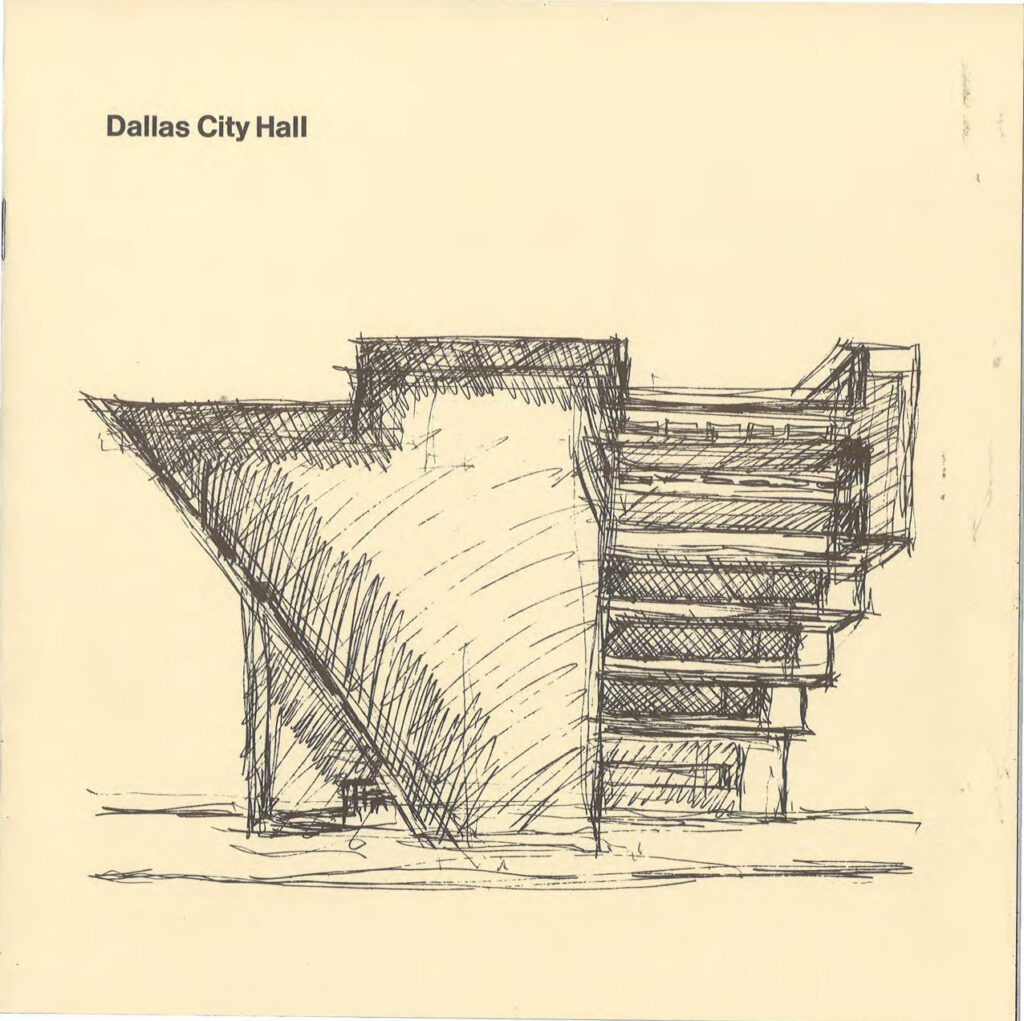
Dallas City Hall
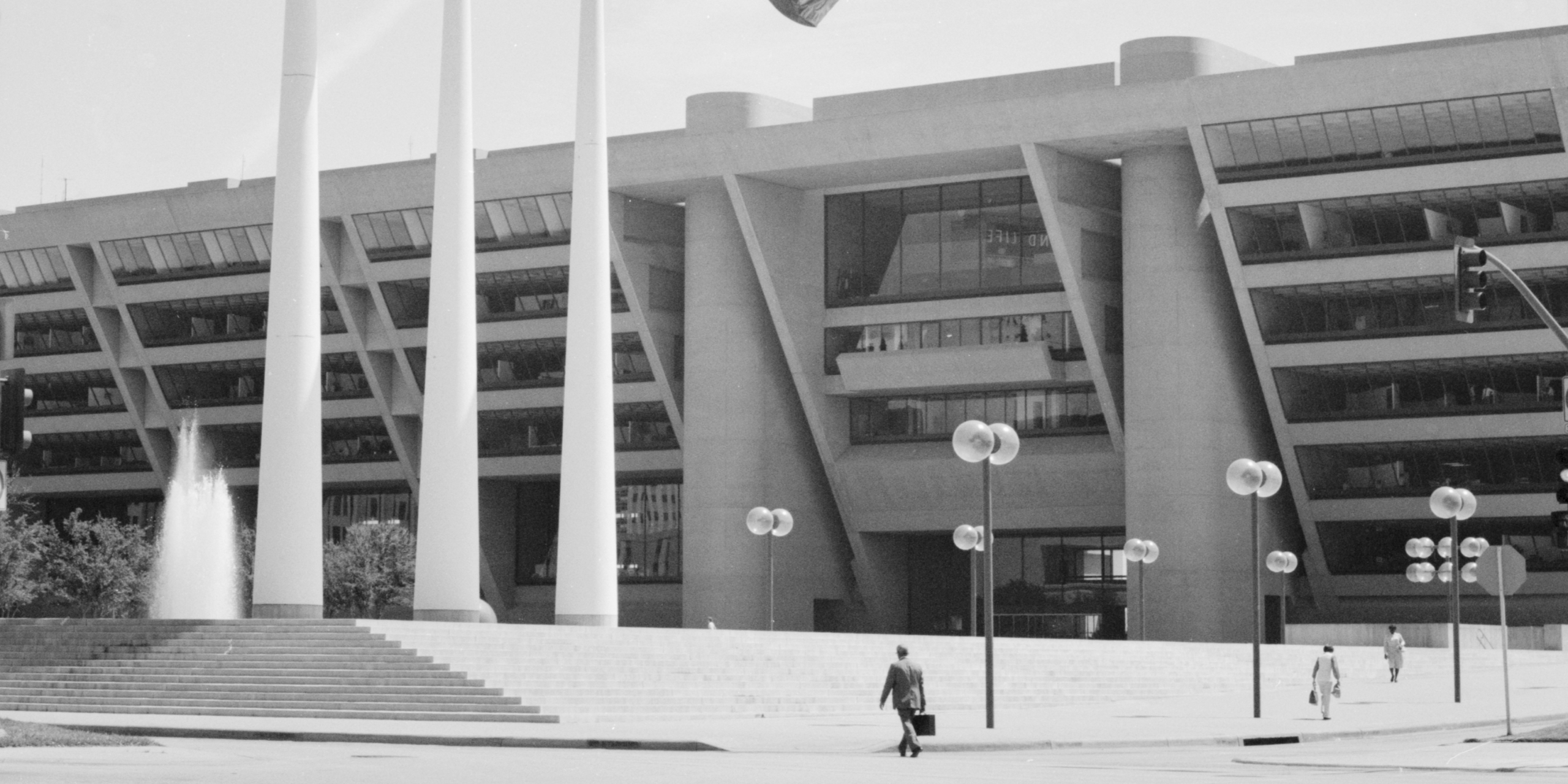 Dallas City Hall, Designed by I.M. Pei; HABS TX-3325, Photograph by Frank Branger, 1981
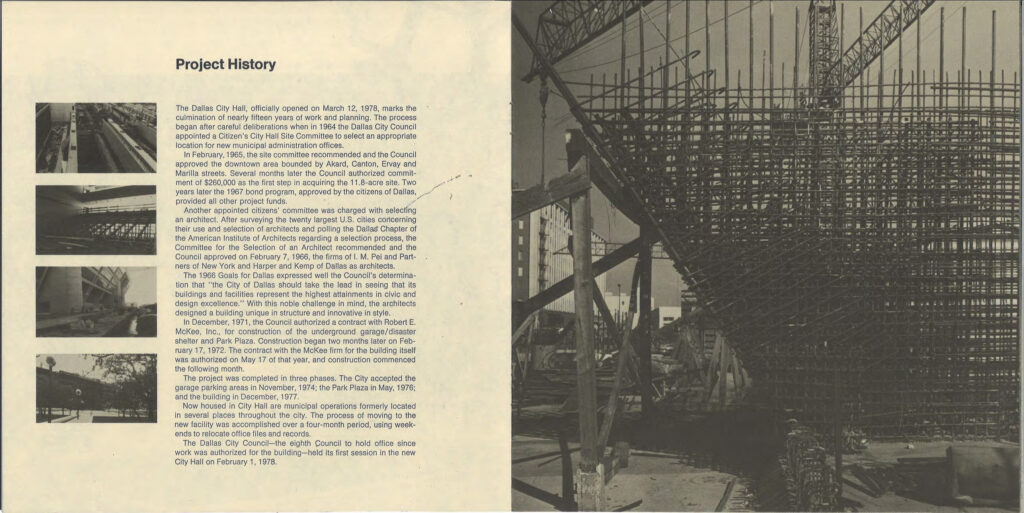
Thirty-four degrees. That is the slope of one of the most identifiable and dramatic façades in Dallas. Designed by renowned architect I. M. Pei, Dallas City Hall is among the finest examples of civic Brutalist architecture in the U.S. Completed in 1978 after more than a decade of planning and construction, the building was deemed “undoubtedly among the most interesting urban constructions of the 20th century” by The New York Times architectural critic Ada Louise Huxtable.
Initially, when Dallas received its charter in 1856, the city conducted its business in rented locations. The first purpose-built City Hall came in 1881 at the corner of Main and Akard Streets. In 1889, a much larger and grander City Hall opened at the corner of Commerce and Akard Streets to accommodate the city’s growth. When Adolphus Busch purchased that site to build his new Adolphus Hotel in 1910, city offices moved to a temporary space until the 1914 City Hall opened on a block of Harwood Street between Elm and Commerce Streets. This served as the home for the city until 1978.
To accommodate the city’s growth, options were explored, including the 1944 Bartholomew Plan for a new municipal center to include a new city hall, music hall, library, and a federal building. The construction of the 1957 Memorial Auditorium, designed by George Dahl, partially implemented that plan. Additions in the 1950s put the planning on hold until the 1960s with a change in city leadership.
In 1964, J. Erick Jonsson became mayor and saw his new role as an opportunity to redefine Dallas after the assassination of President John F. Kennedy and to move beyond the “City of Hate” moniker. Jonsson was a visionary civic leader who co-founded Texas Instruments, was the first president of the Dallas Chamber of Commerce and was the head of the influential Dallas Citizens Council. In April 1964, Dallas citizens approved a $5 million bond for a “City Hall Expansion.” Shortly after the vote, a trip to Europe for the new mayor and civic leaders led by Dallas architect Enslie “Bud” Oglesby proved pivotal to the direction for City Hall. Jonsson became enamored with Copenhagen’s City Hall and how it fronted a large public square. During the trip, Jonsson made it known that he wanted a new purpose-built City Hall for Dallas.
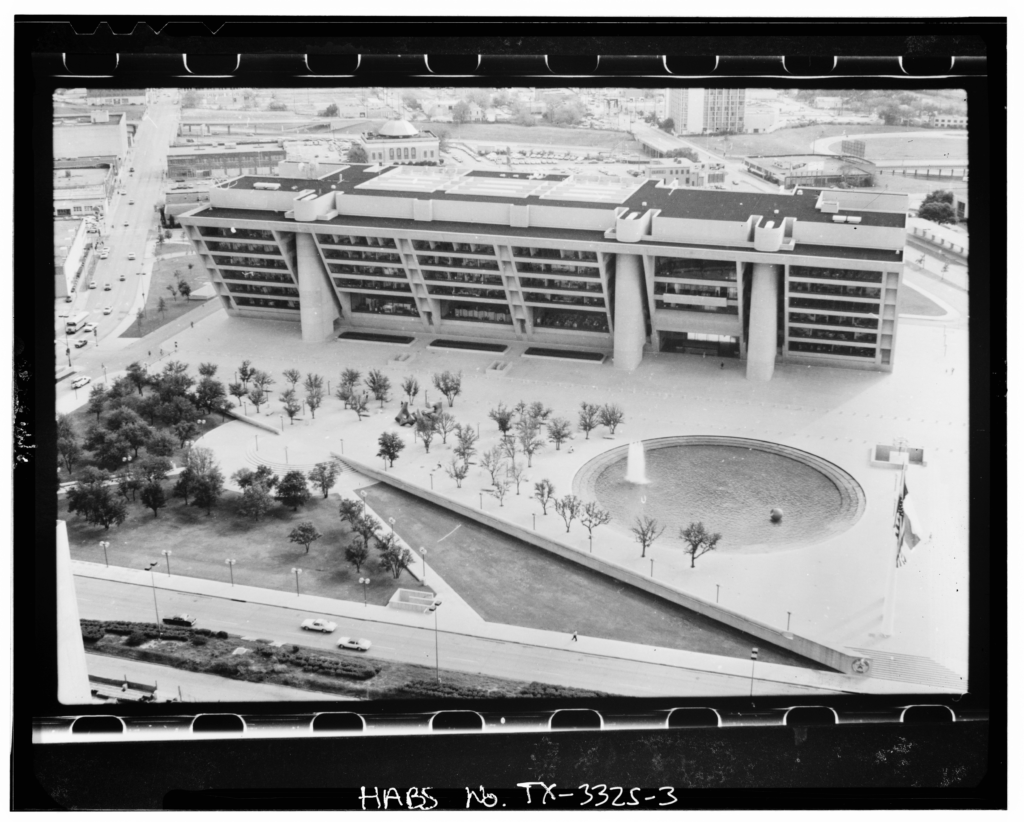
Historic American Buildings Survey (HABS) No. TX-3325-3
Photo by Frank Branger, 1981
Upon his return, he established two committees: one to study the city’s needs for the new building and another to select a site. The site committee investigated three sites before recommending the current 10-acre site bounded by Marilla, Akard, Canton, and Ervay. Committee member Carl Thomsen stated, “When you stand on this one [site] and look back at downtown Dallas, you get a mental picture of what can be achieved there. You get mighty enthusiastic.” The City Council approved the site and Jonsson expressed, “This is an exceptional site… we should never settle for anything humdrum. Let us try for something truly beautiful and imaginative.” The roughly 5-acre Park Plaza north of Marilla wasn’t acquired until 1967.
After the site selection, a new architect selection committee included some of the city’s most prominent civic and professional figures, including Stanley Marcus, chairman of Neiman Marcus; civic activist Ruth Collins; real estate developer John Stemmons; civil engineer T. Carr Forrest Jr.; Gifford K. Johnson, president of the Graduate Research Center of the Southwest (the predecessor of UT Dallas); business executive Avery Mays; and Robert G. Storey, dean of SMU’s Dedman School of Law. Mayor Jonsson and City Manager Elgin Crull took part as ex officio members. John Ely Burchard, the dean of the Massachusetts Institute of Technology, led the process. Three internationally renowned architectural firms rose to the top of the list out of the eight interviewed: Philip Johnson; Skidmore, Owings & Merrill (SOM); and I. M. Pei & Associates. Pei was selected on February 7, 1966, with the Dallas firm of Harper and Kemp as local associate architects.
Pei was widely regarded as a rising star, despite having a relatively modest project portfolio. The recent completion of the 18-story Green Building at MIT, funded by Cecil Green, a colleague of Jonsson’s at Texas Instruments, and Jacqueline Kennedy’s selection of Pei in 1964 to design the John F. Kennedy Presidential Library, did not go unnoticed by the committee and further elevated Pei’s profile.
Construction took place in three phases. In February 1972, construction of the underground parking garage and Park Plaza commenced. The garage construction finished in November 1974, and the Park Plaza in May 1976. Construction of the building itself began in May 1972 and finished in December 1977. Robert E. McKee Inc. served as the contractor for the project. The total cost for the garage, plaza, and building came to $43 million.
When Dallas City Hall opened to the public in 1978, it was unlike anything else in the downtown area, with its dramatic form and the cast-in-place concrete used inside and out. More than just a building, it had a sculptural appearance, like a large piece of art. The dramatic form and character of Dallas City Hall were driven by Pei’s goals for his design, which he summed up:
“When you do a city hall, it has to convey an image of the people, and this had to represent the people of Dallas … The people I met—rich and poor, powerful and not so powerful—were all very proud of their city. They felt that Dallas was the greatest city there was, and I could not disappoint them.”
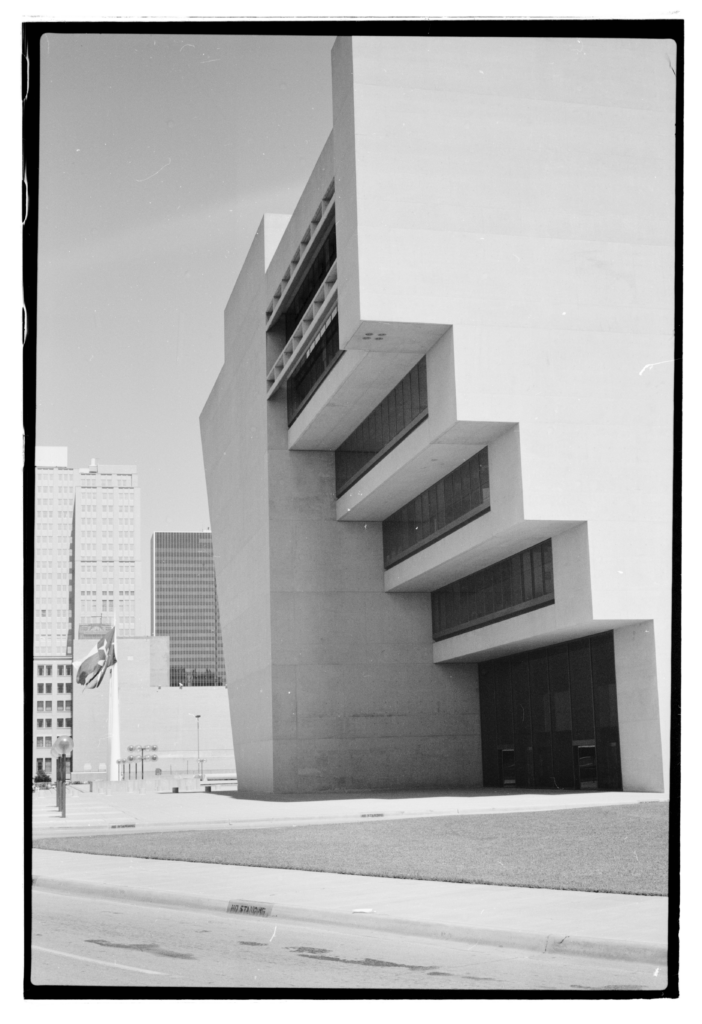
The Brutalist style for City Hall, with its architectural concrete left unfinished and bearing the marks of the forms imprinted on the concrete as it cured, was popular with modernist architects from the 1950s to the 1980s and was often used on large-scale civic projects. Many think that the term comes from a building looking “brutal.” However, the name derives from “beton brut,” French for “raw concrete,” which term Le Corbusier used for the construction of the 1952 Unité d’Habitation in Marseille, France. The British architectural critic Reyner Banham coined the term “Brutalism” in his 1966 book, The New Brutalism: Ethic or Aesthetic, putting the style on the map.
The most dramatic aspect of City Hall’s 560-foot-long north façade is the slope over the four-acre park plaza. At the base of the building, the width is 130 feet, and that expands to 192 feet at the top. Functionally, the slope provides shelter from the sun and rain for those entering the building. Symbolically, it serves as a gigantic “front porch” for the building. More importantly, it allows the relatively short 122-foot-high building of seven stories to visually hold its own with the soaring skyscrapers of the Dallas skyline and establishes a presence appropriate for a governmental center for a dynamic city.
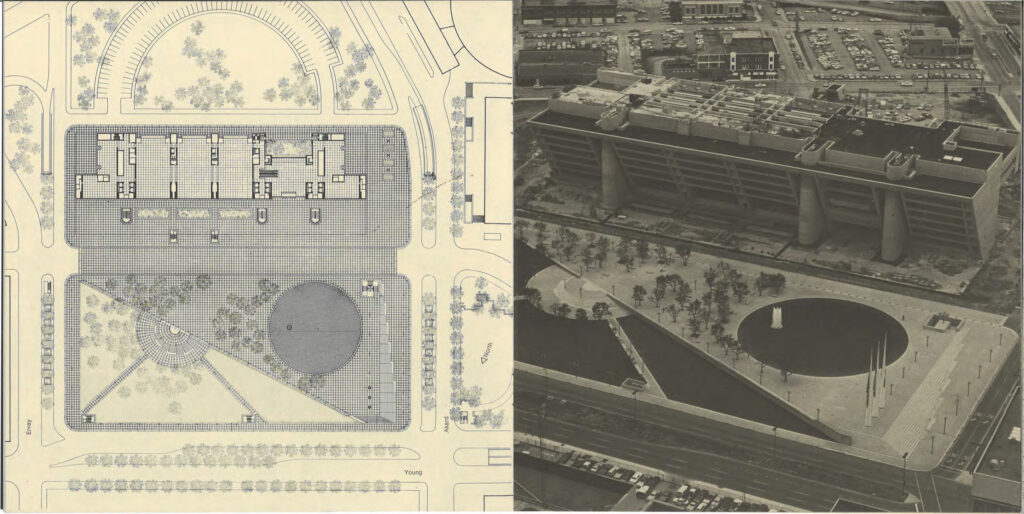
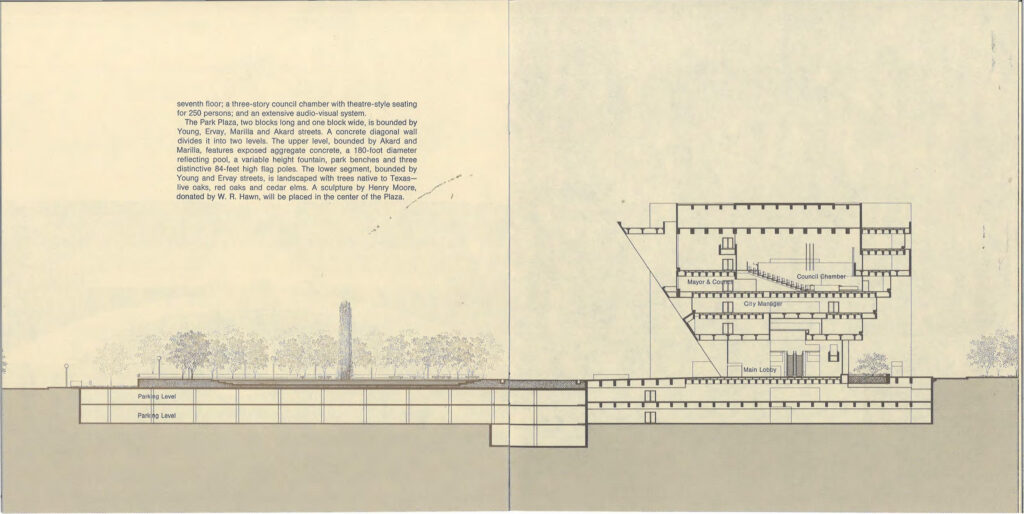
It became apparent that the lower floors, where the public would interface with the city bureaucracy, didn’t need to be as large as the upper floors, where most staff would be located. As that converted into a built form, the dramatic slope became logical and served a functional reason beyond mere image. The east and west elevations also reflect this with a series of stepped cantilevers. The south elevation presents a more conventional appearance, except for the bay, which recesses in steps into the building.
Five vertical elements divide the front of the building and add scale and visual interest. Supposedly, Pei added the three rounded vertical elements to the design after Mayor J. Erik Jonsson expressed to Pei that the dramatically sloped building looked like it might “fall down.” While they visually appear to “hold up” the building, they are not structural and contain only fire stairs.
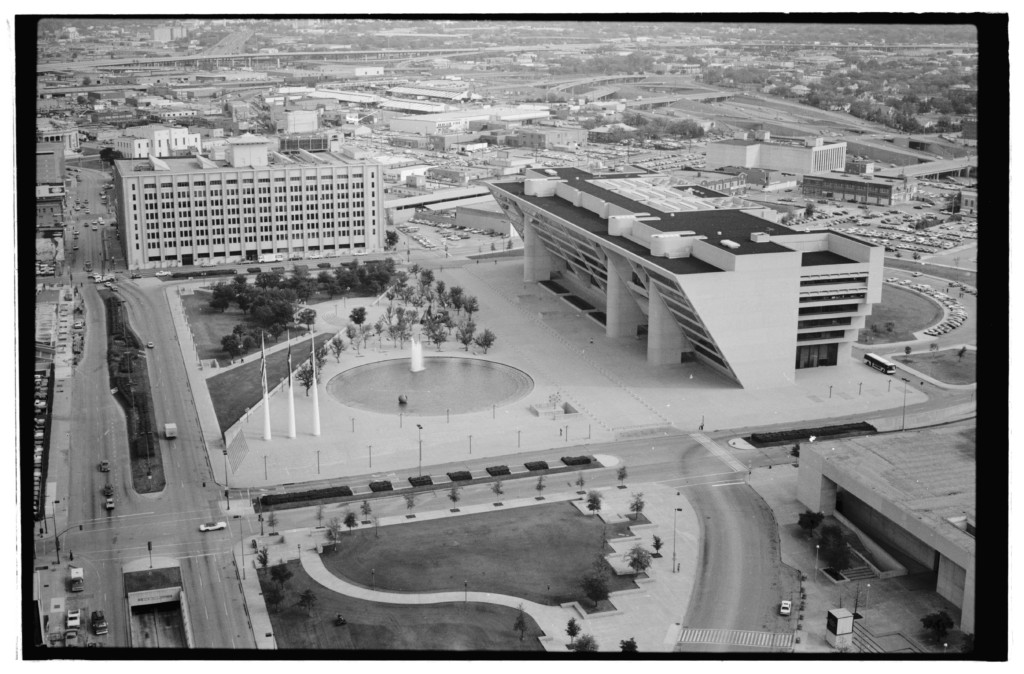
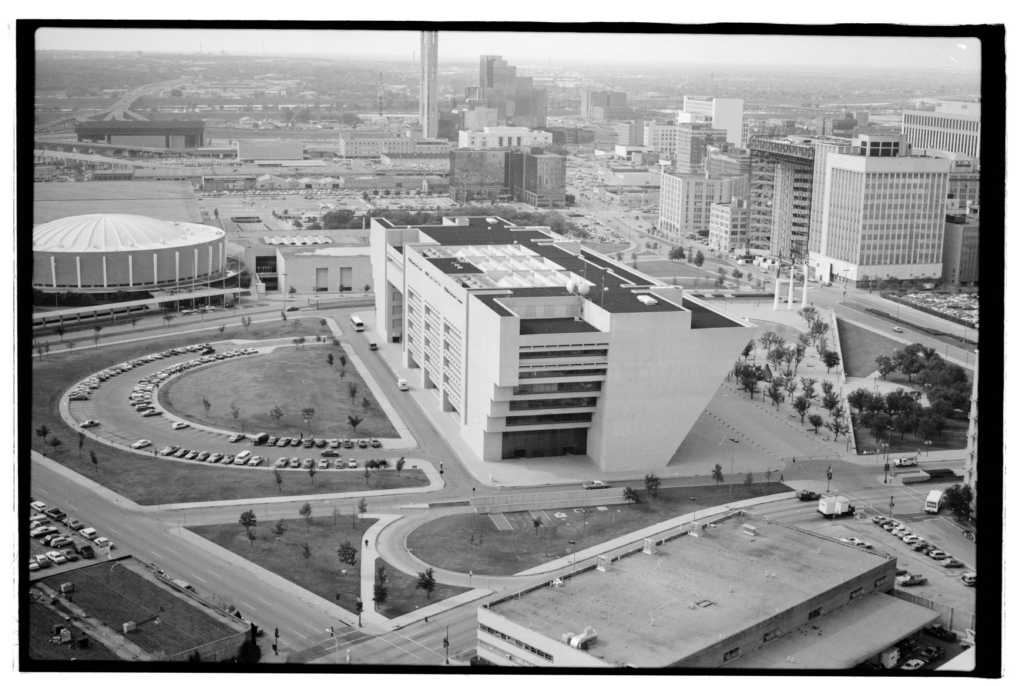
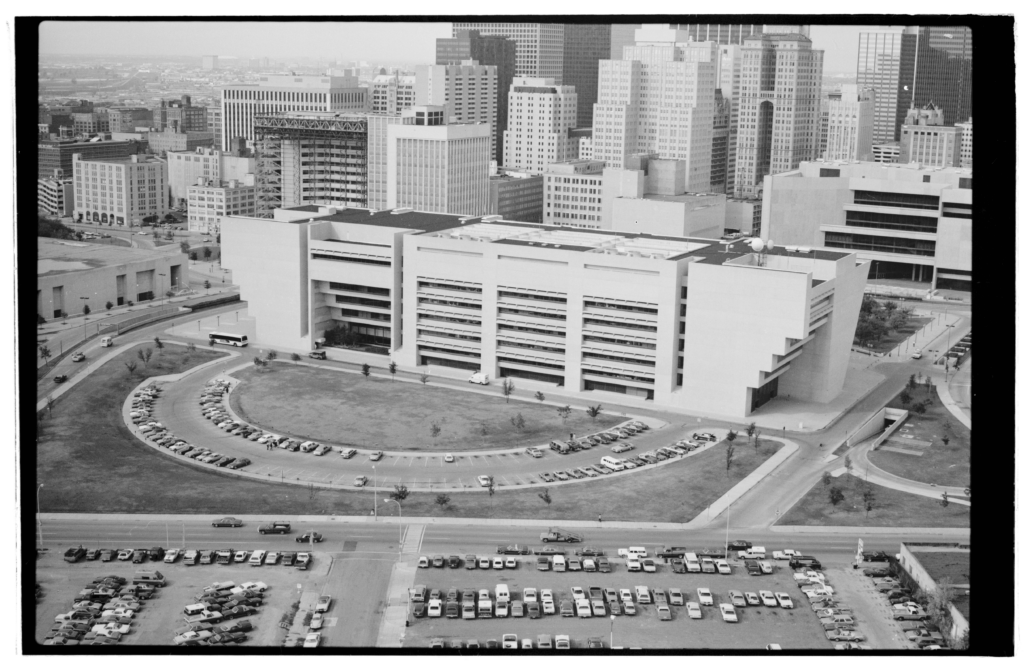
Cast-in-place concrete, selected for its durability, drama, and low maintenance, serves as the primary material on the exterior and interior of City Hall. Pei was a master of architectural concrete and went through a rigorous process to ensure an appropriate level of finish and sophistication for such an important civic building. To find the right formula to avoid cracking after curing, more than 50 sample panels using varying mixes of cement and aggregate underwent testing. Texas Industries ultimately provided the special shrinkage-compensating concrete with color consistency to last through the 18 months of construction.
Even with substantial amounts of concrete, City Hall also has a transparency to it, with copious amounts of exterior glazing. Dark bronze mullions frame the large sheets of tinted glass set mostly flush with the surrounding concrete, reinforcing the clarity of the dramatic form.
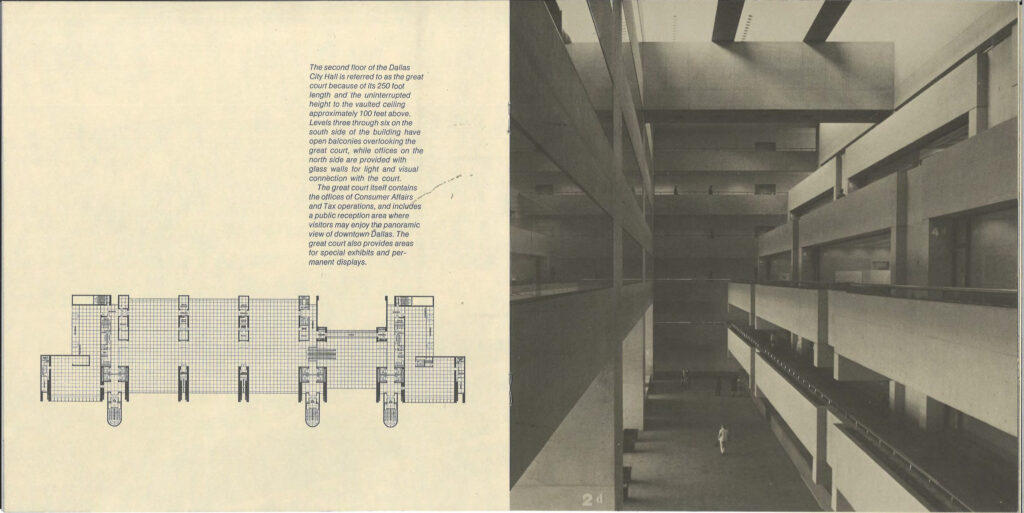
Along with offices for city staff, City Hall has four public areas. The two-story Main Lobby serves as the public foyer, ceremonial space, and access to elevator banks. The double-height glass walls on each end provide light to the space. Originally, escalators led from the lobby up to the Great Court on the second level; however, stairs replaced them a few years ago. The 250-foot-long Interior Court is impressive with its 100-foot height and curved concrete roof monitors that bring light deep into the space. Offices line one side with windows to the court. On the other side, offices open onto walkways that extend the length of the court and step back on each level to prevent a canyon feeling. The walkways lined with planters allow greenery to soften the concrete.
The two-story Flag Room on the sixth floor serves as the antechamber to the Council Chambers and offers an elevated, dramatic view of the skyline. Named for the room’s flags, it hosts ceremonies, press announcements, and more. From the room, one enters the 250-seat Council Chambers at the top of its tiered seating, which slopes down one floor to the horseshoe-shaped console for the mayor and City Council, with a bas-relief city seal above.
Office space for city departments fills the large, open floor plates throughout the building. Service spaces that contain mechanical equipment separate the office bays. Natural light from the exterior or the court fills most of the offices. The two basement levels contain the city’s emergency services space, meeting rooms, offices, a small auditorium, the municipal archives, and access to the parking garage levels.
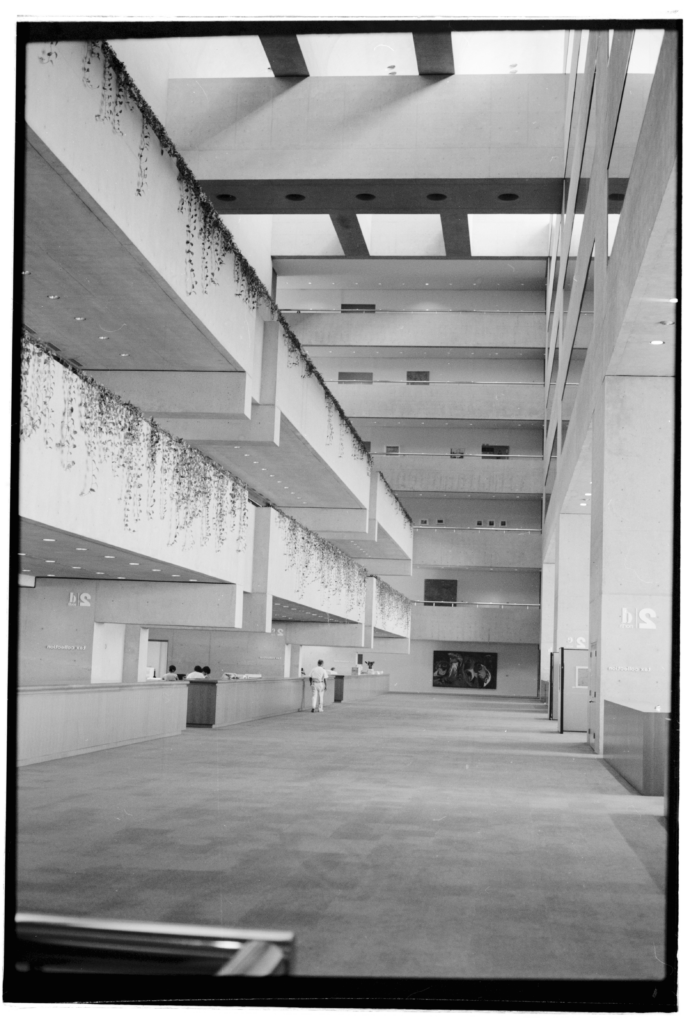
Photo by Frank Branger, 1981
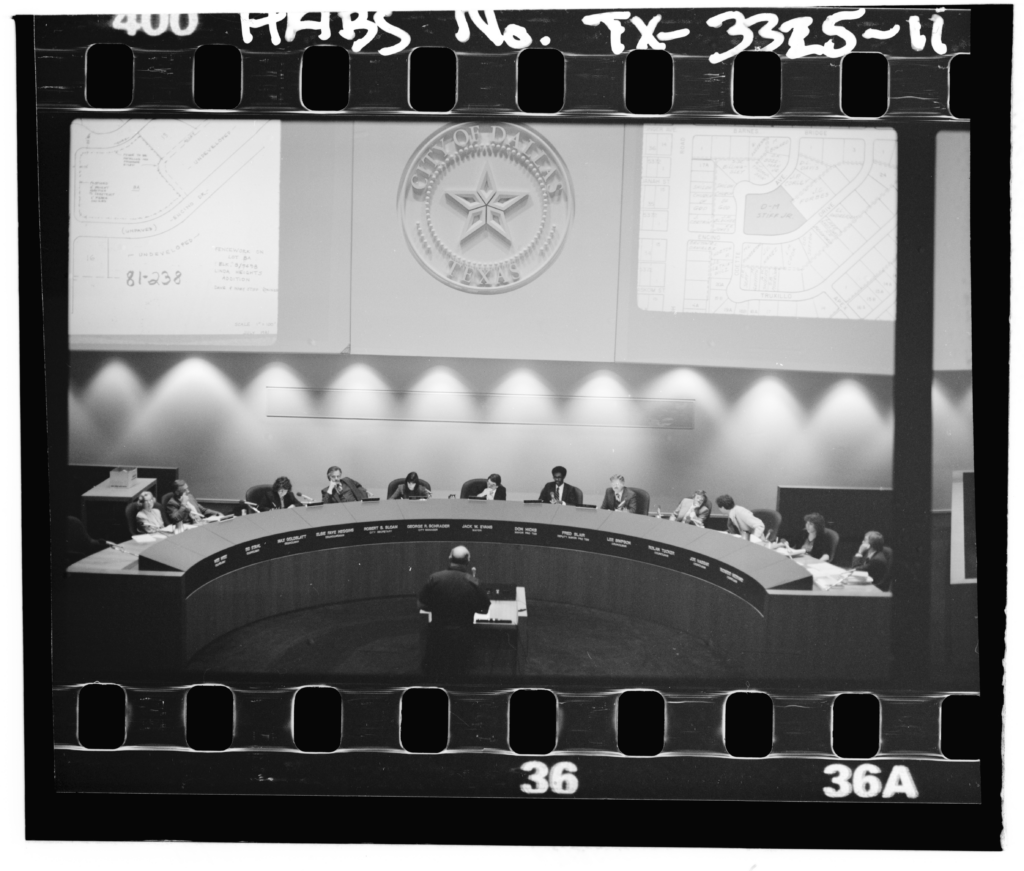
Photo by Frank Branger, 1981
Dallas City Hall set the standard for precision and quality of cast-in-place concrete with its smooth-faced finish that creates a consistent, monolithic appearance. Pei required a meticulous construction process with specifications of a 1/16-inch tolerance for the joints between forming boards to achieve a consistent appearance. Some 1,700 molded fiberglass “domes” were used to achieve the smooth surface and the precision required for the complex coffered combination ceiling-and-floor slab system. Local architect James Pratt noted, “That level of construction—to have built the structure in situ with materials that are not covered up by plaster or some other substance—is a real feat. It’s beautiful as a piece of sculpture, particularly from a distance.”
Pei designed the floor/ceiling system as a 36-inch-deep slab on a 4′-8″ grid. The design incorporated lighting and HVAC vents in the ceiling and electrical and data wiring in floor troughs. This allowed easy reconfiguration of partition walls without requiring new lighting or HVAC outlets. Free-standing furniture placed anywhere in the space created a highly flexible office arrangement.

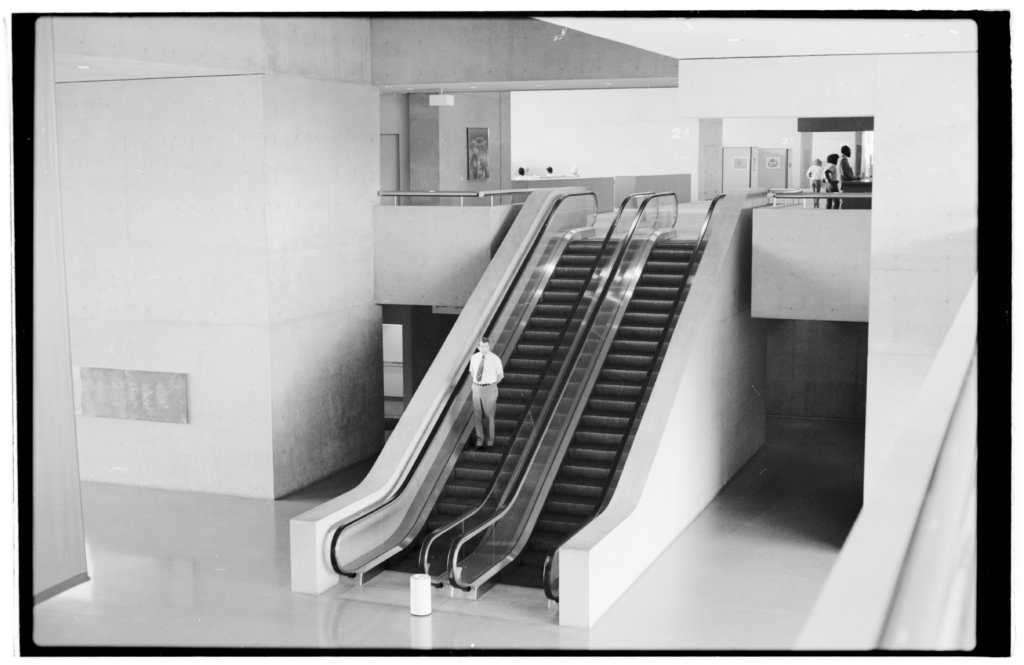
Alterations to the exterior of the Dallas City Hall since it opened have been minimal, with the biggest alteration being the addition of a security vestibule on the north side. Other changes include the replacement of glass on the east and west elevations and the elimination of exterior doors for security. Interior changes have been greater with the installation of interior partitions, walled offices, and secure areas.
At a luncheon in 1967 for the unveiling of the design, I. M. Pei said City Hall and the Park Plaza would “give Dallas a sense of identity and a sense of place.” His vision for Dallas’ City Hall achieved that goal, giving Dallas one of its most identifiable buildings and one of the most iconic modern municipal buildings in the country. At the time of its opening, The Dallas Morning News said, “The New Dallas City Hall brings a sense of permanence, monumentality, excitement and elegance to the city.” Dallas City Hall was a triumph of design that captured the civic spirit of Dallas and its attempt to redefine itself post-Kennedy assassination as a forward-thinking, modern city.
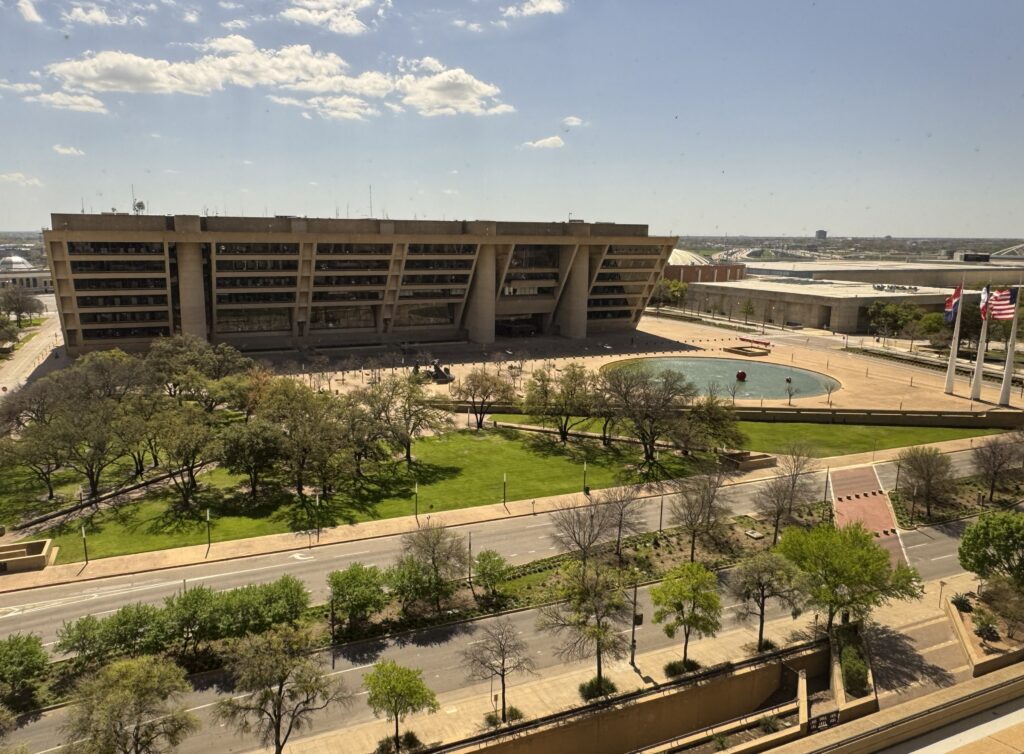
Special thanks to all the contributors from the Docomomo US North Texas Chapter—Nancy McCoy, Bob Meckfessel, Kelly Mitchell, Marcel Quimby, and Reagan Rothenberger.