People First
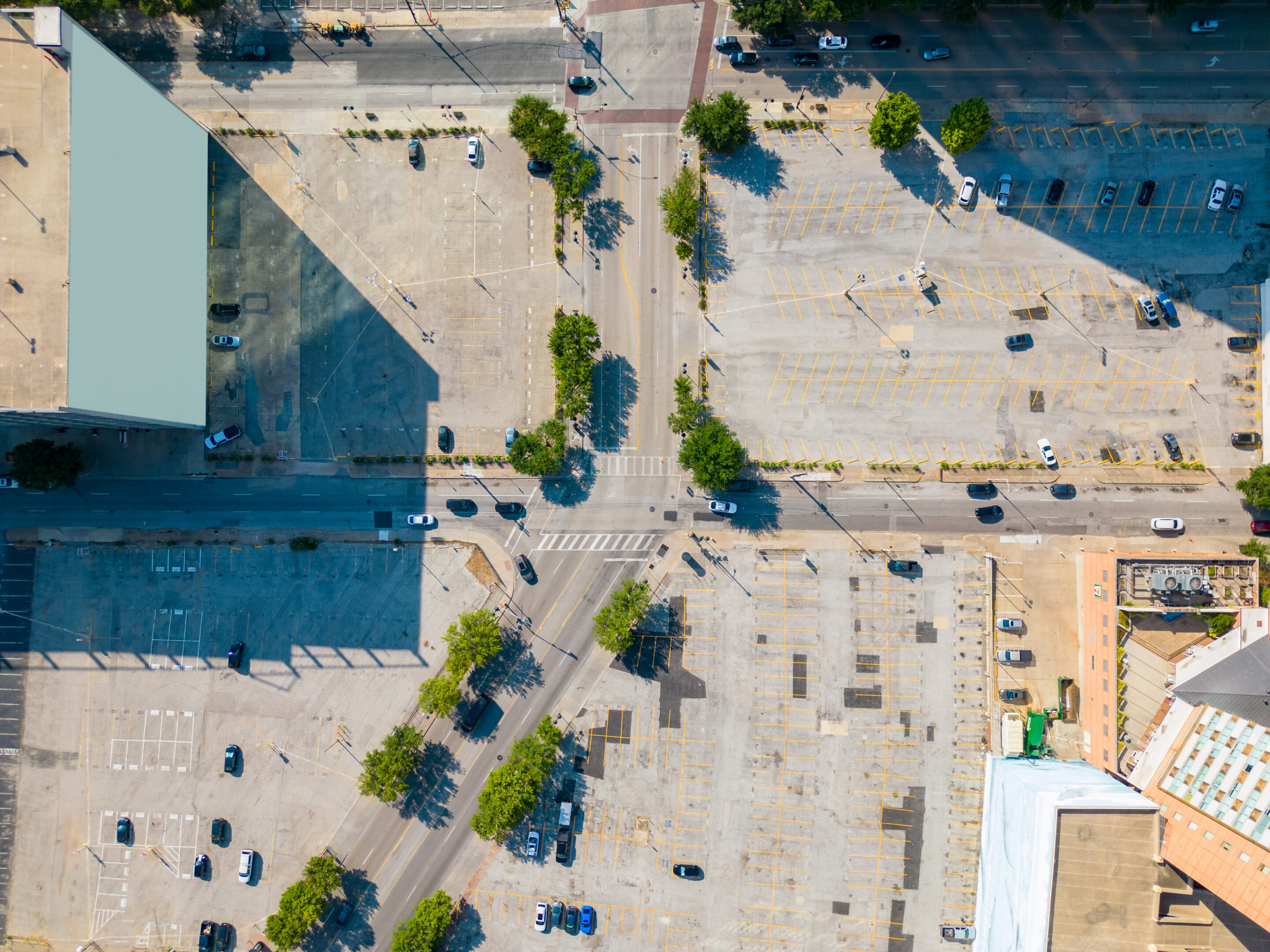 Aerial photo of parking lots in Downtown Dallas.
The Downtown Disparity
Downtown Dallas is at an inflection point. Over the past two decades, the district has experienced remarkable growth, expanding from just 200 residents in 2000 to more than 16,000 today, while remaining the metroplex’s largest office hub with over 34 million square feet. Yet, like many downtowns nationwide, the commuter-driven office model that once sustained the urban core has been disrupted. Recent tenant losses have weakened public and investor confidence, and competition from nearby districts has intensified questions about long‑term relevance. At the same time, Downtown Dallas is far from stalled: nearly $6 billion in transformative development is underway, supported by ongoing efforts focused on public safety and activation. This convergence of investment and unmet potential presents a timely opportunity to recalibrate downtown’s future, shifting strategy toward a people‑first model that prioritizes walkable, safe, and connected neighborhoods. By focusing on where people choose to live and spend time, downtown Dallas can unlock broader change and reassert itself as the cultural and economic heart of the metroplex.
Density and Connection
Downtown Dallas is constrained by two interdependent challenges: insufficient residential density and a fragmented public realm. Without enough people living downtown, active ground‑floor uses such as retail, dining, and entertainment cannot be sustained. Yet without a cohesive, walkable, and engaging public realm, it is equally difficult to attract the residents needed to justify new housing development at the necessary scale. Each condition reinforces the other, leaving downtown caught in a cycle that limits its vitality.
A Fragmented Public Realm
Downtown contains several strong but isolated bright spots, such as the Dallas Farmers Market, Klyde Warren Park, and the AT&T Discovery District, but these assets remain poorly connected to the wider district. One‑way streets designed for a commuter era still prioritize vehicle throughput over pedestrians, diminishing safety, undermining retail viability, and suppressing the character of the district. Blank façades, vacant storefronts, and surface parking lots widen the gaps between destinations, creating a discontinuity that weakens the appeal of the public realm and reinforces perceptions of an unwalkable and uninviting environment. As Doug Prude of DDI observes, “In many places, we’ve got some good clustering and areas that feel tied together, and then we’ve got big gaps between them, and that’s part of our challenge.”
Although short‑term beautification and opportunistic leasing improve isolated blocks, they do not address the deeper issue: downtown lacks the consistent activity and density required to fully activate the public realm. These everyday conditions shape how people experience downtown, whether they choose to walk, linger, and explore, or retreat to cars and buildings.
The Density Gap
Downtown also lacks the residential rooftops to support a robust ecosystem of daily life. As Billy Prewitt of Pacific Elm notes, “It’s like painting over cracks in a house with foundation problems… It’s unsustainable if you don’t have the rooftops and density to support it… We need to add as many people as we can to the neighborhood at every price point.”
Without enough residents, pedestrian activity drops sharply outside peak hours, reinforcing the perception that people pass through downtown rather than live in downtown, and any cohesive retail corridors, dining districts, and entertainment offerings will continue to struggle for viability. This absence of consistent street life, and of residents to claim the neighborhood as their own, creates conditions that can unintentionally invite the unhoused population to use public spaces in ways that heighten social and safety concerns, an issue that continues to shape perceptions of downtown. As Pruitt emphasizes, “Great neighborhoods usually have a community of people that claim it as their own and fight for it.” Investments in downtown parks, transit, and even the convention center transformation only succeed when they sit on top of a strong resident base that “owns” and activates them.
The path forward begins with re‑evaluating the ground plane and designing environments that reward presence—places where people want to walk, linger, and return, so downtown functions as a cohesive neighborhood rather than a collection of disconnected destinations.
A People‑First Approach
A thriving public realm does not emerge by accident. It requires deliberate strategies that balance walkability, livability, and the less tangible qualities that shape how a place feels. A people‑first approach centers the experience of residents and visitors, recognizing the inseparability of physical design, social dynamics, and emotional resonance. In practice, the most successful downtowns provide both purpose and reward: purpose through meaningful offerings, and reward through a journey that is engaging, delightful, and worth lingering for.
A simple framework lies at the core of this approach: Comfort and Engagement. Comfort is the baseline. People must feel safe, oriented, protected from the elements, and provided with places to pause and rest. When comfort is present, people will more likely walk, gather, and linger. Engagement provides the reasons to stay: the retail, dining, daily conveniences, culture, events, and moments of delight. Public spaces must offer more than efficient movement; they should invite exploration and enjoyment. “People come to downtown and decide what the quality of this location is based upon what they’re seeing on the ground plane. They don’t walk into every building… The ground plane tells you what kind of neighborhood you’re in.” Pruitt emphasizes. In other words, people do not experience comfort and engagement as abstract ideals; they experience them in the everyday quality of streets, building edges, crossings, and shared spaces.
Unmet Potential
Several catalytic investments underway could reshape downtown’s future. The convention center district in particular offers the opportunity to restore long lost connectivity, by opening its public “heart” to the city and re-establishing key north–south movement corridors. As Jane Hamilton of Inspire Dallas explains, “This project sends a powerful message: downtown no longer has its back to the south. The district’s new connections reopen that gateway and stitch together parts of the city that have long been cut off.”
However, major projects alone cannot create a cohesive downtown. The corridors connecting these investments to existing “bright spots” remain fragmented. Without intervention, these new developments risk becoming another disconnected piece of the puzzle, successful in isolation but unable to knit together a continuous neighborhood experience.
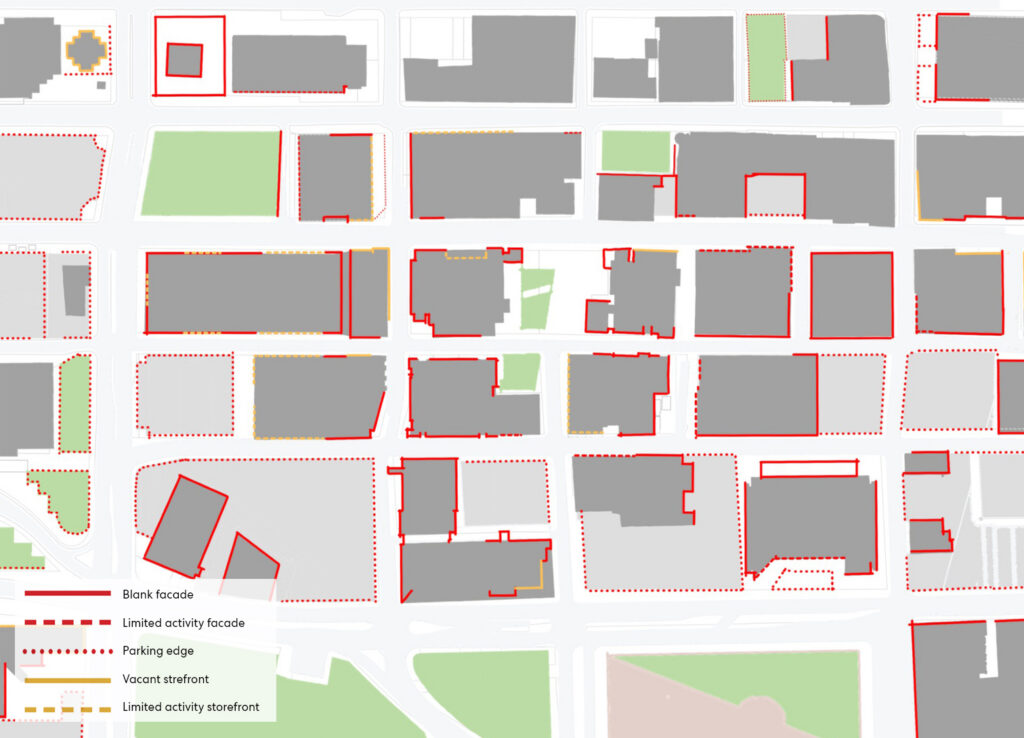
The diagram below reflects a snapshot of key corridors downtown and the realities of the urban fabric that exists. It highlights inactive or inaccessible edges, blank façades, service yards, vacant storefronts, and garage driveways that reduce the connectivity, activation, and porosity of the built environment. In combination, these edges ultimately weaken the conditions that make people feel safe and comfortable walking, lingering, and returning. Many older buildings operate like fortresses, turning their backs to the sidewalk, so the experience of downtown becomes fragmented and discouraging. Being able to walk from one place to another doesn’t automatically result in people choosing to do so. The public realm must also deliver comfort and engagement, purpose and reward, so people have reasons to walk and stay.
The Dallas Farmers Market demonstrates the impact of intentional care and design. As Emily Valentino observes, “People notice a marked difference… It’s clean, people feel safe, every demographic feels included… You can come here and not spend any money at all… If people come and just sit and dwell, that’s fine… We know they’ll come back because they like how they feel when they’re here.” The success of the Farmers Market underscores that people are drawn to places that support everyday life, not just programmed activity.
Strategies for Success
Meaningful transformation requires coordinated action across public and private stakeholders. A clear, shared vision supported by aligned policy, incentives, design standards, and infrastructure is essential for downtown to function as an integrated ecosystem rather than a series of isolated projects. When considering the challenges of creating city‑scale change, Evan Sheets of Downtown Dallas, Inc (DDI) reiterates its complexity, “There are levels of coordination and efficiency that don’t exist when there are multiple stakeholders and decision makers… That’s the environment we’re working in.” But, while it’s complex, it is achievable. Other cities, such as Detroit, have demonstrated that they can deliver ambitious, multi‑stakeholder strategies at scale, demonstrating that stakeholder alignment and public/private partnerships provide lasting benefits for the downtown and the city as a whole.
1. Building Neighborhoods
Revitalization must begin with building real neighborhoods, places defined not by a single destination, but connected by everyday life. For Downtown Dallas, this requires a surgical, corridor‑first strategy that identifies connective lines between existing and emerging locations of engagement and then deploys targeted interventions to strengthen the connective tissue between them. Adding residential density through infill and multifamily development is critical. As Doug Prude notes, success requires working with parallel strategies “working with brokers and owners…creating clustering…[and] making the environment inviting.” Sheets adds that successful districts such as the Farmers Market are the product of “strong public‑private partnerships, visionary developers, and adventurous capital.”
The Dallas Farmers Market exemplifies the power of this approach. “We won the RFP from the City of Dallas,” recalls Valentino. Over a decade later, “we did exactly what we said we were going to… We saw it as more than running a farmers market. We saw it as building a neighborhood, a community.” The result is a district anchored by people who live and work there, shaping its character and sustaining activity throughout the day.
Downtown cannot rely solely on office workers, convention‑goers, or tourists. Retail, dining, and entertainment only thrive when everyday neighborhood life demonstrates strength and locals come first. When community takes root, amenities evolve, and tourists tend to follow. As Valentino notes, “It seems like people are really seeking out a lifestyle… We truly are catering to both [locals and tourists]… If you’re just a tourist destination, you’re not going to survive any downturn.” Their touchstone reflects simplicity, authenticity, lifestyle, and a sense of belonging, the foundations of a thriving neighborhood.
2. Improving Infrastructure
Infrastructure reform will unlock downtown’s potential and create the conditions for comfort and engagement at a district scale. Dallas has implemented several transformational investments already. As Scott Goldstein of The GoldHam group notes, “With the convention center, I‑30 reconstruction, and future mobility investments, we’ll see natural connectivity emerge… linking downtown north to south, east to west… in ways most people haven’t yet realized.”
Improving access to public transit and improving its quality represent a key component of this shift, reducing reliance on cars and supporting a more walkable, people‑oriented downtown. The redesign of streets themselves results in equal impact. Converting select one‑way streets to two‑way traffic can dramatically improve pedestrian experience, calm traffic, improve intuitive navigation, and support street‑level commerce, helping Downtown move beyond piecemeal beautification toward district-wide vitality.
However, the city must undertake these changes thoughtfully and inclusively. As Sheets points out, “Major moves like a two‑way street conversion…require broad, inclusive conversations… We must balance servicing dense office uses and the vibrant street experience tenants want.” When a city aligns transportation, mobility, and street design, infrastructure enables everyday use, making it easier, safer, and more comfortable to walk, linger, and connect.
3. Activating the Public Realm: Designing the ground plane for comfort, engagement, and purpose
The most impactful “surgery” occurs where people experience downtown most directly: the ground plane. Billy Pruitt reinforces this notion, “Connection to the public realm is easily the number one most important thing about every project that we do. People pick up on social cues from the ground plane… It becomes part of our truth about where we are.”
Streets, sidewalks, storefront edges, and building façades shape not just movement, but meaning. Improving comfort at a corridor scale through enhanced sidewalks, seating, lighting, signage, shade, landscaping, and weather protection encourages people to walk, pause, and feel safe. When designed intentionally, these elements transform streets from simple corridors of movement into places of experience.
Engagement comes from purpose and reward. Active ground‑floor uses such as retail, dining, live/work spaces, and the thoughtful programming of public spaces provide reasons to linger and return. Achieving this is challenging: early stage activation may not be financially viable without density, clustering, or incentives. Retrofitting existing buildings introduces additional complexity, often requiring policy support, financial tools, phased delivery, and absorbing or offsetting short‑term risk. As such, that engagement does not require active uses or retail on every foot of every block. Focused activation, strategic anchoring, improved visibility, and porous building edges can create a lively and engaging environment when paired with high‑quality streetscapes.
Putting People First to Fuel Downtown’s Rise
Genuinely magnetic, walkable districts happen intentionally, not as the result of one-off projects or temporary activations. They require clarity and commitment to a cohesive vision, intentional design, aligned investment, and sustained public–private initiatives. When downtown prioritizes people first through comfort, engagement, authenticity, and the creation of community, it lays the foundation for long-term resilience and relevance. Dallas can move beyond perception challenges and unlock its full potential, not by chasing trends, short-term fixes, or the next big tenant, but by building real neighborhoods, shaped around everyday life. In doing so, downtown can once again rise to become the thriving, connected, and unmistakably human heart of the Dallas–Fort Worth metroplex.