A Conversation with Brad Bell
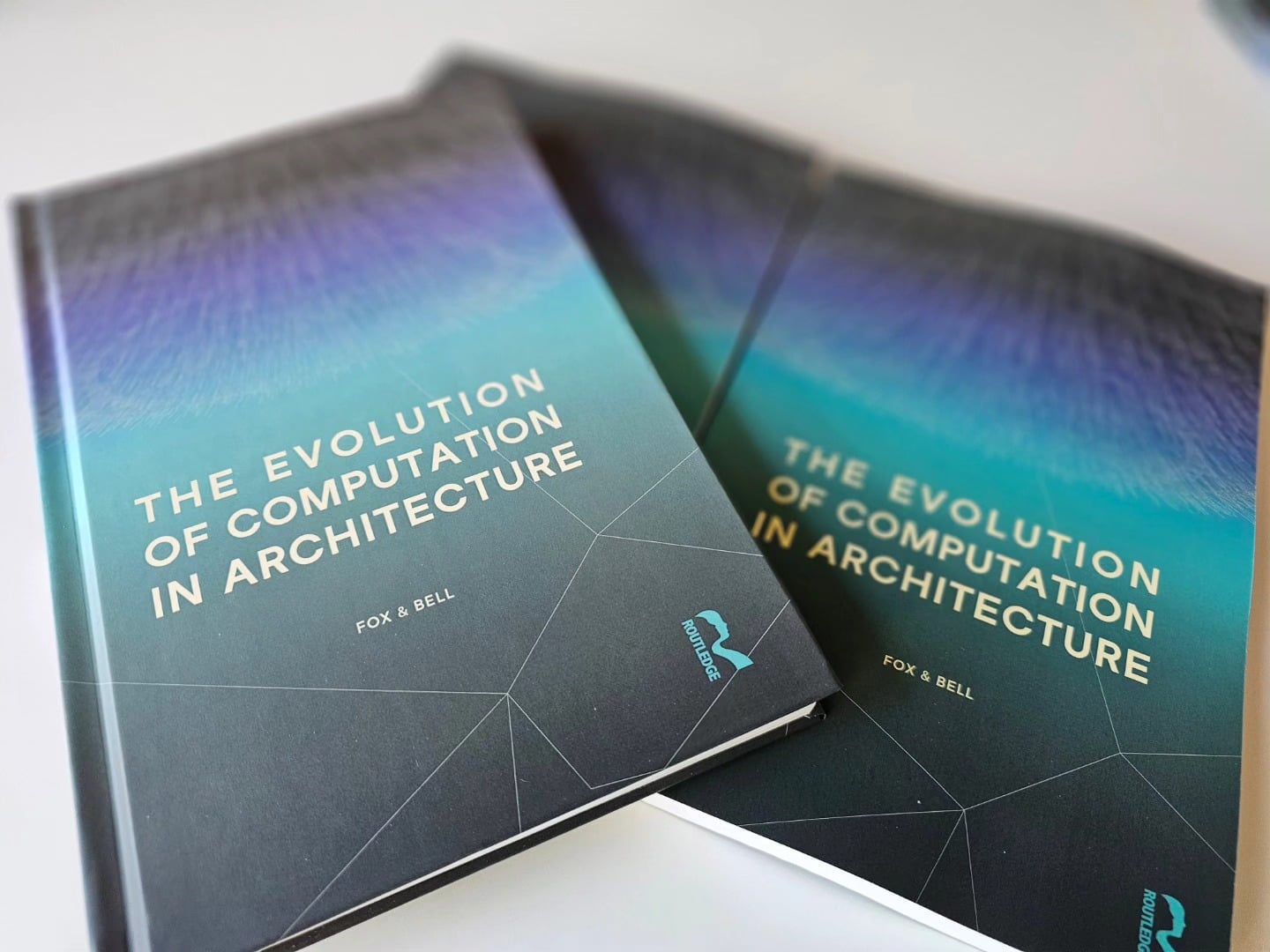
Over the last 60 years, architecture has experienced a technological evolution—from hand-drafted two-dimensional and perspective drawings to complex digital models and simulations. Michael Fox and Brad Bell’s book, The Evolution of Computation in Architecture, explores this progression from the advent of computers to now. As forewarned in the prologue, this book does not offer a definitive history of computational architecture or an archive of computational design. Instead, the authors highlight innovations through historical narrative. The book positions computational architecture as cyclical, starting with experts developing tools for specific uses and the subsequent exploration by academics and professionals alike.
Andrew Lane: I know from the introduction of the book that this project started with a conversation with Michael Fox during ACADIA (Association for Computer-Aided Design in Architecture). Could you talk more about the inception of the book?
Brad Bell: Michael Fox has a real passion for the way knowledge is formalized within the field. There were others, like Sean Alquist, who were pushing for higher and more rigorous research standards in terms of how we formalize our work compared to other fields. After a couple of years, we realized that many innovative people are coming in with new energy and new ideas, but there are also people who have been working in this space and have done work that could serve as a foundation.
We would joke every time we saw each other at a conference—“Are we ever going to do it?” Many projects come together because of things that you can’t predict or control. If Michael and I hadn’t started at that point in time in education, both as students and then as teachers, we wouldn’t be as interested in writing this book because it spoke to both our journeys over the last 35 years.
Lane: As a student and an educator, did you understand the lineage that computation had as a technical tool, or did that come with the research that you and Michael Fox did?
Bell: I lived some of it. My dad worked for NASA, so I would see the rooms that held the giant mainframes. I’d play underneath the Mission Control space. I just assumed as a kid that everybody’s parents worked to put people in outer space.
We had one of the first PCs. It wasn’t an IBM because they were still very expensive, but we had a personal computer, and I hated it. My dad tried to teach me programming languages that were not user-friendly. When I said I wanted an Apple computer, it was like a dagger because he was working for NASA through IBM.
Lane: You and Michael Fox wrote this book together, but physically apart due to COVID. How did that affect the writing process?
Bell: He or I could have written this book without each other, but there was something nice in a writing partnership where we complemented each other. Michael has a kinetic energy in the way he approaches these types of projects. I’m the opposite, in the sense that I move methodically and organizationally with a certain intent. We essentially had assigned sections and then turned around and rewrote each other’s sections so that the voice became synthesized.
Lane: The AI conversation, which started academic and research-based, is actually a back-and-forth. Everyone is trying to figure out what is useful. You talk in the book about deep learning and its potential. To me, deep learning seems more beneficial than AI imagery in general.
Bell: We debated whether or not to include it. AI could have been Chapter One: Pioneering. We could have discussed AI and its development throughout the entire book. We decided to use it as an example of how the stages are cycling back. We are at an early stage where this will ultimately impact all of us. How is it going to be assimilated into our lives? It’s the feeling, right? I don’t know how you feel in the office, but it feels like we’re on the cusp. It’s moving quickly.
Lane: Part of the anxiety is the nonownership of the tools. What would you say to early practitioners or even students about how to tap into that and not be guided blindly?
Bell: Over the last several years, we have continued to find ways to enhance what we know, but it reinforces what we already know. Even with new interest in animating drawings, they look more hand-delineated. We’re evolving an aesthetic. It is most compelling when someone has something they want to do through the technology and they are clear about how they are accessing it. Early on, all the way back to the Paperless Studios in Columbia, finding a degree of agency and coauthorship was critical for advancing the conversation, whether that was students or faculty.
We’re in that space, but I don’t know if we have turned the corner to where the next wave of designers have figured out how to use the newer developments. I think it’ll happen simultaneously. There will be offices that are exploring this and places within academia that are pushing that. It will create a generation of folks with knowledge that races past what you have, while you have already raced past what I have.
Lane: I’m waiting to see the first AI studio with the minimal amount of human labor possible.
Bell: What is the lightest footprint? We have siloed the profession for many different reasons—history, legalities, communication, technology. For me, the question is, do AI and the capacity that we’re forecasting erase some of the siloed aspects? Maybe it’s not just a light footprint in terms of design delivery, but also post-occupancy? How will we see the cross-cutting in that space?
Lane: It almost sounds like a Brunelleschi viewpoint where architects understand the tools, means, and methods, not just create drawings for others to figure out.
Bell: I’m a little skeptical. There was a moment starting 10 years ago, maybe a little longer, when this idea of the master builder resurged. It felt more like a reaction to the loss of market share than something that practically makes sense. But theoretically it makes sense. Maybe in the near future, we will have tools that can actually facilitate that.
In the context of the AI hype of the past few years, Fox and Bell believe we are restarting the cycle of technological innovation. Our collective thinking on AI’s role in the profession is in flux, open to adaptation by experts and novices alike. This book is a welcome addition to the canon of books reflecting on the architectural profession.
This interview has been edited for clarity and brevity.