Pilgrimage, Concept and Complexity
Approaching an architecturally mythical town in the French countryside, the windows of our train car framed a series of vacant industrial buildings lining the road below. After a nearly silent stop, we emerged into a sun-drenched reality for which I was not quite prepared. I don’t know what I was expecting, but this was not it—an open-air, dual-platform gash in the golden wispy grass along with an unapologetic postwar rest stop vibe. The primary feature was a utilitarian bridge/stair awkwardly spanning the tracks while a couple of mismatched shelters dotted each side, the newest of which reluctantly bore the name of our destination: Ronchamp.
I had convinced my 15-year-old daughter that this pilgrimage was a reasonable, if not spectacular, way to spend a day away from Paris. Her enthusiasm fell somewhere between modest interest and polite indulgence, so our inauspicious arrival added an unnecessary layer of uncertainty to this rural expedition.
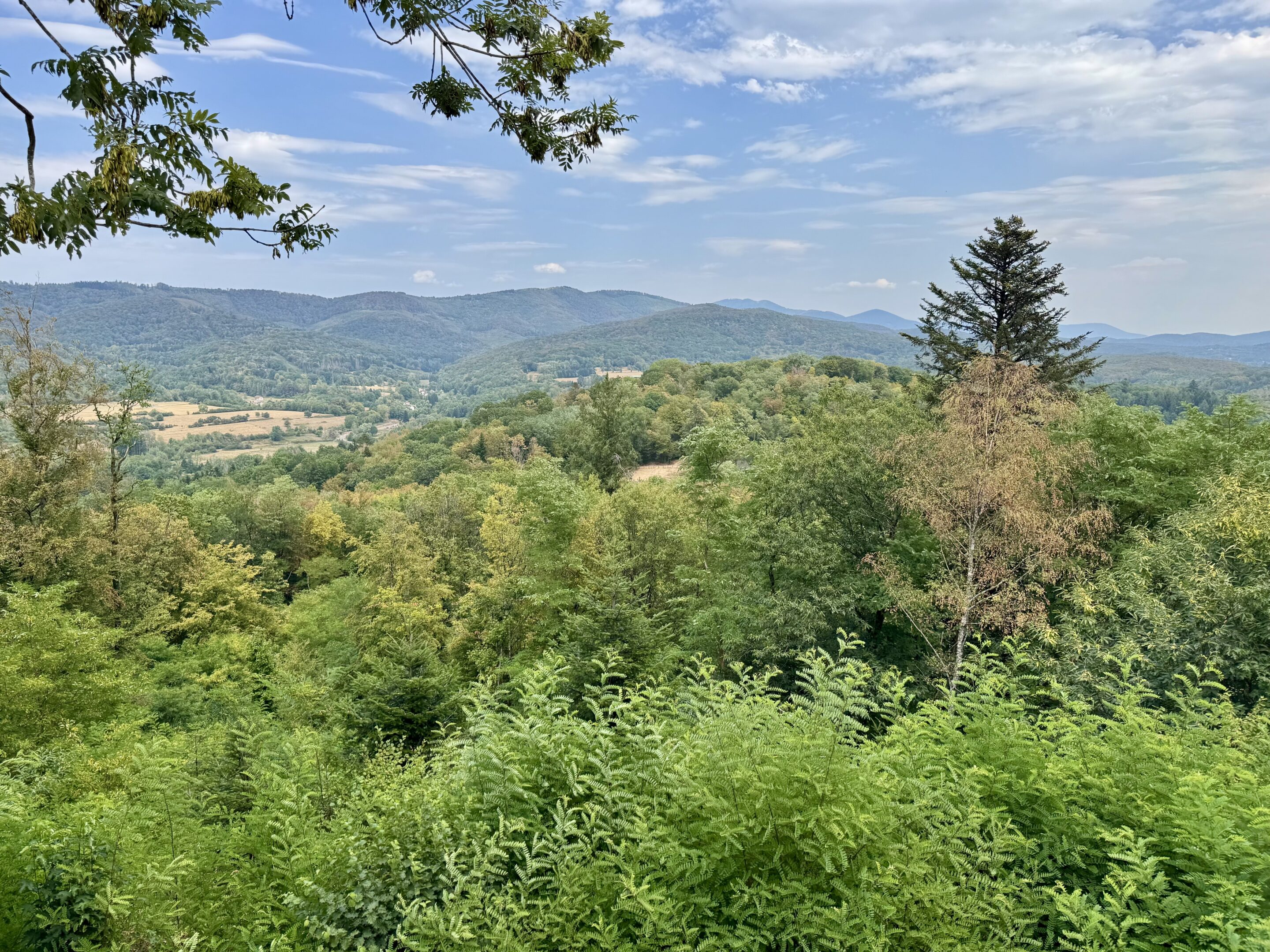
Fortunately, we had not journeyed three and a half hours to visit the train station. Nevertheless, I felt the pressure building as we descended the hill into a town that seemed very sleepy for 1 p.m. on a Monday. Google Maps suggested we were close to the center and the outskirts of town simultaneously, but a bend in the road harbored a faint hope that what we couldn’t see was better than what we could. A sign at the bottom of the hill suggested there were two distinct destinations worthy of consideration, but I was not interested in the Musée de la Mine.
Marching on, we passed a storefront for a taxi service, which was the only business that appeared to be functioning. I briefly considered stopping in but instead decided we would grab lunch before heading toward architectural bliss. We could now see the town center which included…wait for it…an old church with a spire rising high above surrounding buildings. What I did not see was a place to eat, so we stopped in the Office du Tourisme flanking the church plaza to inquire.
“Oh … at this hour there is not so much. We have a grocery a short way down there (pointing in the wrong direction for our ultimate destination) and the bakery is not open today.” Sensing we were less than thrilled with this revelation, she went on to assure us that the Chapelle was just a twenty-minute walk up the hill. “But they don’t have food. Only coffee.”
As we weren’t overly hungry and were short on options, we decided to forge ahead. The word we should have heeded from the previous exchange was hill. As we passed through the arch of the railway bridge, we were confronted by a curving 20% grade featuring signage, seemingly scaled for pedestrians, assuring us we were headed in the right direction and implying that walking was a reasonable decision.
Our ascendant journey eschewed efficiency in favor of shade as this reluctant jaunt transpired during the fourth French heatwave of 2026. I didn’t time the hike or count the sporadic cars buzzing past us because that would not have improved our mood. We passed only one other pedestrian—a frazzled-looking middle-aged man descending with a backpack and a large camera hanging from his neck. Most definitely a fellow pilgrim.
The effort required to scale the road put a damper on most conversation, but I attempted to briefly describe the project and its distinctions from La Tourette, which we had visited a few days prior. Most of the engagement from my daughter revolved around how close we were to the chapel and the true dagger: “Who is Corb?”
Finally cresting the final incline, we were greeted by a stylish parking lot and a man backing his large camper van into a wooden bollard. The loud cracking sounds masked by a revving engine, he seemed confused as to why he couldn’t reverse any further and continued his effort for an uncomfortable amount of time. When he eventually pulled away, the visitor center came into view. It was refreshingly well detailed and, more importantly in the moment, air-conditioned.
Hope of rapid cooling quickly evaporated because this was a place that prefers an inefficient mix of conditioned and fresh air to ensure that nobody catches a cold (or something). Despite an afternoon high in the mid 90’s all the doors were propped open, for reasons that were not at all clear. The vents spat out tepid, humid air from equipment struggling to keep up. Nobody seemed overly uncomfortable, but then again, they had only hiked from the parking lot. We took a break near the aforementioned coffee but soon realized it was somehow more pleasant outside…at least in the shade.
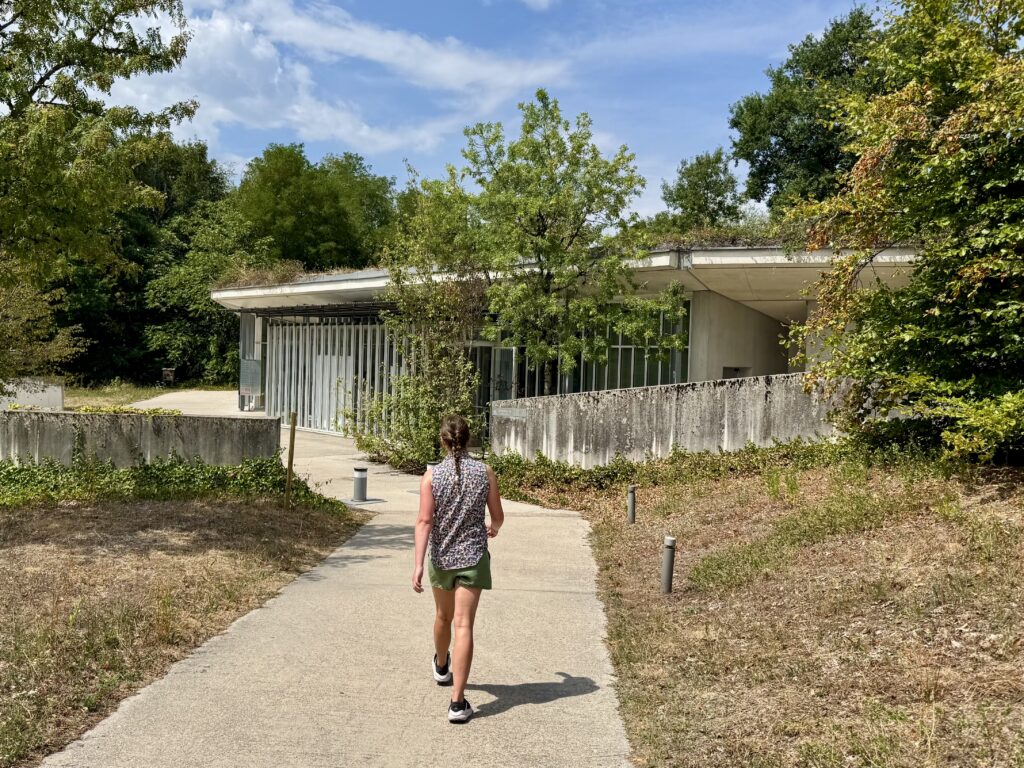
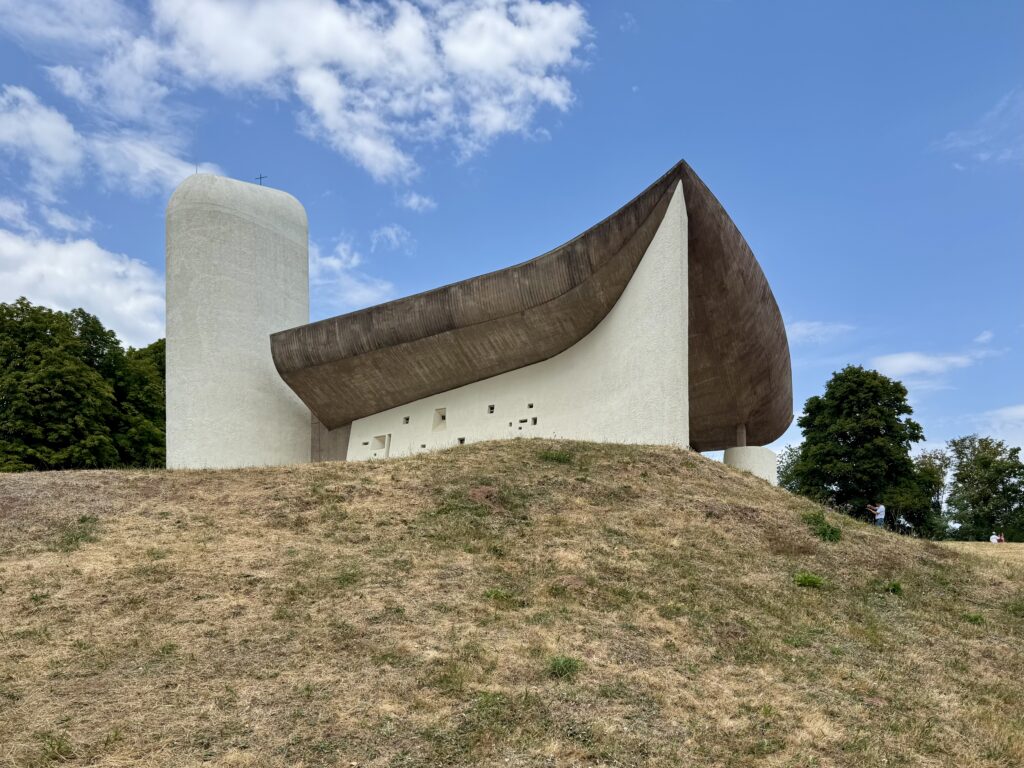
Upon check-in, I learned that Renzo Piano had designed the visitor center along with a convent expansion some 15 years before. It was nice to see Renzo on a (semblance of a) budget, but something seemed off with the interior scale and the glazing was too fussy for the simplicity of the structure. The new program, with its vegetated roofs, was grouped in tiered wings cut into the bottom of the hill, which mostly disappeared from the views atop the hill, with the chapel still the star of the show—and apparently the entire town.
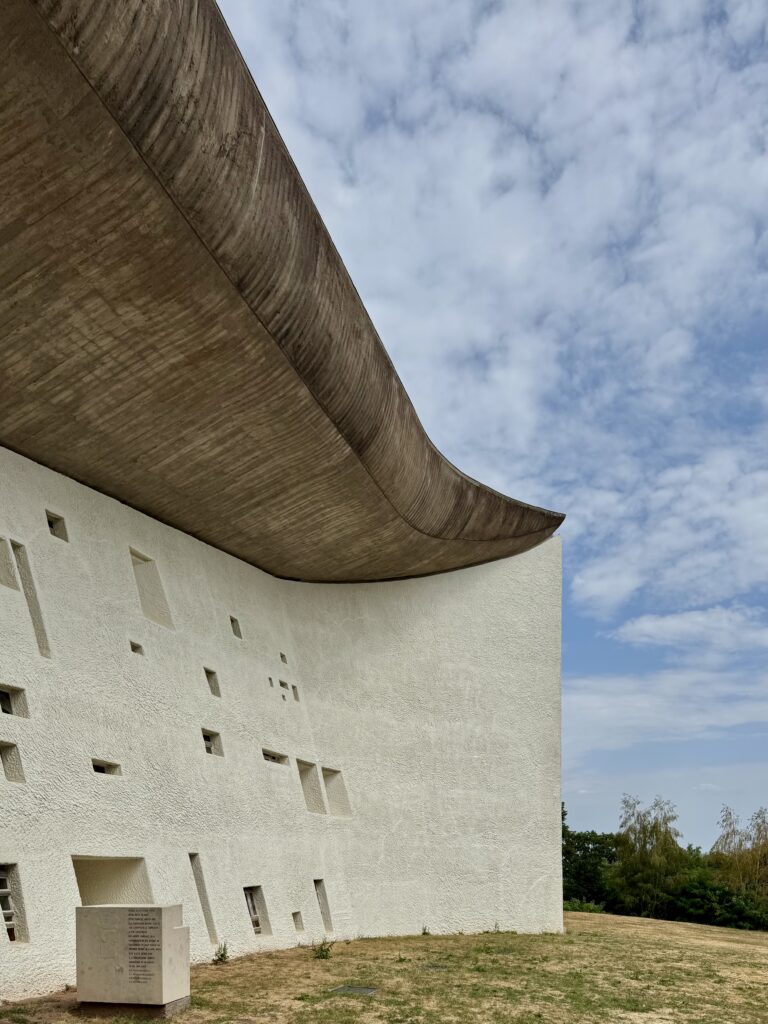
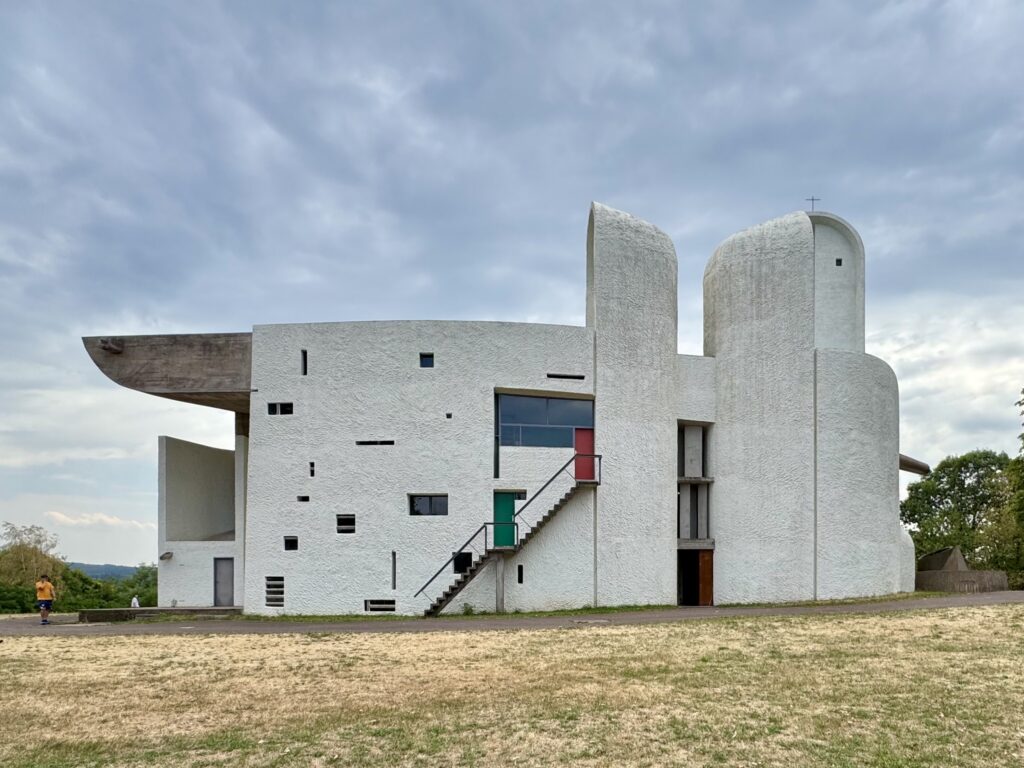
Once we’d gathered ourselves, we headed up a slightly smaller hill to the main attraction, which did not disappoint. The iconic roof form and random window array of the south facade are the first elements to greet visitors on approach. And as you reach the top of the hill, the scale of the massive white chapel takes over until you find an occasion to turn and absorb the view.
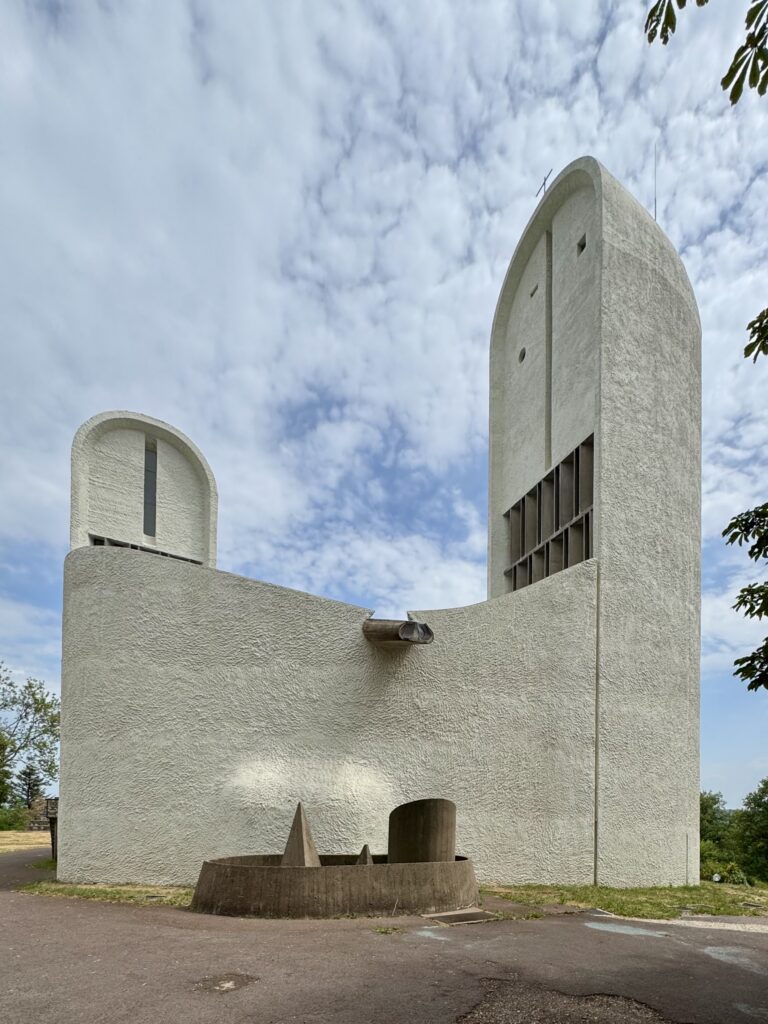
The less-photographed secondary facades are equally compelling compositions, but this design is all about the interior. Soft light spills into the space through deep-set stained glass and a thin, impossibly long ribbon window, allowing the massive cast-in-place roof form to float above the walls. The vertical volumes visible on the exterior create a series of light wells, with different exposures forming a trio of varied contemplative spaces directly adjacent to the sanctuary.
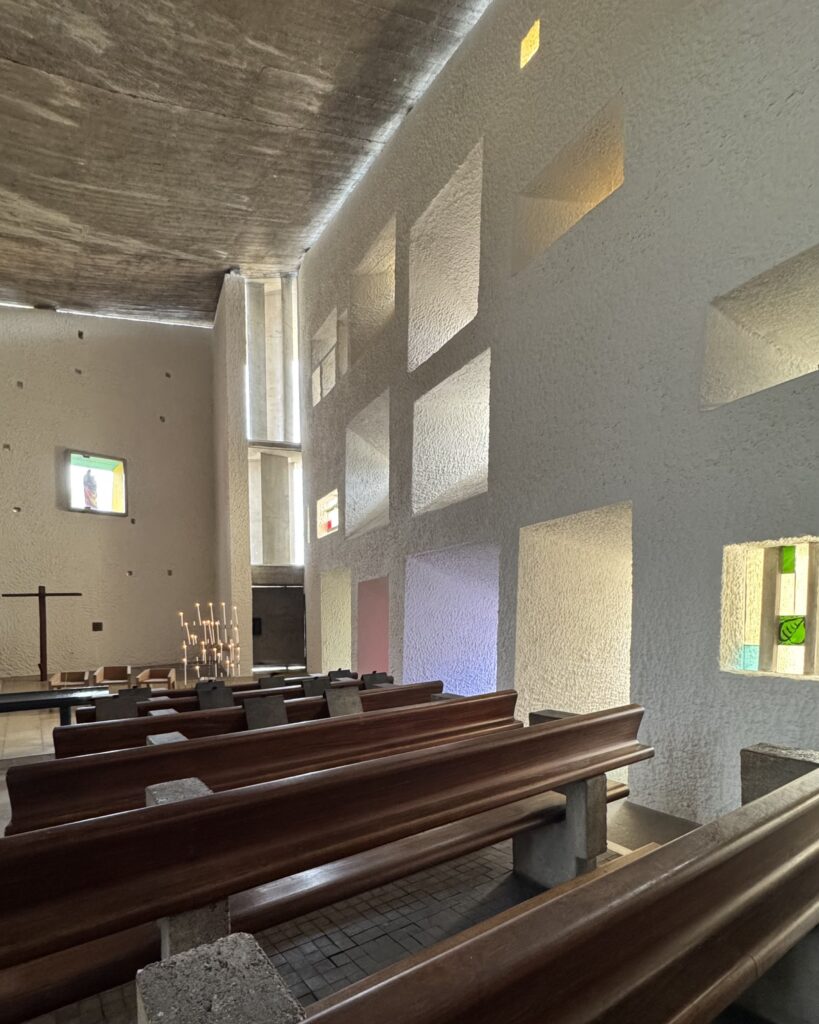
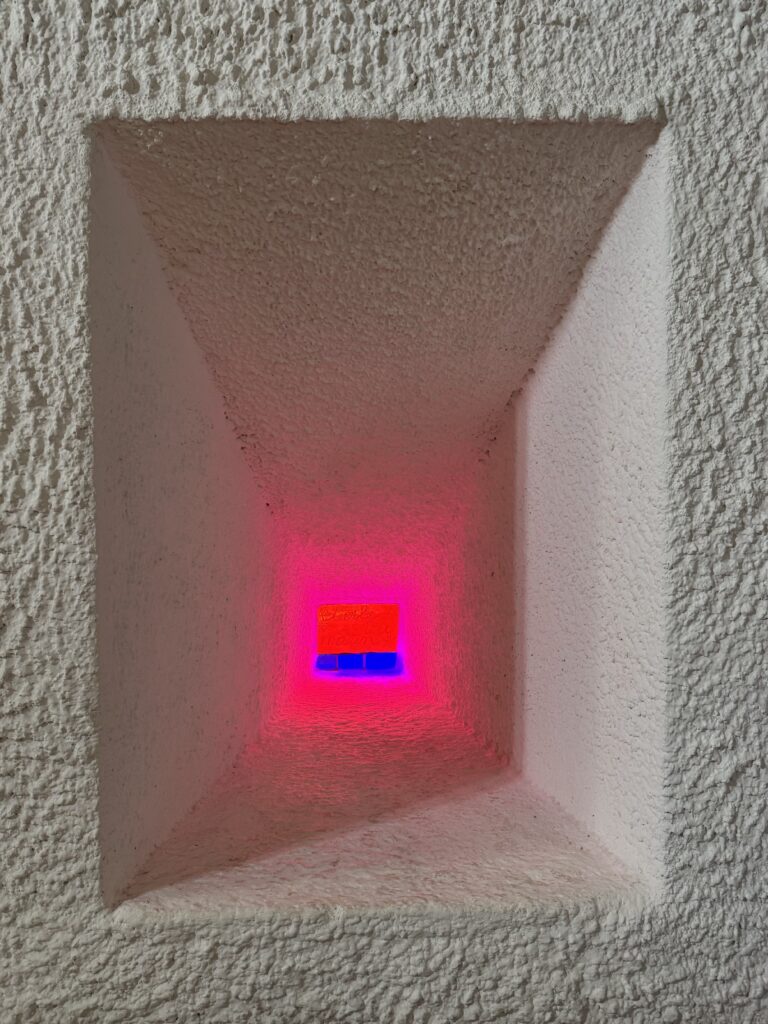
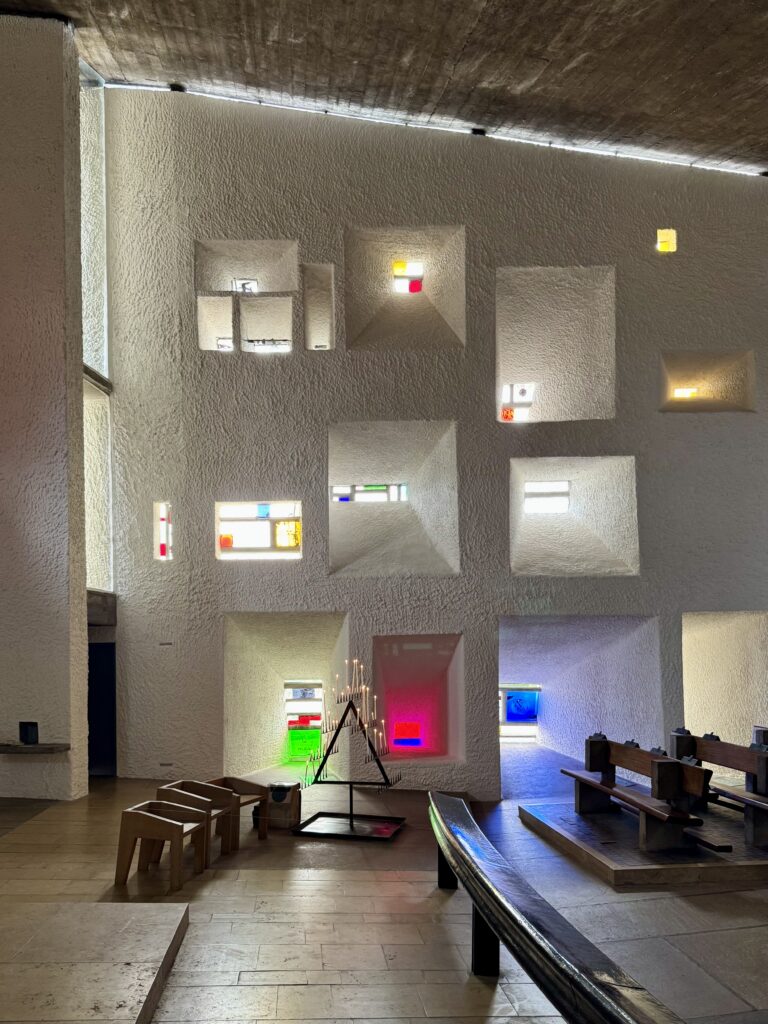
While its massing is composed of dynamic forms, this is a building of remarkable simplicity. The materials are concrete steel and glass with a few wood accents. There are no MEP or life safety systems. Light is provided only by the windows and a few candles. I couldn’t even find a receptacle. There must be power within the sacristy because there was a single loudspeaker with a hidden switch below the elevated pulpit.
Constructed in 1955, the building has never been retrofitted—suggesting it generally functions as intended. It also felt cooler than the visitor center, even without cross-ventilation. On a 95-degree afternoon, the building was in full sun yet the interior temperature, while not cool, was comfortable enough for us to linger and enjoy the space.
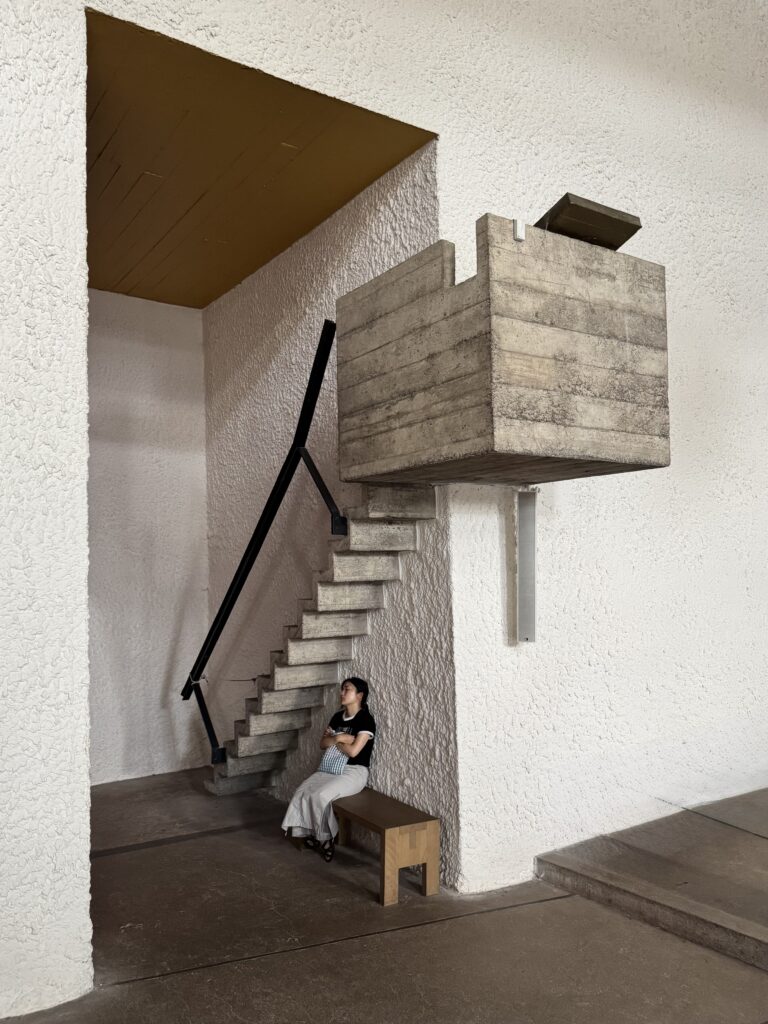
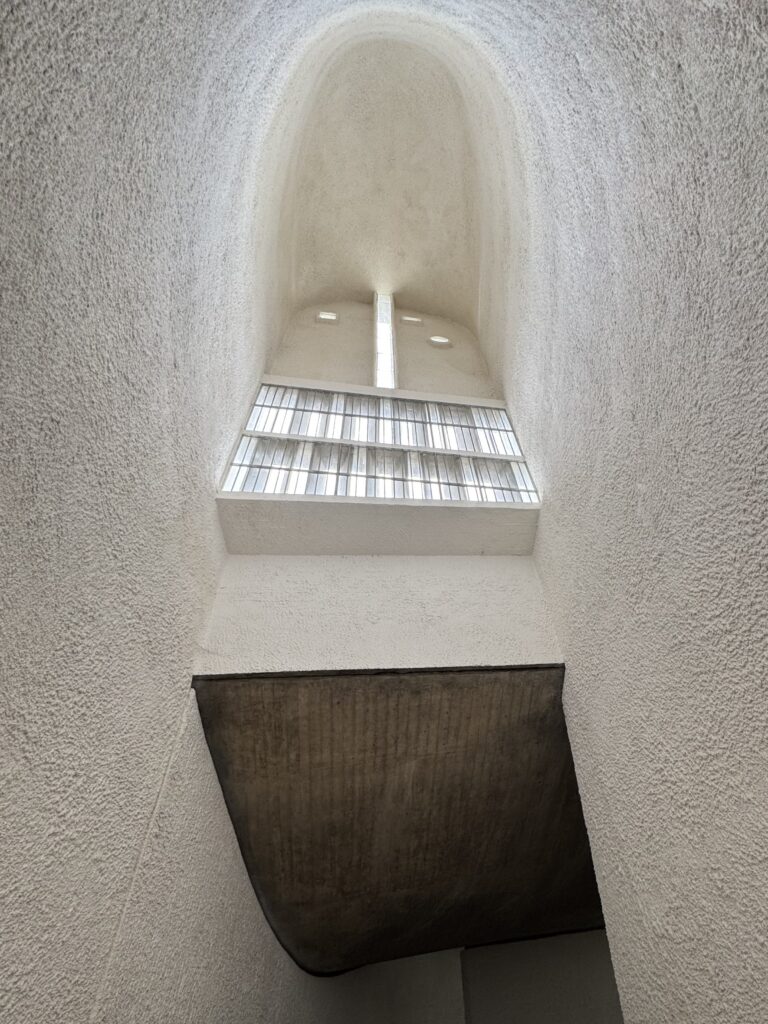
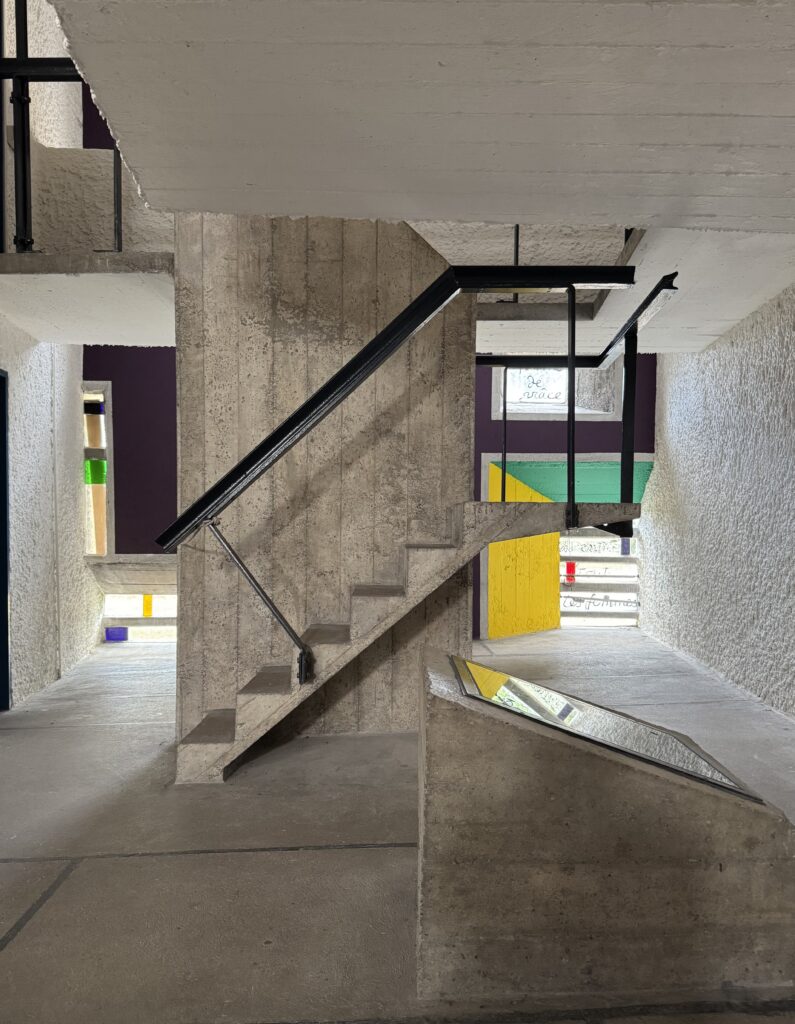
On the train back to Paris, I tried to explain to my daughter why contemporary construction does not resemble this lauded example. Today, good architecture requires monumental coordination and integration of systems. The best design manages to make all the noise disappear—or at least look like it belongs. Twenty-first-century architecture is rarely about the true essence of a material because most building elements are assemblies, requiring layers of components to satisfy energy and life safety codes.
So, we work with raised floors, suspended ceilings, veneers, coatings, and diaphragms, along with systems and assemblies to cover the stuff nobody wants to see or that nobody has the time to design and fabricate in a manner that is sympathetic to the aesthetic. Many of these systems require digital technology to operate properly, which introduces a seed of obsolescence into nearly every design.
I could tell I was losing my daughter in the details. She wanted to read her book. The only reason she was still listening to me was that I had called a cab from high atop the town of Ronchamp to whisk us back to the train station…into air-conditioning.